
 E-Paper



Scientifically Speaking: An ancient Tamil visitor in Egypt’s Valley of the Kings
Ancient Indian graffiti found in Egypt’s Valley of the Kings reveals early global travel links and overlooked inscriptions hidden for nearly a century.

 Prefer HTon Google


I just returned from an extended trip to Egypt. The pyramids, the temples, and the museums, particularly the recently opened Grand Egyptian Museum, were extraordinary. So were the hieroglyphs and wall paintings that look like they were created yesterday, despite being more than three thousand years old in the Valley of the Kings at Luxor.
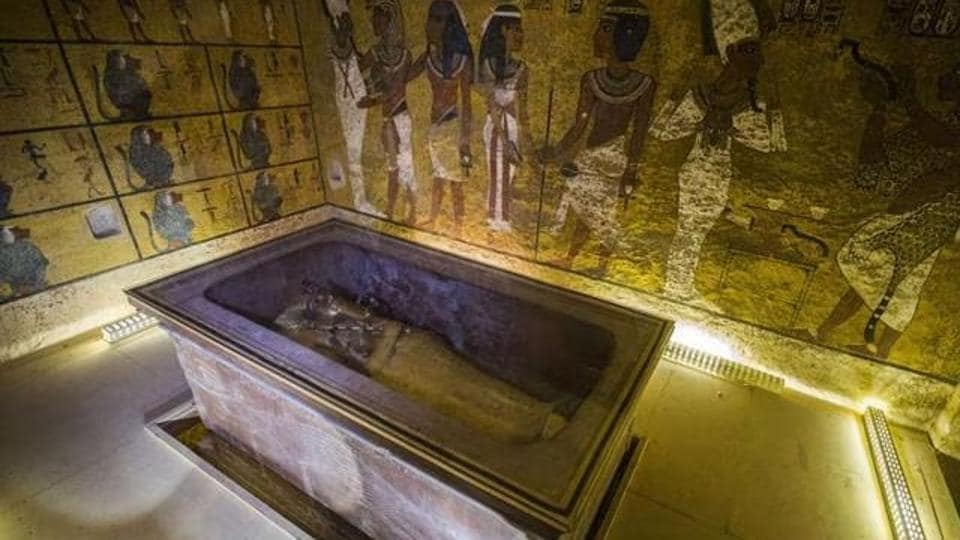
What also struck me was everything that has been added to it since. The walls of these tombs and temples are covered in centuries of graffiti. Greek and Roman visitors cut their names into the stone. Coptic Christians left crosses and inscriptions when they turned royal burial chambers into informal sacred spaces. Nineteenth-century European travellers on the Grand Tour scratched their names into the Temple of Luxor.
What had not been recognised until very recently was that, scattered across six tombs in the Valley of the Kings, are nearly thirty inscriptions in ancient Indian languages.
A man named Cikai Korran scratched his name eight times in five different tombs roughly two thousand years ago. In the tomb of Ramses IX, his inscription sits five to six metres above the entrance, and no one has yet figured out how he got up there. The Tamil text translates simply as “Cikai Korran came here and saw.”
The finding was presented at the International Conference on Tamil Epigraphy in Chennai in February by Ingo Strauch of the University of Lausanne and Charlotte Schmid of the French School of Asian Studies. About twenty of the inscriptions are in Tamil-Brahmi, the earliest known script for writing Tamil. The rest are in Sanskrit, Prakrit, and Gandhari-Kharoshthi, suggesting visitors arrived from across the Indian subcontinent.
A Sanskrit inscription identifies its author as a messenger of King Kshaharata, from a dynasty that ruled western India in the first century. In one tomb, the Sanskrit and Tamil graffiti appear to engage with a nearby Greek inscription, hinting that the writers could read across all three languages.
We have known for some time that ancient Indians travelled the Roman world. The trading colonies at Berenike on the Red Sea, the Indian artefacts on Socotra, and the Tamil-Brahmi pottery scattered across both paint a vivid picture of a connected ancient world in which goods and people moved between the Malabar coast and the Mediterranean for commerce.
The Valley of the Kings inscriptions add a more intimate layer. Korran had travelled inland to a sacred site already ancient in his own time. Like me, he was a tourist, though unlike me, he left his mark for posterity.
The inscriptions were not hidden. In 1926, the French scholar Jules Baillet published a catalogue of more than two thousand graffiti in these tombs. For the next century, generations of Egyptologists relied on it, but the question of what the unrecognized scratches might be was never asked, because those who know Indian languages do not study Egyptian pharaohs.
Strauch happened to know the languages that turned those ignored scratches into sentences. He noticed the writing on a tour, photographed it, took it home, and recognized what other scholars had walked past.
This is a reminder that what looks like a complete record can be incomplete for a hundred years, simply because the right reader has not arrived.
It is also a case where a particular kind of artificial intelligence has something to offer. Headline-grabbing examples of Artificial Intelligence (AI) in research tend to be the specialist ones. The Vesuvius Challenge has used machine learning and new imaging to read the charred Herculaneum scrolls buried by the eruption that destroyed Pompeii in 79 CE. These were long considered impossible to unroll without destroying them.
The large language models that most of us use are doing something different. They are not as deep as human experts or specialized AI models trained for specific tasks. They are wider in breadth but shallower in depth. A model that has read across Egyptology, Tamil literature, and Indian Ocean trade does not belong to any one of those fields. That is precisely what can make it useful as a connector of disparate ideas.
Strauch made his discovery because he was in a tomb where he saw the scribbles on the wall. But, had the question been asked, AI might have suggested years earlier that the marks Baillet ignored resembled Indian scripts and were worth showing to someone who could read them.
The world’s old catalogues and colonial-era reports almost certainly contain more ancient tourists waiting to be noticed.
The same is true across the sciences. We sit on vast archives of data, specimens, and observations gathered for one purpose and never reread for another.
Anirban Mahapatra is a scientist and author. His most recent book is When the Drugs Don’t Work. The views expressed are personal


