In a first, the Wildlife Institute of India (WII), Dehradun has tracked the journey of a common crane from Gujarat to its breeding site in Northern Kazakhstan and back to Gujarat where it returned on World Migratory Bird Day (October 10, 2020).
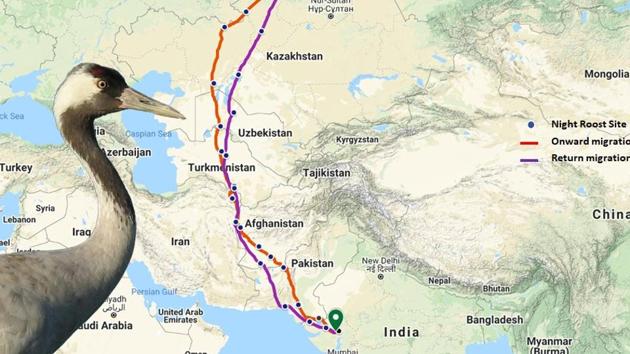
This female common crane (a migratory bird) named Vadla was tagged with a transmitter in March this year by WII scientists to access the impact of power lines on such migratory birds.
Suresh Kumar, a senior scientist from the Endangered Species Management department in WII who led the project said, “This project aims to study the impact of power lines on large birds like cranes and flamingos. The primary purpose is to see how these cranes fly across these power lines as there are reports of cranes and flamingos colliding with power lines and dying, which is a major issue.”
Kumar said that the project is funded by the Power Grid Corporation of India Limited. He further said that this is the first of such study where scientists are trying to assess these impacts and trying to identify the critical power line stretches that could potentially affect these birds.
“One of the ways in which we are trying to understand this is by deploying transmitters on these birds to see how they move around when they are here. Now, one such bird that we had tagged in March this year, left for its breeding ground from Gujarat and has now returned. While tagging we did not know about its breeding ground, as it was being done for the first time… it ended up in Northern Kazakhstan from where it has returned,” Kumar said.
{{/usCountry}}“One of the ways in which we are trying to understand this is by deploying transmitters on these birds to see how they move around when they are here. Now, one such bird that we had tagged in March this year, left for its breeding ground from Gujarat and has now returned. While tagging we did not know about its breeding ground, as it was being done for the first time… it ended up in Northern Kazakhstan from where it has returned,” Kumar said.
{{/usCountry}}The scientist further said that they now know the migratory route of the bird, the spots where the crane stopped at night for resting, “They are now trying to gather more information about the sites, as many of them are extremely remote like deserts in Afghanistan and Turkmenistan. With the broad idea of the crane’s behaviour, we will analyse all the data we get in a more detailed manner in the near future.”
Prakash Javadekar, Union minister for environment, forest and climate change (MoEFCC) took to social media on Tuesday morning and tweeted, “A common crane named Vadla, migrated to a breeding site in Kazakhstan and then returned exactly to the site of her tagging in Gujarat on World Migratory Bird Day Oct 10. Isn’t it amazing and Kudos to Dr. Suresh Kumar and his team who tracked Vadla.”
The theme of this year’s World Migratory Bird Day was Birds Connect Our World.
The common crane is a medium-sized crane which is found in the Indian subcontinent, Asia, Africa, Europe. These cranes which are migratory in nature usually breed during May.
Power lines have been a big threat to the birds in the country. Studying the Great Indian Bustard, the MoEFCC last year had released a report stating that high voltage transmission lines with vertical alignment are the biggest threat to the Great Indian Bustard.