Even as 37 of his 53 MLAs ostensibly defected and joined hands with the BJP-Sena government in Maharashtra, NCP chief Sharad Pawar was quick to say on Sunday evening that he would not be pursuing a legal battle, choosing instead to go to the people directly. Hours after his nephew Ajit Pawar claimed that the NCP would ally with the BJP in the 2024 Lok Sabha and Maharashtra assembly elections, Pawar, 82, said that there is no need to fight
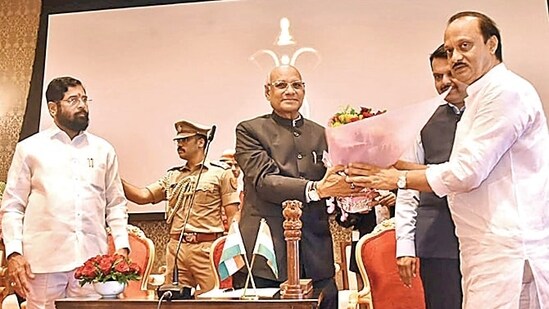
Within hours of the rebellion, state NCP president Jayant Patil hit back, declaring that the party has moved disqualification petitions against the nine rebel MLAs, including Ajit Pawar, who were inducted as ministers in the Shinde-Fadnavis government. “We have requested Speaker Rahul Narwekar to hear our side,” said Patil, adding that they have approached ECI too.
While Ajit Pawar has apparently followed the template successfully executed by Shinde last year, the senior Pawar seems cognisant of the unfavourable outcomes Thackeray faced despite a fierce legal battle that he led before the Supreme Court and the Election Commission.
Supreme Court verdict in Sena vs Sena
Some of the crucial issues before a five-judge Constitution bench in Sena vs Sena pertained to the formation of a new government in Maharashtra by Shinde following the governor’s decision to call for a floor test that prompted Uddhav Thackeray to resign. Even as these issues are absent in the latest episode of the rebellion, the Supreme Court, in the May 11 verdict, went into granular details to clarify the legal position on disqualification of rebel MLAs, recognition of a political party inside the House and allotment of a party name and symbol. All these contentions are bound to arise in the latest controversy involving NCP too.
On Monday morning, NCP state president Patil said that the nine MLAs were disqualified the moment they took oath as ministers in the Maharashtra government. The May ruling by the apex court, however, makes it clear that there is no concept of “automatic disqualification” under the anti-defection law, and that Speaker is the exclusive authority to take a call on such pleas.
In Sena vs Sena, the Thackeray faction instituted disqualification petitions against Shinde and several other MLAs supporting him. Before the bench, they argued that a decision on these petitions should not be left to Narwekar, who is a BJP leader, and that the court should instead decide the disqualification pleas by itself to ensure fairness. Shooting down this request, the court ruled that the Speaker is “the appropriate constitutional authority to decide the question of disqualification under the Tenth Schedule”.
Even as the court quashed Narwekar’s decisions on July 3, 2022, to recognise Shinde as the leader of the Shiv Sena legislature party and Bharat Gogawale as the chief whip, it left it to the BJP leader to recognise the new leader of the Shiv Sena legislature party and the chief whip again following an enquiry by him into the state of affairs when there could be two factions of the same party. The May verdict made Narwekar emerge as the exclusive authority to take a call on the spectrum of controversies -- from deciding the disqualification petitions to identifying the “real” Shiv Sena; from recognising the new chief whip of Shiv Sena to notifying its leader of the House.
Thus, the process to decide disqualification petitions against Ajit Pawar and the MLAs supporting him, and the identification of the “real” NCP inside the House, will have to follow the same legal principles with Narwekar holding all the cards.
In Sena vs Sena, the Constitution bench also articulated some important principles for ECI to take note of in adjudication of disputes between two rival factions of a political party. It ruled that pendency of disqualification proceedings against members of a rival faction in a political party will not prevent ECI from deciding a dispute before it under Paragraph 15 of the Election Symbols (Reservation and Allotment) Order, 1968, for allotment of the party symbol.
In its ruling, the top court rejected Thackeray’s plea that there should be a “constitutional sequence” that proceedings under the anti-defection law must be decided by Speaker before ECI decides the dispute under the Symbols Order.
The May 11 judgment maintained that since no deadline could be set for the Speaker to decide a disqualification plea, keeping the symbol dispute on hold until the Speaker’s decision would amount to indefinitely staying the proceedings before ECI. The judgment gave ECI the liberty to go ahead and allot the party name and symbol to any one faction, uninfluenced by the disqualification petitions.
The five-judge bench ruling further held that nothing prevents an MLA facing disqualification proceedings under the anti-defection law from approaching ECI for the allotment of a party symbol – a legal principle that may come handy for the Ajit Pawar faction. The judgment further advised the poll body to look beyond the test of legislative majority and consider some other parameters too, such as an evaluation of the majority in the organisational wings of the political party or an analysis of the provisions of the party constitution, before ruling in favour of a faction. The bench was, however, quick to add a caveat that it is for ECI to decide which are the tests best suited to the unique facts and circumstances of the case before it. Therefore, the Supreme Court verdict boils down to strengthening the Speaker’s hands and green-lighting ECI to decide the array of disputes when a party undergoes a vertical split.
Election Commission verdict in Sena vs Sena
Soon after breaking ranks with Thackeray, Shinde approached ECI for the allotment of the bow-and-arrow symbol of Shiv Sena to the faction led by him. By a decision on February 17, 2022, ECI ruled that Shinde’s faction will inherit the original party’s name and its symbol, capping an eight-month-long feud between the two leaders over control of the regional party.
ECI, in its judgment, followed the procedure laid down in a 1971 Supreme Court judgment in the Sadiq Ali case, which said such disputes must be decided on the basis of a triple test. ECI found that the conclusion of the first two benchmarks were inconclusive.
The first test — objectives of the party constitution — was deemed improper because the 2018 constitution of Shiv Sena was found to be undemocratic and concentrated power in the hands of a few. The second test — that of the majority in the organisational body of the party — was also not considered because the poll panel found that neither side provided accurate details of the composition of internal bodies, and no determinable or satisfactory findings could be ascertained.
Therefore, ECI relied on the third prong — the test of majority in the legislative wing. Here, the poll body found that 40 of the 55 members of legislative assembly backed the Shinde faction, which translated to 76% of the total votes polled by the unified party in the 2019 assembly elections. Moreover, 13 of the 18 Lok Sabha members of the party backed Shinde, which translated to 73% of the total votes polled in the 2019 general elections. While Thackeray has challenged ECI’s decision before the top court, the appeal is still pending while the Shinde faction has successfully retained the party name and symbol so far.
The judgments by the Supreme Court and ECI clearly bolstered Shinde’s position, particularly since he had the numbers. Known for his Machiavellian politics, the senior Pawar must be cognisant of the trajectory that the legal battle surrounding Shiv Sena followed. As far as Ajit Pawar’s fate is concerned, if he can manage to keep the flock together and plays his cards well in demonstrating the organisational support of the party, the legal principles evolved in Sena vs Sena seem to be weighing in his favour, at least for now. Much, though, will depend on the number of MLAs backing him.
One Subscription.
Get 360° coverage—from daily headlines
to 100 year archives.
Archives
HT App & Website
Utkarsh Anand is the National Legal Editor at Hindustan Times, where he leads the newspaper's coverage of the Supreme Court, constitutional law, the judiciary and the Union law ministry. He joined Hindustan Times in 2020 after stints at Press Trust of India (PTI), The Indian Express and CNN-News18, and has over two decades of experience reporting on law, governance and public policy. His work has focussed on some of India's most consequential constitutional and legal developments, including the Supreme Court's judgments on Article 370, marriage equality, decriminalisation of homosexuality, the Babri Masjid dispute, electoral reforms and judicial appointments. He specialises in making complex legal proceedings and judgments accessible to readers while examining their wider social and political impact. Beyond daily reportage, Utkarsh has led investigative projects and enterprise reporting that have shaped public debate and prompted institutional responses. His work has received several journalism awards, including the Ramnath Goenka Excellence in Journalism Award. As National Legal Editor, he has also played a key role in expanding Hindustan Times' legal journalism footprint, mentoring reporters and strengthening coverage across platforms. A Chevening South Asia Journalism Programme Fellow, Utkarsh regularly writes analyses on the judiciary and constitutional issues, and his reporting is widely followed by lawyers, judges, policymakers, academics and readers seeking clarity on India's evolving legal landscape.