
 E-Paper



Sibal quits Congress, files RS nomination with SP’s support
On Wednesday, Sibal, accompanied by Akhilesh Yadav, reached the UP Vidhan Bhavan around 12.10pm after a 40-minute meeting at the SP Uttar Pradesh headquarters


The Congress party lost its third prominent leader in less than two weeks after former Union minister and eminent lawyer Kapil Sibal, a vocal critic of the Congress high command in the recent years, announced he resigned from the party nine days ago. Gujarat state Congress working president Hardik Patel resigned on May 18, and former Punjab unit chief Sunil Jakhar quit on May 14.
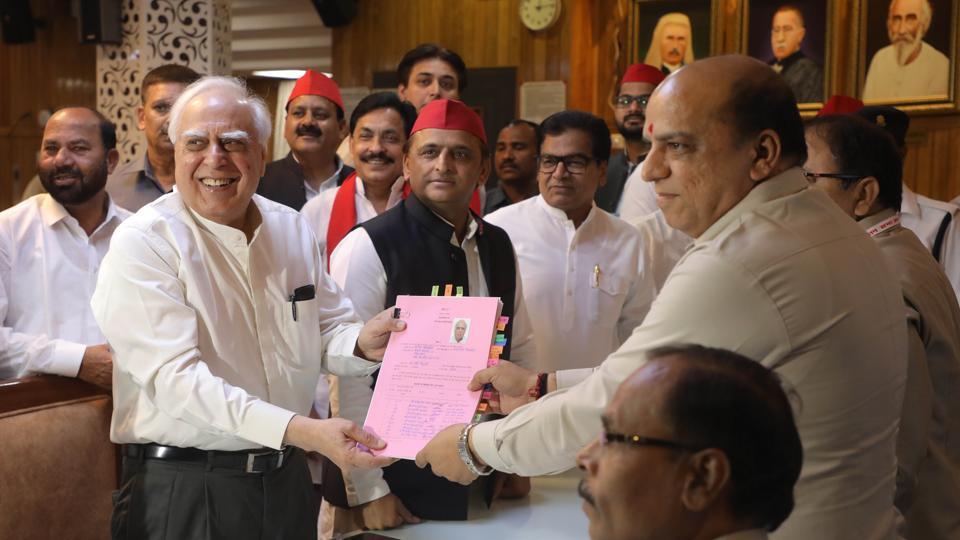
On Wednesday, Sibal filed his nomination as an independent candidate for a fresh term in the Rajya Sabha, supported by the Samajwadi Party (SP). “I have filed nomination as an independent candidate. I have always wanted to be an independent voice in the country. On May 16, I resigned from the Congress party,” he said after filing his nomination.
“Kapil Sibalji has just filed his nomination for the Rajya Sabha with Samajwadi Party support. He is an eminent lawyer and has effectively raised and discussed important issues in the Lok Sabha and Rajya Sabha. The country has many issues facing it and I hope that he will effectively raise these in the Rajya Sabha,” SP leader and former UP chief minister Akhilesh Yadav said.
Congress general secretary KC Venugopal was quoted by ANI as saying: “People come and go from our party.” Another senior leader, who asked not to be named said Sibal’s exit would be “zero loss” for the Congress, invoking the former minister’s famous argument against the allegations of notional loss of ₹1.76 lakh crore in 2G spectrum allocation.
But Sibal, a member of the so-called G-23 grouping of 23 Congress leaders pushing for organisational and leadership change to stem the rot in the party, and who said last year that the grouping is not “Ji Huzoor-23” (his meaning was that they were not yes men) left gracefully and said: “I still say that we all hold to the ideology of Congress which is the ideology of an inclusive India. This is the ideology of the entire Opposition and we will move forward on the basis of that.” His Rajya Sabha term ends on July 4.
According to people in the Congress, his primary membership of the party expired after he didn’t renew it earlier this year.
Sibal, who started his Lok Sabha career in 2004, defeating the BJP’s Smriti Irani in Delhi’s Chandni Chowk, was the HRD minister when the landmark Right to Education law, making free education a right of every child between the ages of 6 and 14, was enacted. A senior Congress leader, however, argued that “the entire credit for RTE should go to the Sonia-Gandhi-led National Advisory Council.” His tenure also saw CBSE doing away with mandatory exams till Class 8.
Sibal served as a minister during the entire 10-year tenure of the UPA government, shifting between science and technology, law, human resource development, and earth sciences portfolios. He was also handed the telecom portfolio after A Raja was removed following the 2G scandal. As the Congress reeled under an all-round political attack, Sibal was one of the key leaders who fought back against the allegations, rejected the notional loss theory and claimed that there was actually no real loss in the spectrum allocations.
Over the past two years, Sibal became a bitter critic of the Congress high command, especially Rahul Gandhi, questioning the functioning of the party amid its downfall. His public criticisms even provoked Congress president Sonia Gandhi to hit back.
On October 17 last year, Congress chief Sonia Gandhi told a CWC meeting that there is “no need for talking to me through media” and reminded the G-23 that she was “a full-time and hands-on Congress president”, days after Sibal held a press conference and said: “There is no president in our party, so we do not know who is taking all the decisions. We know it, yet we don’t know.” His public censure of the party didn’t find support of other G-23 leaders, who preferred negotiating with the Congress president for more power.
Sibal’s links with the Samajwadi Party go way back. He argued in January 2017 (during the Yadav family feud) at the Election Commission that Akhilesh Yadav should get the “bicycle” symbol. Eventually, Akhilesh did get t the symbol. Last week, he represented senior SP leader and MLA Azam Khan in the Supreme Court, following which the apex court granted a two-week interim bail to Khan, who was in Sitapur jail for 27 months in several cases of cheating and land grabbing.
Sibal also said: “I’ll not say anything about Congress… not appropriate for me to say anything. It’s not easy to leave a relationship of 30-31 years. We are all constrained by the fact that we are members of parties and have to abide by the discipline of that party but it is important to have an independent voice.”
In 2016, the Congress, with its 29 MLAs in UP, and the support of the SP, managed to elect Sibal to the Rajya Sabha from the state.
On Wednesday, Sibal, accompanied by Akhilesh Yadav, reached the UP Vidhan Bhavan around 12.10pm after a 40-minute meeting at the SP Uttar Pradesh headquarters. While filing his nomination, Sibal was flanked by Yadav, SP state president Naresh Uttam Patel (MLC) , SP national general secretary (and RS member) Ram Gopal Yadav, and 10 SP MLAs.


