E-Paper



South Africa shares risk management plan on cheetahs’ translocation
Madhya Pradesh's Kuno National Park is expected to host four male and four female cheetahs from Namibia by end of this month, starting the translocation project aimed to bringing back cheetahs to the wild in India 55 years after the last of them was hunted down in the country.


Bhopal: The cheetahs being translocated to India from Namibia and South Africa were born in wild and have a good potential to breed, according to a risk management plan that flags the challenges the big cats would face at the Kuno National Park in Madhya Pradesh.
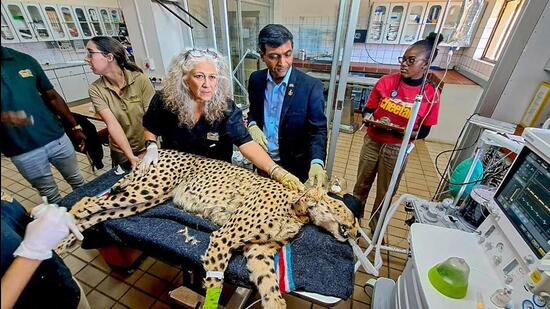
Kuno is expected to host four male and four female cheetahs from Namibia by end of this month, starting the translocation project aimed to bringing back cheetahs to the wild in India 55 years after the last of them was hunted down in the country.
A team of South African cheetah experts will be in India later this month to brief the Indian foresters about the risk management plan prepared by South African cheetah metapopulation project
Should some of the cheetahs prove to be troublesome, there’s a contingency plan to relocate them from Kuno to Mukundra Hill Tiger Reserve in Rajasthan, where a special enclosure is being built.
In September, 12 cheetahs from South Africa are expected in Kuno once the two nations sign a memorandum of understanding, officials said. Earlier, the plan was made to translocate cheetah on August 13, two days before India’s 75th Independence Day, but it was postponed because of delay in tranquillizing the cheetahs in Namibia.
“All 20 cheetahs are ready for export to India,” a South African official familiar with the project said, declining to be named.
Once India approves the risk management plan shared with the government, a team of South African officials would visit Kuno. “We expect the visit to happen by end of August,” he said.
The management plan submitted Vincent ven der Merwe, director of the metapopulation project, is about the steps to be taken to prevent disease transmission, mortality in transit, low post release survival rate, human wildlife conflict and long-term genetic and demography viability of wild cheetahs.HT has seen a copy.
Between 2001 and 2009, 157 cheetahs removed from South Africa farmland were relocated to 41 newly established fenced reserves in South Africa, collectively known as the metapopulation, the plan document says.
These cheetahs would be best suited for the proposed Indian reintroduction as they were born and raised among competing predators, including lion, spotted hyena, leopard, wild dogs and brown hyena, and can be considered predator savvy, the document argues.
These cheetahs can be easily immobilised for management reasons from vehicles or on foot, and they are accustomed to living within confined protected areas, the document says.
All 12 cheetahs from South Africa have been vaccinated against relevant diseases and treated for both internal and external parasites, the plan says. Collars have been fitted to the cheetahs during vaccination, it says, adding that a similar exercise has been done for cheetahs from Namibia as well.
For transit, the plan says, specialized transport crates meeting International Air Traffic Association specifications have been purchased. “These crates have been designed based on experiences obtained from 50 years of cheetah transport and are designed to minimise stress and allow for veterinary intervention in the case of emergency,” the plan says.
The cheetahs will be exported via Fireblade Aviation from OR Tambo International Airport. “A privately charted cargo aircraft of the National Tiger Conservation Authority of India will transport the cheetahs to India. Heavy lift helicopters, with closed doors, have kindly been made available by the Indian Air Force for the relocation of the cheetahs from Jaipur International Airport to the holding facilities and Kuno National Park,” it says.
The real risk comes after the release of the big cats in an enclosure because cheetahs have a low survival rate after release. Close monitoring will be important to improve the survival rate, the plan says.
On the possibility of a cheetah escaping from the enclosure in Kuno, the plan says the animals will be immobilized and brought back to the enclosure. Serial escapees will be sent to Mukundra Hills Tiger Reserve in Rajasthan, it says.
“Two experienced South African veterinarians, Dr Mike Toft and Dr Jennifer Lawrence, will also be present for the first two months post-release to ensure further training in the field and sufficient manpower in the event of multiple escapes,” the plan says. “Gus van Dyk, one of South Africa most experienced reserve managers, will also advice on best practice with regards to wild cheetah boma management and wild cheetah capture for a two-week period post release.”
There is a possibility of human-wildlife conflict in the 48,700 hectare buffer zone surrounding Kuno National Park, as well as the livestock farming areas on the periphery of the protected area. “Cheetahs that are responsible for several cases of livestock depredation will be considered for relocation to the fully enclosed Mukundara Hills Tiger Reserve,” the plan says.
Kunois fully prepared to receive the cheetahs, officials said, seeking anonymity. A 12km fencing has been completed with seven internal compartments. The fencing has been fitted with solar electric charge to deter other wild animals, an official said.
However, catching two leopards in the enclosure is proving to be a challenge.
“Long weed, grass and muddy soil is hindering our effort to catch the leopards,” said Prakash Verma, field director, Kuno National Park. “Now, two elephants have arrived from Satpura Tiger Reserve and soon the leopards will be tranquillised.”
To establish a viable wild cheetah population in India, a regular supply of wild cheetahs is required to “ensure genetic and demographic viability” in the long term, the South African plan says. “This will require long term commitment by South African and Namibian authorities,” it says.