A school bus pressed into service for election duty, a fatal road accident, and a legal battle over who should pay compensation -- the Supreme Court has now settled the question, placing the burden squarely on the State.
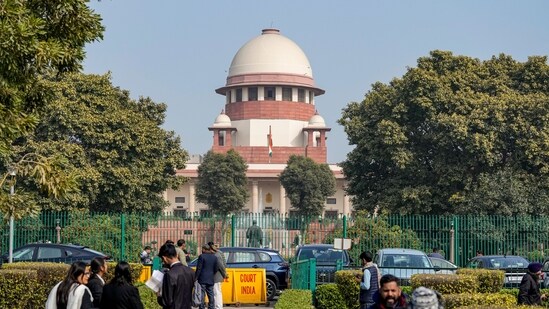
In a verdict with wide implications for election administration, the Supreme Court has ruled that governments cannot shift liability onto private insurers when accidents occur during the use of requisitioned vehicles.
A bench of Justices Sanjay Karol and N Kotiswar Singh held that once a vehicle is taken over by authorities under statutory powers, the liability to pay compensation under the Motor Vehicles Act rests with the State functionary, not the private owner or its insurer, because control and, therefore, responsibility shift entirely to the State during the period of requisition.
“It is held that where a vehicle is requisitioned for public functions and an incident occurs during the period of such requisition, liability ought properly to be borne by the requisitioning authority, and not by the insurer engaged by the owner for the vehicle’s regular and voluntary use,” declared the judgment released last week.
The ruling came in a case arising from a 2010 accident in Madhya Pradesh, where a school bus requisitioned for panchayat election duty collided with a motorcycle, resulting in the rider’s death. While the Motor Accident Claims Tribunal had initially fastened liability on the insurer, the Madhya Pradesh High Court shifted it to the district magistrate and election authorities -- a finding now upheld by the Supreme Court.
{{/usCountry}}The ruling came in a case arising from a 2010 accident in Madhya Pradesh, where a school bus requisitioned for panchayat election duty collided with a motorcycle, resulting in the rider’s death. While the Motor Accident Claims Tribunal had initially fastened liability on the insurer, the Madhya Pradesh High Court shifted it to the district magistrate and election authorities -- a finding now upheld by the Supreme Court.
{{/usCountry}}Senior advocate Archana Pathak Dave assisted the court as amicus curiae.
Dismissing the state’s appeal against the 2024 order, the bench held that requisition fundamentally alters the nature of control over a vehicle. It noted that the owner is “divested of custody and decision-making power” and has no say in how, when, or where the vehicle is deployed during such period.
The bench relied on some earlier precedents to underline that liability under the Motor Vehicles Act follows possession and control, not mere ownership.
Rejecting the state’s argument that such liability would deter authorities from requisitioning vehicles for public purposes, the court underscored that statutory power carries corresponding responsibility. “When the State steps in, assumes control, and deploys the vehicle for its own purposes, it assumes with that control the corresponding responsibility,” it noted.
Importantly, the court drew a distinction between voluntary contractual arrangements and compulsory requisition under law. It clarified that insurance policies are designed to cover risks arising from the owner’s ordinary use of the vehicle, and cannot be stretched to cover risks generated by compelled governmental deployment.
“Compelled deployment for public functions cannot reasonably be characterised as ‘regular use’ within the ‘usual’ contemplation. To fasten liability upon the insurer in these circumstances would be to extend the contract beyond the risk that was agreed to be covered. Requiring the insurer to answer for consequences arising from a use neither authorised nor controlled by the insured would be unfair,” it noted.
The judgment also noted that although the Representation of the People Act permits requisition of vehicles, it does not explicitly provide for requisition of drivers. However, where authorities choose to use the driver along with the vehicle, they effectively accept responsibility for both the vehicle’s operation and the driver’s conduct during the period of control.
“Once the vehicle is requisitioned and deployed for election duty, its control and use effectively passes to the State authorities for the duration of that period, as already observed supra. In such circumstances, it is a reasonable conclusion that by accepting and utilizing the services of the driver, the Authorities implicitly recognized such a driver’s competence, capacity and ability to operate the vehicle,” it held.