The Lok Sabha on Tuesday passed the Constitution (One Hundred and Twenty-Seventh Amendment) Bill, 2021 paving the way for states and Union Territories to prepare their own Other Backward Classes (OBC) list. During its passage, 385 members of Parliament voted in its favour while no members opposed it. The bill was passed with bipartisan support but MPs from both sides during the discussion before the passage blamed each other's parties for not doing enough for the OBC communities.
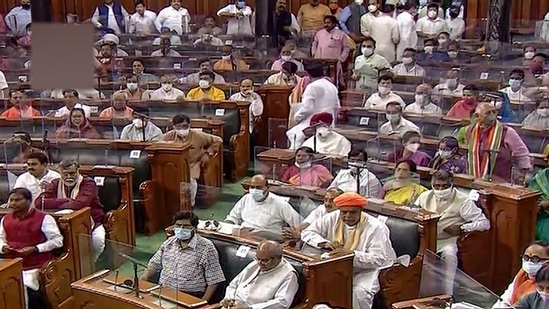
Union minister Virendra Kumar initiated the discussion saying that the bill be passed to allow states and Union Territories to prepare their own Socially and Economically Backward Classes (SEBCs) list.
Lawmakers agree but with few differences
Union minister and Apna Dal MP Anupriya Patel said that representation is necessary for the upliftment of backward classes. “Several communities continue to demand their inclusion among the Other Backward Classes but due to the Supreme Court ruling the state governments’ hands were tied. The amendment brought forth by the government allows state governments to take these decisions.” Patel said.
Patel attacked the Congress for failing to give constitutional status to the National Commission for Backward Classes when it was in power. She said that PM Modi-led NDA did it in 2018 for the welfare of the people who belonged to these groups. She also said that the NDA took the decision to increase the creamy layer limit from ₹6 lakh to ₹8 lakh and also make provisions for admissions of students from OBC communities to Kendriya Vidyalayas, Jawahar Navodyaya Vidyalayas and Sainik Schools.
All India Majlis-e-Ittehadul Muslimeen MP Asaduddin Owaisi said the BJP is doing it for votes and said that it should have the courage of ‘breaking the ceiling’ of 50% reservation. He highlighted that the decision to give Scheduled Castes reservation in 1950 was on a religious basis and said it was against the right to equality. “This is a golden chance. Make it religion-neutral. If there is provision for including Hindus, Buddhists and Sikhs in Scheduled Castes then why can Muslims, Dalits and Christians not be a part of it?” Owaisi asked. He also questioned the government that out of 89 secretaries, how many of them belong to the OBC community.
{{/usCountry}}All India Majlis-e-Ittehadul Muslimeen MP Asaduddin Owaisi said the BJP is doing it for votes and said that it should have the courage of ‘breaking the ceiling’ of 50% reservation. He highlighted that the decision to give Scheduled Castes reservation in 1950 was on a religious basis and said it was against the right to equality. “This is a golden chance. Make it religion-neutral. If there is provision for including Hindus, Buddhists and Sikhs in Scheduled Castes then why can Muslims, Dalits and Christians not be a part of it?” Owaisi asked. He also questioned the government that out of 89 secretaries, how many of them belong to the OBC community.
{{/usCountry}}Former UP chief minister and SP MP Akhilesh Yadav, BSP MP Ritesh Panday and other opposition leaders extended support to the bill but said that the Bharatiya Janata Party is being divisive citing that people from the OBC communities are not able to fully avail the benefits and increase their representation.
Why is the bill needed?
The bill is needed because if the state list gets nullified, then more than 600 OBC communities would lose access to reservations in appointments as well as in educational institutions thus impacting at least one-fifth of the total OBC communities.
The need for this amendment arose after the Supreme Court in its Maratha reservation ruling upheld the 102nd Constitutional Amendment Act. The Supreme Court, however, said that the President, depending on the recommendations made by the National Commission for Backward Classes (NCBC) which would decide which communities would be part of the state OBC list.
The 102nd Constitution Amendment Act of 2018 inserted Article 342A along with Article 338B and Article 342. While Articles 338B dealt with the powers of NCBC, Article 324A allowed the President to decide with the governor which socially and educationally backward classes would make it to the list.