A significant gap in the implementation of the Centre’s ambitious nutrition programme, the Poshan Abhiyaan, has prompted the ministry of women and child development (WCD) to ask laggard states to accelerate the scheme’s execution and utilize the funds allocated to them.
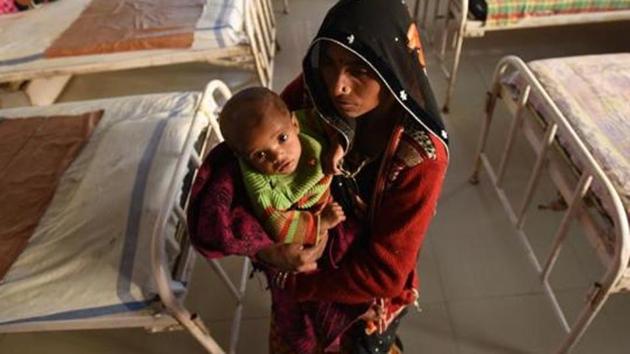
Implementation of Poshan Abhiyaan, targeted at children, pregnant women and lactating mothers, in states such as West Bengal, Haryana, Punjab, Kerala, Odisha and Goa remains patchy. According to WCD ministry data, till now, the Centre has released ₹ 3,769 crore under the scheme. Of this, only ₹ 1,058 crore (33%) has been utilised.
In West Bengal, Odisha and Goa, the scheme hasn’t even taken off, while in Karnataka and Punjab, only 1% of the released funds have been used. In Haryana and Kerala, the usage of funds remained less than 10%. The WCD ministry has disbursed ₹ 1,058 crore for spending on the scheme in this financial year till September 20.
As to why the scheme hasn’t been implemented in West Bengal, state women and child welfare minister Shashi Panja said, “We already have the state nutrition mission in place. It is much more comprehensive than the Centre’s scheme. Malnutrition level in Bengal is far lower than that of most states. But the Centre never appreciates the good work done by the state.”
{{/usCountry}}As to why the scheme hasn’t been implemented in West Bengal, state women and child welfare minister Shashi Panja said, “We already have the state nutrition mission in place. It is much more comprehensive than the Centre’s scheme. Malnutrition level in Bengal is far lower than that of most states. But the Centre never appreciates the good work done by the state.”
{{/usCountry}}In Goa, the scheme wasn’t launched till 2018. “We are implementing it since. We have been given an allocation of around ₹432 crore. In Goa, it is difficult to use the whole allocation as we have not appointed the 39 staff as has been provided to us under the scheme. Much of this money was to be used to pay their salaries. But this doesn’t mean that we are not working. We are working with out existing staff of the department, but the allocation has not been fully utilised,” said state director of women and child development Deepali Naik.
Punjab has fared marginally better. State principal secretary, department of women and child development, Raji P. Shrivastava said, “Statistically speaking, fund utilisation appears low currently because of delayed release of funds and consequent delay in procurement of smartphones and growth monitoring devices. However, procurement activities are in full swing and are expected to be completed by November, which will then result in a better expenditure status. But Punjab has been at the forefront in running the POSHAN Maah campaign and the full gamut of POSHAN Abhiyaan field activities through over 27,000 anganwari centres in full convergence with several other departments like health, water supply, education, rural development, local government and sports, through an imaginatively designed and energetically executed IEC campaign and sustained grassroots activities.”
WCD minister Smriti Irani has asked the states that are lagging behind in implementation to meet the goals set for them under Poshan Abhiyaan, said officials. The WCD ministry, along with the health ministry, has called state representatives to a review meeting to assess their implementation of the programme. The meeting is scheduled to be held sometime this month.
The lag in implementation was also taken up by the ministry at the last meeting of the National Council of Nutritional Challenges, held on October 10, which was attended by NITI Aayog vice-chairman Rajiv Kumar, WCD secretary Rabindra Panwar, officials of the health ministry, the Indian Council of Agricultural Research (ICAR), Indian Council of Medical Research (ICMR), National Institute of Nutrition and the Food Safety Standards Authority of India (FSSAI), among others.
In its surveys of 27 aspirational districts, the Niti Aayog also found that while 78% of pregnant and lactating women were registering at anganwadis, only 46% ad access to take home ration. And while the Pradhan Mantri Matru Vandana Yojana (PMMVY) mandates that expectant and new mother be provided ration for 25 days, food was being provided for only 12.5 days.
In its surveys of 27 aspirational districts, the Niti Aayog also found that while 78% of pregnant and lactating women were registering at anganwadis, only 46% ad access to take home ration. And while the Pradhan Mantri Matru Vandana Yojana (PMMVY) mandates that expectant and new mother be provided ration for 25 days, food was being provided for only 12.5 days.
The effort to roll out Poshan Abhiyaan, which involves 14 ministries, is being closely monitored by the Prime Minister’s Office. Because her ministry is overseeing its implementation, Irani has spearheaded the effort across states; she has met 11 chief ministers and visited nine states.
Updated WCD data as of October 10 show that 628,000 smartphones had already been procured for anganwadis (women and child care centres) so that so that realtime data can be sourced on implementation of Poshan Abhiyaan. The procurement of 495,000 more smartphones has been initiated. West Bengal, Punjab and Odisha haven’t procured any smartphones as yet.
Data from the NITI Aayog show that of the total 1.4 million anganwadis in the country, only 27.6% had smartphones and 35%, access to growth monitoring devices such as infantometers (infant height measuring scale), stadiometers (height measurer) and weighing scales till March this year.
The Centre has set a target of digitising all anganwadis by 2021. WCD data indicates that 484,901 anganwadis from 285 districts across 26 states had digital facilities and were uploading beneficiary data online as on October 10, 2019. This marks an increase of 240,000 in the second term of the Narendra Modi government.
Niti Aayog has also pointed out that the data on mother and child health collated under the smartphone initative , known as the ICDS-CAS (Integrated Child Development Servces-Common Application Software), has not been fully utilised, and the quality of realtime data that is available has not been examined yet.
The think-tank has also pointed to the lack of sufficient personnel to roll out the ICDS programmes as well as the maternity benefit programme, Pradhan Mantri Matru Vandana Yojana (PMMVY). Vacancies to the posts of child development project officers and lady supervisors are in the range of 25%. Under PMMVY, the vacancy rates are 58% and 74% at state and district levels.
In the third meeting of the National Council on Nutritional Challenges , the Centre found 1.4 million fake beneficiaries in Poshan Abhiyaan.
Under the Abhiyaan, Niti Aayog has laid out the goals for the states: to reduce stunting rates by 2% annually, wasting by 2% annually, anaemia in children, women and adolescent girls by 3% and instances of low birth weight by 2%.