The Supreme Court asked the government on Thursday how it could make a rule to freeze a bank account for not linking it with Aadhaar and said a law that called for the 12-digit unique identification number to be linked to the accounts did not provide for any penal action.
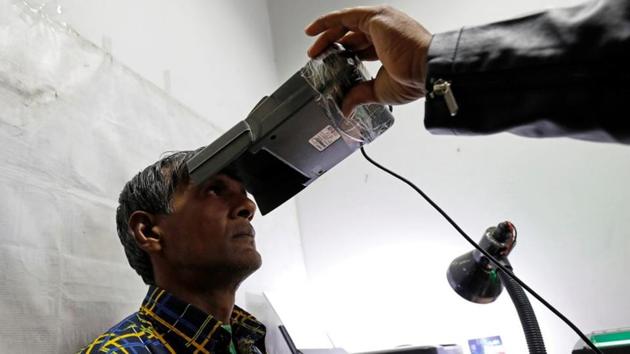
A Constitution bench led by Chief Justice Dipak Misra also expressed concern over “information surveillance” and referred to the recent Facebook data breach to point out that even the Aadhaar data of 1.3 billion people could be used for commercial purposes in the absence of a strong data protection law.
The court is hearing a set of petitions challenging the validity of Aadhaar.
The query over bank accounts was posed to additional solicitor general Tushar Mehta when he, on the behalf of the Unique Identification Authority of India (UIDAI), defended rules under the Prevention of Money Laundering Act (PMLA) that say an account “ceases to be operational” if its not linked to Aadhaar.
CJI Misra raised the first question: “Can you prescribe an onerous condition like shut the bank account?”
Justice DY Chandrachud elaborated on the CJI’s query, reading out the provisions of PMLA. He said they only asked the government to prescribe a procedure for banks or financial institutions to identify its clients and maintain records.
{{/usCountry}}Justice DY Chandrachud elaborated on the CJI’s query, reading out the provisions of PMLA. He said they only asked the government to prescribe a procedure for banks or financial institutions to identify its clients and maintain records.
{{/usCountry}}“What you have done, in the exercise of power, is to provide for consequences in a penal nature. You say a bank account holder would not be entitled to operate the account if not linked to Aadhaar. Are you authorised to do this under the law, under the rule-making power? The answer will be no because the Act only asks you to prescribe a procedure and not to stop operation of bank accounts,” Justice Chandrachud said.
Mehta said the penal consequence is a result of non-compliance of the procedure. But Justice AK Sikri suggested that the government had gone beyond its rule-making power. “The law does not provide for a penal provision,” he said.
Mehta submitted that the freezing of bank account was a consequence and could not be construed as a penalty, to which Justice Sikri replied: “It is in the nature of penalty. My account is blocked and you deprive me of my money. These bank accounts have been there for years, much before this law came. Identification of customers took place as per the existing law and now you want a new identity.”
Mehta argued that the purpose behind linkage was to weed out fictitious bank accounts and stop money laundering. “But the effect is being felt across the board, even to the 99% who are not into money laundering,” Justice Sikri replied.
The deadline for the linking of bank accounts with Aadhaar numbers was extended till the time the court reached a verdict in the case.
Later, when senior counsel Rakesh Diwedi, appearing for Gujarat government, was explaining the rationale of collecting Aadhaar data, Justice Chandrachud said that in the absence of a robust data protection law it is difficult to stop commercial surveillance and the sharing of information. “When we mean surveillance, it is not real or physical surveillance but commercial surveillance,” the judge said.
He cited the instance of the Cambridge Analytica data mining scandal and said: “Today all information in WhatsApp or Facebook is commercially sensitive. Why should somebody intrude on my privacy and keep a tab over the conversation when I share a message with my wife? Our concern is that it will affect a vast number of population and the future generation and how are we going to lay down a law.”
The CJI asked Dwivedi to explain on April 17 how the Aadhar data will be protected.