The Supreme Court Collegium on Monday recommended the elevation of the current chief justices of the Gujarat, Delhi, and Telangana high courts as judges of the Supreme Court.
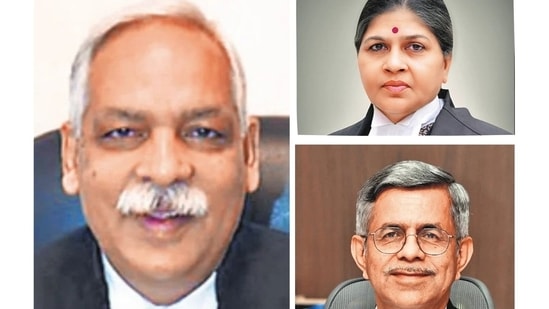
The three judges, whose names were recommended following the Collegium’s meeting on September 28, are Gujarat High Court Chief Justice Sunita Agarwal, Delhi High Court Chief Justice Devendra Kumar Upadhyaya, and Telangana High Court Chief Justice Aparesh Kumar Singh.
The Supreme Court currently has 34 judges against an approved strength of 38.
The recommendation to elevate Justice Agarwal is especially significant given that she had some very public differences with the Gujarat High Court Bar during her tenure as Chief Justice.
Also Read | Supreme Court censures Delhi government for public safety failures amid rising sexual offences
In February 2025, the Gujarat High Court Advocates’ Association (GHCAA) passed a resolution seeking her transfer, citing concerns over courtroom and administrative issues. The resolution at the time was after a heated exchange between the Chief Justice and GHCAA president Brijesh Trivedi during a hearing. The association had also objected to changes in the roster and other administrative decisions. Justice Agarwal subsequently went on leave for two weeks, with Justice BA Vaishnav performing the duties of Chief Justice during her absence.
In October 2025, the GHCAA again wrote to then Chief Justice of India BR Gavai seeking Justice Agarwal’s transfer, this time citing difficulties allegedly caused by instructions governing corrections and interpolations in court filings and the resulting delays in the registry. The association said the problems had particularly affected lawyers and litigants, including junior members of the Bar.
{{/usCountry}}In October 2025, the GHCAA again wrote to then Chief Justice of India BR Gavai seeking Justice Agarwal’s transfer, this time citing difficulties allegedly caused by instructions governing corrections and interpolations in court filings and the resulting delays in the registry. The association said the problems had particularly affected lawyers and litigants, including junior members of the Bar.
{{/usCountry}}The Collegium has now recommended Justice Agarwal be elevated to the Supreme Court despite that history.
The Collegium’s recommendation, however, does not record any findings.
Justice Agarwal, whose parent high court is the Allahabad High Court, was appointed a judge in November 2011 and became Chief Justice of the Gujarat High Court in July 2023. The Gujarat High Court’s official website records her date of birth as April 30, 1966 and her appointment as Chief Justice on July 23, 2023.
She graduated in law from Awadh University in 1989 and enrolled as an advocate in December 1990. If appointed to the Supreme Court, she will have several years of judicial tenure remaining, with her retirement due in April 2031. This gives her a considerably longer potential tenure in the apex court than the other two judges recommended on Monday.
Also Read | Delhi high court gets 7 new judges as Centre clears collegium recommendations
Justice Upadhyaya studied law at Lucknow University and enrolled as an advocate in May 1991. He served as Chief Standing Counsel for Uttar Pradesh from 2007 until his elevation to the Allahabad High Court in November 2011. He became Chief Justice of the Bombay High Court in July 2023 and was transferred as Chief Justice of the Delhi High Court in January 2025.
Justice Singh studied law at the University of Delhi and enrolled as an advocate in 1990. He practised before the Patna High Court before moving to the Jharkhand High Court, where he was elevated as a judge in 2012. He served as Acting Chief Justice of the Jharkhand High Court before becoming Chief Justice of the Tripura High Court in April 2023. He was transferred to the Telangana High Court and took oath as its Chief Justice in July 2025.
The three recommendations, if confirmed and notified by the union government, will take the number of judges in the Supreme Court to its sanctioned strength of 38 once the appointments are completed.
If elevated, Justice Agarwal will become the third woman judge currently serving on the Supreme Court, alongside Justices BV Nagarathna and V Mohana.