
 E-Paper



SC rejects plea against razing of part of Narayan Rane’s bungalow in Mumbai
Narayan Rane’s efforts to save his property from demolition had suffered a setback on September 20 when the Bombay high court turned down his request for retention of the portion of property facing demolition and ordered demolition to begin within two weeks.


The Supreme Court on Monday refused to stay the demolition ordered against portions of the residential bungalow at Juhu owned by Union minister Narayan Rane, but gave him three months to remove the unauthorized construction and save his property from demolition.
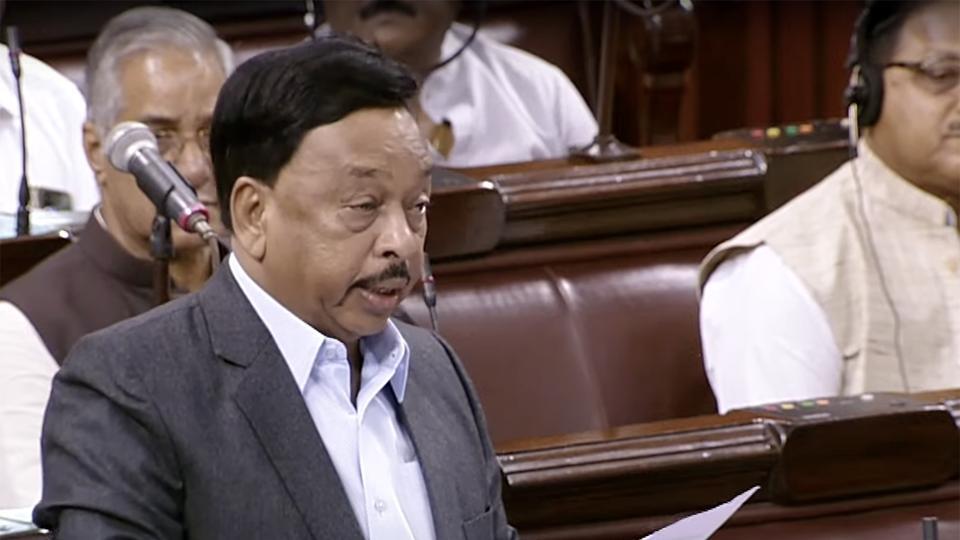
Rane’s efforts to save his property from demolition had suffered a setback on September 20 when the Bombay high court turned down his request for retention of the portion of property facing demolition and ordered demolition to begin within two weeks. Rane through his family-owned company, Kaalkaa Real Estate Private Limited, questioned the high court decision in the top court and sought a stay on the demolition.
A bench of justices Sanjay Kishan Kaul and AS Oka refused to interfere with the high court’s order. The bench agreed to grant Rane three months to bring the residential building in compliance with the applicable laws.
Rane was represented by senior advocates Mukul Rohatgi and Satish Manshinde, who submitted that the high court was wrong in applying principles applicable to large-scale illegal constructions and illegal constructions on public lands without realizing that the construction in question was on private land belonging to Rane.
The property in question, Aadish Bungalow, is the residential property of Rane located in Juhu, Mumbai, covering 1187.84 square metres. In his petition filed through law firm Karanjawala & Co, Rane’s company stated that all necessary permissions were obtained from the Municipal Corporation of Greater Mumbai (MCGM). After completing the construction, he obtained the occupation certificate on January 23, 2013.
Trouble started early this year when the MCGM issued notices under Section 351(IA) of the Mumbai Municipal Corporation Act, 1881, alleging change of user of some parts of the property held to be unauthorised under law. MCGM did not consider Rane’s objections in March, following which the former Maharashtra chief minister approached the Bombay high court.
The MCGM case was that the areas that were free of floor space index (FSI) under the original plans were put to use by Rane and, thus, use of such portions without factoring the same for the purpose of FSI calculation was unauthorized.
Rane moved two applications for regularization of the portion claimed by MCGM to be unauthorized. His latest representation was moved on July 11 that was pending with the authorities. But the high court by its September 20 order dismissed Rane’s petition and went on to dismiss his application of July 11 paving way for the demolition of the portion. In addition, the could also imposed a cost of ₹10 lakh.
In his appeal before the top court, Rane urged that the high court misconstrued the extent of the construction by terming it as being three times unauthorized, whereas only the areas that were taken free of FSI under the occupation certificate were put to use.
Prior to the September 20 order, the high court had passed an order on June 23 with relation to subdivision of the plot. This defect was removed by Rane, following which he moved the second application on July 11.


