E-Paper



Supreme Court revives Bhojshala case, allows prayers at site
To be sure, the court ordered strict maintenance of status quo at the site and prohibited any change to the character of the structure.

 Prefer HTon Google


The Supreme Court on Thursday revived proceedings before the Madhya Pradesh High Court in the long-running dispute over the Bhojshala Temple-Kamal Maula Mosque complex in Dhar district, in the first such order of its kind after a moratorium by the apex court in 2024 while hearing challenges to the Places of Worship (Special Provisions) Act, 1991.
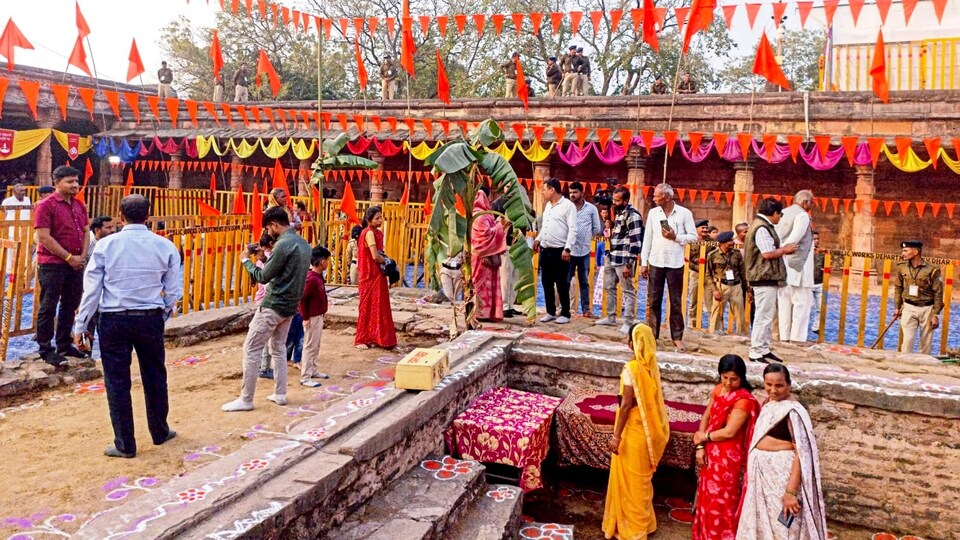
To be sure, the court ordered strict maintenance of status quo at the site and prohibited any change to the character of the structure.
Also read: Yellow alert in Delhi today as IMD predicts rainfall, gusty winds; AQI improves
A bench led by Chief Justice of India Surya Kant and comprising justices Joymalya Bagchi and Vipul M Pancholi permitted the Indore bench of the high court to open the sealed report submitted by the Archaeological Survey of India (ASI) pursuant to a court-mandated survey, share it with all parties, invite objections and responses, and proceed to finally hear the matter.
The 11th-century monument has been at the centre of a prolonged dispute, with Hindu groups asserting that it is a temple dedicated to Goddess Saraswati, while the Muslim community maintains that it is the Kamal Maula Mosque.
Also read: India absent as Donald Trump in Davos unveils ‘Board of Peace’ for Gaza
Significantly, Thursday’s order effectively carves out an exception to a sweeping December 2024 directive of the Supreme Court, by which another three-judge bench restrained all courts across the country from entertaining fresh suits or passing any interim or final orders, including directions for surveys, in cases seeking determination of the religious character of places of worship.
The December 2024 order, passed by a bench headed by then CJI Sanjiv Khanna, was issued while the apex court was seized of multiple challenges to the Places of Worship (Special Provisions) Act, 1991. The bench then directed that no fresh suits be registered and that courts hearing pending matters should not pass any “effective or final orders”, including survey directions, until the Supreme Court decided the issue.
The restraint was aimed at halting a surge in litigation initiated by Hindu groups seeking to establish that existing mosques were built over demolished temples -- a trend that had led to conflicting orders by trial courts and high courts and heightened communal tensions.
In contrast, Thursday’s order allows the Madhya Pradesh High Court to resume proceedings in the Bhojshala matter, albeit with the consent of both sides.
In a separate but related order passed during the same proceedings, the bench also dealt with an application filed by the Hindu Front for Justice (HFJ), seeking rights for Hindus to offer prayers at the disputed complex on Basant Panchami this year, as the festival coincides with Friday prayers on January 23.
The bench directed the Madhya Pradesh government and the district administration to ensure that both Hindus and Muslims are able to perform their respective religious observances peacefully at the site.
Recording submissions by senior counsel Salman Khurshid, who appeared for the mosque management committee, the court noted that the mosque management committee would provide a list of persons who would visit the complex to offer namaz between 1 pm and 3 pm. The district administration has been directed to issue passes, maintain law and order, and adopt all necessary measures to prevent any untoward incident.
The bench also took on record the suggestion of additional solicitor general KM Nataraj, representing the state and ASI, that separate entry and exit points be demarcated for the two communities, and urged both sides to “show mutual respect” and cooperate fully with the local administration.
The Basant Panchami application assumed significance because ASI’s 2003 order does not expressly deal with years when the festival coincides with Friday prayers. On previous such occasions-- in 2006, 2013 and 2016, ASI had issued special advance directions allowing staggered access to both communities.
Under ASI’s 2003 arrangement, Muslims were permitted to offer Friday namaz while Hindus were allowed to perform puja on Tuesdays and observe rituals on basant panchami.
Meanwhile, disposing of the appeal filed by the Maulana Kamaluddin Welfare Society, which manages the mosque and had challenged the Madhya Pradesh High Court’s March 11, 2024 order directing a “complete scientific survey” of the site, the Supreme Court laid down a structured road map for the high court to follow.
The bench noted that the high court’s directions required ASI to identify the “real character” of the historical structure, along with detailed documentation, photography, videography and the opening of all locks at the site. It recalled that on April 1, 2024, the apex court restrained authorities from taking any steps based on the ASI report and barred physical excavation during the survey.
During Thursday’s hearing, ASG Nataraj informed the court that the scientific survey had already been completed before the April 1 interim order and that the report was currently lying in a sealed cover before the high court.
Khurshid agreed that the report could be supplied to the parties, who would then file their objections for consideration at the stage of final hearing.
Accepting this consensus, the bench directed that the pending writ petition be taken up by a division bench of the high court, preferably headed by the chief justice or the senior-most judge of the Indore bench, within two weeks. It asked the high court to unseal the ASI report in open court and provide copies to both sides, permitting inspection of any non-copyable portions in the presence of counsel and experts. The parties have been granted two weeks thereafter to submit their objections, suggestions or opinions, which the high court may consider during final adjudication.
The bench further ordered that all parties shall maintain status quo at the site and that there shall be no alteration of its character, while clarifying that religious practices may continue in accordance with the ASI’s April 7, 2003 order. The court emphasised that it had expressed no opinion on the merits of the dispute.
The controversy escalated in March 2024 when the high court allowed ASI to conduct a survey of the protected monument. ASI conducted the survey between March 22 and June 30, 2024, and submitted a report to the high court in July, concluding that the mosque was constructed using remnants of earlier temples. Though details of the findings entered the public domain unofficially, the report remained sealed following the Supreme Court’s April 1 directions.