
 E-Paper



Suvendu joins modest cohort of non-RSS CMs
Suvendu Adhikari was sworn in as West Bengal's first BJP chief minister, marking a significant political shift and leveraging his past TMC experience.

 Prefer HTon Google


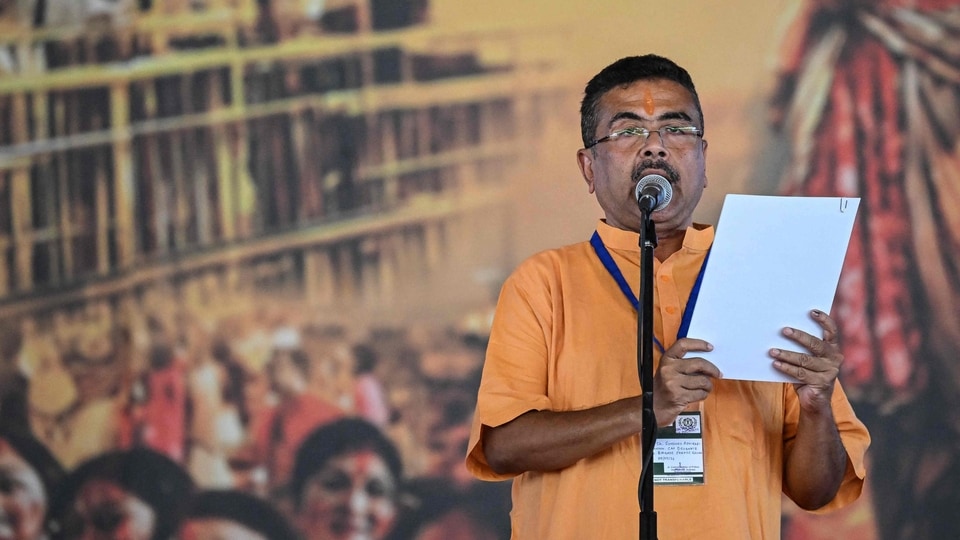
NEW DELHI The Bharatiya Janata Party formed a government for the first time in West Bengal on Saturday as 55-year-old Suvendu Adhikari was sworn in as chief minister. Adhikari, who was unanimously elected leader of the BJP legislature party, joins a cohort of chief ministers who do not trace their political moorings to the party’s ideological fount, the Rashtriya Swayamsevak Sangh (RSS).
Adhikari joins several other BJP heads of state who were previously with other political parties. As on date, chief ministers Himanta Biswa Sarma in Assam, Manik Saha in Tripura, and Pema Khandu in Arunachal Pradesh are all former Congressmen. Bihar CM Samrat Choudhary, who joined the BJP in 2018, was earlier with the Rashtriya Janata Dal and the Janata Dal (United).
Former Manipur CM Biren Singh also moved from the Congress, while former Karnataka CM Basavaraj Bommai arrived from the Janata Dal (Secular).
A former confidant of Trinamool Congress supremo and three-term CM Mamata Banerjee, Adhikari joined the BJP in 2020. The move was perceived to bring heft to the BJP ahead of the 2021 assembly polls. A former minister in the state, Adhikari resigned from the Nandigram assembly constituency, which he went on to reclaim.
The BJP did not only bank on his legislative experience — Adhikari served as Lok Sabha MP twice and as a three-term legislator — but on his grasp of grassroots politics. His experience in building the cadre and his administrative acumen were credited with helping the BJP sharpen its outreach in the state, once a communist stronghold.
In 2021, the BJP’s tally in West Bengal rose from three to 77. Adhikari’s victory in Nandigram, where he defeated Banerjee that year, catapulted him to the top. A second victory in her bastion of Bhabanipur cemented his claim to the top job.
BJP leaders stated Adhikari’s hardline Hindutva pitch helped him override the impediment of not being from the sangathan and the parivaar. “His statements exposing Mamata Banerjee’s politics of appeasement were significant in helping the BJP’s narrative,” a senior RSS leader said. “Since he was part of the TMC and her inner circle, he knew the implications of the demographic changes allowed in the state. Not having been part of a shakha is not an impediment; not being aligned to the ideology is.”
While the opposition criticised Adhikari for polarising utterances—such as referring to his former party chief as “begum” or urging people to refrain from visiting “Muslim-majority” places such as Kashmir—the RSS leader stated he played a key role in “restoring Hindu pride.”
“Secularism has been incorrectly read as Muslim appeasement in Bengal. Bengalis have been at the forefront of cultural and religious renaissance, so how can people who follow Swami Vivekananda and Sri Aurobindo not take pride in being Hindu? Bengal needed leaders like Adhikari who are Hindutvawadi,” the RSS leader said.
On whether the RSS has diluted its stance on appointing non-Sangh leaders to top positions, a second functionary said the organisation believes in inclusivity but does not compromise on core values.
“Ideology and the concept of nation first are non-negotiable. There are many leaders who are not associated with the Sangh but share the sentiment of preserving India’s heritage. When such leaders join the party and the decision makers find them fit for a position, then it is their call,” the second leader said.
The Sangh’s position is in contrast to disagreements between the mentor and the party during the Atal Bihari Vajpayee years. The then RSS chief K Sudarshan had made reservations regarding the appointment of Jaswant Singh as finance minister and Brajesh Mishra as the National Security Advisor.
It is also a departure from the time when only dyed-in-the-wool ideologues such as Bhairon Singh Shekhawat, Kalyan Singh, and Uma Bharti were elevated to the top job in states.
The second functionary, referring to RSS chief Mohan Bhagwat’s statements about the Sangh not interfering in the political party’s matters, said the organisation believed in being expedient in welcoming people of “nationalist thoughts.”
“Leaders such as Sushma Swaraj and Nitish Kumar came from the socialist school of thought, but they did not diverge from the nationalist point of view,” the second functionary said.


