
 E-Paper



‘Truth has won, we’ll continue our work': Activist Sonam Wangchuk's wife on his release after 6 months
Arrested after statehood-demand protests in Leh turned violent last September, Sonam Wangchuk was detained under the National Security Act

 Prefer HTon Google


A day after he was released from the Jodhpur jail in Rajasthan, Ladakhi activist Sonam Wangchuk was all set for a hospital visit, his wife Gitanjali Angmo said in New Delhi on Sunday.
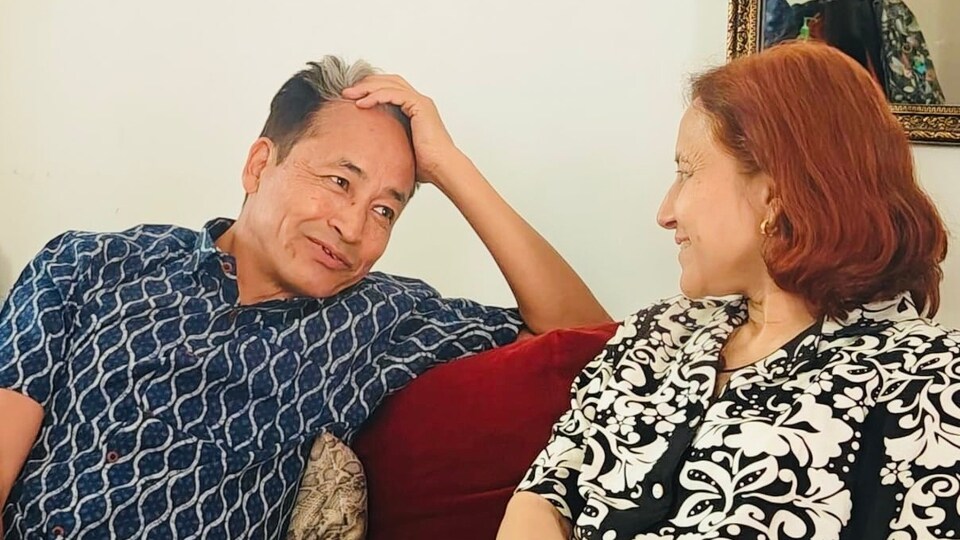
She also said they will resume their long-standing work in education, developing their Himalayan Institute of Alternatives, Ladakh (HIAL) into a university, preserving glaciers, and empowering the region.
“After a long time had a free flowing chat with [him] without glancing at the scary clock every now and then to make the most of the fleeting 60 minutes as in jail!” Ango posted on X, along with their pictures, “Taking him for a health checkup as per the strong recommendations of our family doctor. He will be under medical observation for 36 hours in a good hospital!”
Arrested after statehood-demand protests in Leh turned violent last September, Wangchuk was detained under the National Security Act (NSA) until he was released on Saturday, after the central government said his release would pave the way for the peace required for further negotiations.
Angmo said the revocation of NSA means the triumph of truth again: "I have always said that India's motto, which has been taken from our Upanishads, ‘Satyamev Jayate’, is not just a slogan; it is a reality. So finally, Satyamev Jayate hua hai, satya ki jeet hui hai (truth always wins, and it has prevailed again),"
On future plans, she told news agency ANI: “We will go to Ladakh (after his health check). And we will start working towards what we have always worked for — education, making the Himalayan Institute of Alternatives, Ladakh (HIAL) a great university, making glaciers last longer, and making Ladakh become an empowered place with all the safeguards. So, that is the future. And making India one of the greatest nations of the world.”
Wangchuk did not immediately say anything.
Angmo made another X post earlier in the day, referring to how the couple met in jail through the six months he was there. “Writing the final letter to the jail superintendent yesterday seeking permission to meet and inform [Sonam Wangchuk] of his release. While I thank Jodhpur for all the love and support, I am glad that [his] ordeal of being inside the jail for 170 days and my ordeal of making 2 trips a week every week for just a 60 minute meeting over the past 5 months has finally ended!” she wrote.
The Ministry of Home Affairs, in a press statement, said the government remains committed to fostering an environment of peace, stability, and mutual trust in Ladakh so as to facilitate constructive and meaningful dialogue with all stakeholders, and that the decision to revoke Wangchuk's detention has been taken in furtherance of this objective "and after due consideration".
The MHA pointed out that the “prevailing atmosphere of bandhs and protests has been detrimental to the peace-loving character” of Ladakh, and adversely affected various sections, including students, job aspirants, businesses, tour operators, tourists, and thus the economy.
His release was widely welcomed by political leaders, local representatives, and community members in Ladakh, who described it as a personal victory for Wangchuk and a positive step for the region.
Congress MP Jairam Ramesh criticised the Centre's handling of Wangchuk's detention, saying the government's decision to revoke it “exposes” PM Narendra Modi-led BJP regime.
In a post on X, Ramesh wrote, "The INC had condemned the arrest of Sonam Wangchuk on completely bogus grounds six months back. Now the Modi Govt has done a total U-turn. It stands fully exposed. It should apologise to not only Mr. Wangchuk and his family, but to the people of Ladakh as well. It should also immediately release all those who were detained for staging peaceful and democratic protests."
Tsring Lagrok of the Leh Apex Body, one of the organisations engaged in talks with the government, expressed joy at his release. "Firstly, this is good news for all the people of Ladakh. Secondly, it marks a personal victory for Sonam Wangchuk. We have maintained from the very beginning that the allegations levelled against him were completely baseless; the government failed to substantiate the claims in the Supreme Court. Since the government was on the verge of losing the case, I believe they chose to bring it to a premature end and subsequently withdrew it," he said.
Sajjad Hussain Kargili, a senior leader of the Kargil Democratic Alliance (KDA), the other main outfit negotiating with the Centre, called it good news for the people of Ladakh during the holy month of Ramadan.
"Our demand is that the remaining detainees should also be released, and our people who are now out on bail – all the charges against them should be dropped unconditionally," he said.
Independent MP from Ladakh, Haji Mohammad Haneefa Jan, called it "a great day for the entire Ladakh" and urged the release of other jailed activists.
AAP Leader Saurabh Bharadwaj said, “Sonam Wangchuk was being called a traitor and framed in false cases. His wife moved to the Supreme Court seeking justice. There is no proof against him, although a false agenda is being propagated.”


