President Droupadi Murmu on Saturday described teachers as “frontline nation-builders” and stressed their role in nurturing curiosity, character, confidence and sensitivity among students, particularly those from disadvantaged backgrounds, while presenting the National Teachers Awards at Vigyan Bhawan.
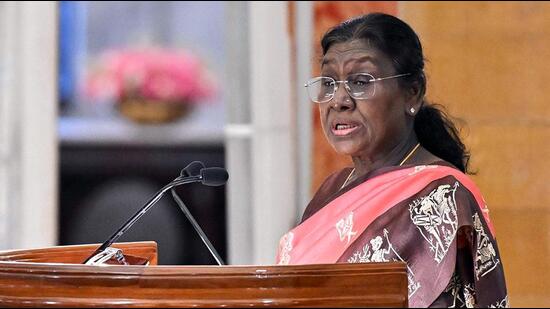
Congratulating this year’s awardees, Murmu spoke about the contributions of education pioneers including Savitribai Phule, Rabindranath Tagore and Utkalmani Gopabandhu Das, highlighting their efforts to expand education and promote learning in natural surroundings. She cited Tagore’s Shantiniketan and Gopabandhu Das’s “Van Vidyalaya” or open-air school as examples of the belief that children develop naturally in the lap of nature.
This year, 82 teachers and educators have been selected for the National Teachers Awards. They include 48 school teachers, 21 teachers and faculty members from higher educational institutions and polytechnics, and 13 skill trainers from the Ministry of Skill Development and Entrepreneurship (MSDE).
Deep Dive
What did President Murmu emphasize about the role of teachers at the National Teachers Awards event?
Why is Teachers' Day celebrated in India, and what significance does it hold?
How can teachers inspire independent thinking in students according to President Murmu?
Also Read: Look beyond academics, spot behavioural changes and help: PM Modi to teachers
Referring to the awardees from across the country, from Ladakh to the Andaman and Nicobar Islands and Arunachal Pradesh to Gujarat, Murmu said it was encouraging that a large number of recipients teach in village schools. Their teaching and training methods, she said, could inspire other educators to pursue excellence.
{{/usCountry}}Referring to the awardees from across the country, from Ladakh to the Andaman and Nicobar Islands and Arunachal Pradesh to Gujarat, Murmu said it was encouraging that a large number of recipients teach in village schools. Their teaching and training methods, she said, could inspire other educators to pursue excellence.
{{/usCountry}}The President also highlighted the importance of recognising teachers from schools, higher educational institutions and polytechnics, as well as skill trainers. She said academic excellence, skill development and entrepreneurship were crucial to India’s development and to the country’s ambition of becoming a “knowledge super-power” and the “skill capital of the world.”
Speaking about higher education, Murmu invoked India’s historic institutions of learning, including Nalanda and Vikramashila, and recalled how teachers such as Nobel laureate CV Raman encouraged students to question, explore and engage deeply with modern physics.
She stressed the “special responsibility” of teachers towards students who face disadvantages, including children from economically weaker families, first-generation learners, shy students, those lacking confidence and “Children with special needs.” Teachers, she said, have the opportunity to give such students confidence and help them move forward.
Education, she said, is the most effective means of translating the constitutional ideal of “equality of opportunity” into reality. Noting the decline in the primary school dropout rate over the past 12 years, she credited teachers with helping achieve this progress.
Calling education the foundation of a developed nation, Murmu urged teachers to ensure that no student is deprived of opportunities for quality education and to infuse every learner with “knowledge, inspiration, morality and sensitivity.”