The Telangana Rashtra Samithi government is heavily banking on borrowings and central grants to implement its welfare scheme, ahead of the assembly elections scheduled next year, the state Budget document revealed.
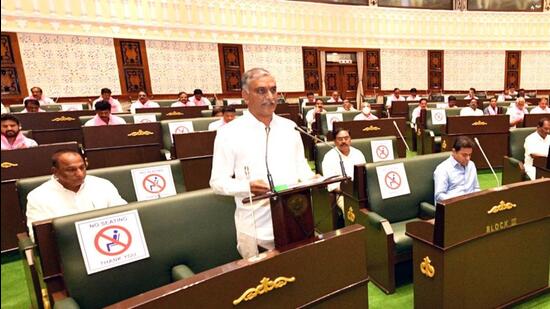
In its annual budget for 2022-23, presented in the state assembly on Monday, the state government has projected total receipts of ₹256,961 crore in the coming financial year, of which the state’s tax and non-tax revenue is only ₹1,33,634 crore. The remaining is expected to come from borrowings and central grants and tax devolutions.
According to the budget document, the state government is planning to mobilise ₹59,672 crore through borrowings from various sources, including ₹53,970 crore from the open market, ₹4,102 crore from central government agencies and another ₹1,500 crore from lending institutions.
With the proposed fresh loans, the outstanding public debt will mount to ₹329,988 crore by the end of 2022-23, as against ₹285,120 crore during 2021-22, the government data showed. In the concluding financial year, the state had taken loans to the extent of ₹49,200 crore from all sources.
Out of these total debt, open market loans account for ₹2.89 lakh crore, while central government loans account for ₹7,188 crore, loans from autonomous bodies ₹13,591 crore and loans from small savings, provident fund and others account for ₹19,336 crore.
{{/usCountry}}Out of these total debt, open market loans account for ₹2.89 lakh crore, while central government loans account for ₹7,188 crore, loans from autonomous bodies ₹13,591 crore and loans from small savings, provident fund and others account for ₹19,336 crore.
{{/usCountry}}“Every year, the state government has been going in for more and more loans. These loans are not being used for creating any capital infrastructure, but to fund its populist schemes, whether it is Rythu Bandhu (paying ₹10,000 per acre to each farmer towards input costs for cultivation) or Dalit Bandhu ( ₹10 lakh to each eligible Dalit family),” Osmania University professor and analyst K Nageshwar said.
He pointed out that the capital expenditure projected in the budget is only ₹29,728 crore, whereas the so-called welfare schemes run into over ₹100,000 crore. “So, it is obvious that the government is going for more loans only for implementing its populist schemes for electoral gains,” he added.
In the last five years, the outstanding loan of the state shot up by nearly three times. In 2016-17, Telangana’s outstanding debt was ₹123,000 crore, and it went up to ₹205,000 crore in 2019-20.
“In the last two years itself, the state resorted to over ₹1 .25 lakh crore,” Nageshwar pointed out.
The budget document revealed that the state government has to pay ₹18,921 crore only towards payment of interests (debt servicing) on outstanding loans. “This is not very alarming. Our debts are well within the prescribed limit of 25 per cent of the Gross State Domestic Product (GSDP), fixed by the Central government,” a senior official in the state finance department said on condition of anonymity.
Besides these loans, the state government is also depending on the grants and devolutions from the Centre. This year, the state government is expecting another ₹59,396 crore from the Central government in the devolution of central taxes ( ₹18,934 crore) and grants ( ₹41,002 crore).
However, this is also a sort of overestimation by the state government. Last year, the state government expected ₹38,669 crore from the Centre in grants-in-aid but got only ₹28,669 crore, a shortfall of ₹10,000 crore.
Similarly, the state government expects to raise another ₹15,500 crore through the sale of the government lands, which has become the latest trend to mobilise money to fill up the coffers. This is part of the non-tax revenue of the state government. In 2021-22, it projected non-tax revenue of ₹30,557 crore, but got only ₹20,500 crore.
“The projections in the budget are only to create an impression that the state’s economy is robust; but in reality, it is not,” Nageshwar added.