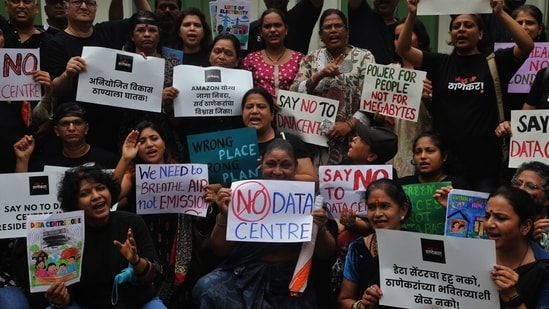
India’s ambition to become an artificial intelligence (AI) powerhouse is beginning to face the kind of local resistance that has slowed data centre projects in parts of Europe and North America. In Thane and Visakhapatnam, residents have launched what are among the country’s first organised protests against large data centres, arguing that the projects could put additional pressure on land, electricity and water.
The protests come as the Centre encourages investment in digital infrastructure. At the AI Impact Summit in February, Prime Minister Narendra Modi urged global technology companies to let their data “reside in India”, pitching the country as a hub for AI infrastructure. Data centres were granted infrastructure status in 2022, while this year’s Union Budget announced a tax holiday until 2047 for eligible foreign cloud service providers. Several states have also introduced policies and incentives to attract investment.
“Half of Thane is living on tanker water. Why have the data centre in a residential area and put all the citizens in trouble?” said Sadhana Pradhan, one of the residents leading the Wake Up Thanekar campaign. Residents say they are not opposed to technology or AI, but to building one of the country’s biggest data centres in a densely populated residential area without fully addressing its long-term impact on the neighbourhood.
In Thane, the data centre facing protests is Amazon’s hyperscale facility, spread across about 53-58 acres at Balkum and Majiwada.
{{/usCountry}}In Thane, the data centre facing protests is Amazon’s hyperscale facility, spread across about 53-58 acres at Balkum and Majiwada.
{{/usCountry}}Data centres classified as “essential services”
The campaign began after residents learnt that data centres are classified as essential services, raising concerns that they could receive priority access to water and electricity during shortages. After scrutinising the project’s approvals, the group sent Amazon and the Thane Municipal Corporation (TMC) a 22-point questionnaire.
It asked whether mandatory public notices on environmental clearance had been issued, whether key water and sewerage approvals had been obtained before construction began, and how the project’s water demand compared with subsequent commitments made by the civic body. They also sought details on thermal impact, emergency preparedness, inspection reports, power demand and compliance with environmental conditions.
The TMC said residents need not worry about drinking water being diverted. Deputy city engineer Dhole said the proposed Amazon facility would receive 12 million litres a day (MLD) of treated sewage water. He said the corporation currently had sewage treatment capacity of about 300 MLD and supplied around 600 MLD of water across the city, with recycled wastewater being supplied for industrial use rather than as potable water.
However, residents are also concerned about heat generated by cooling systems, noise from equipment, pressure on the local power network and the cumulative impact of locating a massive data centre next to homes, schools and hospitals.
Also Read I Data centres must pay their true costs
Amazon responds
In its response, Amazon said its data centre development in Thane would not use water for cooling. “In fact, we do not currently use water for cooling in any of our data centres in India, and do not draw from the community’s drinking or potable water for cooling purposes. The approved water supply permit for the Thane data centre is 0.01 MLD and is strictly for basic human needs, including restrooms and drinking water for Amazon employees.”
It said the data centre would be built and operated in compliance with the Noise Pollution (Regulation and Control) Rules, 2000. “We are investing in advanced technology and engineering for industry-leading sound management, including sound-dampening building materials and insulation, strategic placement of equipment, and acoustic enclosures and mufflers where needed. The generators will not be in constant use and will mostly run for brief midday tests to ensure they are ready and reliable when needed during rare emergencies.”
The company added that heat from the servers would be released through cooling towers or air-handling systems that distribute it efficiently. The heat dissipates naturally into the atmosphere without affecting the air temperature in nearby communities, Amazon said.
Similar protests in Visakhapatnam
Nearly 800 km away, a similar campaign is taking shape in Visakhapatnam, where several citizen groups are opposing a proposed Google-Adani hyperscale AI data centre complex. Planned as a 1-GW cluster split across three sites, the project would cover about 200 acres at Tarluvada, 120 acres across Adavivaram-Mudasarlova, and 160 acres at Rambilli in Anakapalli district.
Activists say the projects raise several of the concerns voiced in Thane, while also creating additional worries over land acquisition and environmental clearances. Over 100 people took part in a stir against the project on July 19 .
Deeksha Vanguru, one of the protesters and a co-founder of the Coalition for AI Regulation, said: “We are concerned about the lack of public consultation and the unchecked, rapid expansion of infrastructure that is more extractive and has fewer socio-economic returns. We also want to know why a ₹22,000-crore tax holiday is being given for these projects.”
Water sourcing and land acquisition
According to the protesters, water for the projects would be sourced from the Polavaram project or through desalination, which they said would be unsuitable for a city that is already water-stressed. Vanguru also questioned whether the projects justified the public resources they would consume, saying government environmental clearances indicated that the three sites together would create about 1,700 permanent jobs.
Vanguru alleged environmental clearances had been rushed and raised concerns over the acquisition of land from Dalit farmers, stating that some had not received the compensation they were promised. Some protesters are considering approaching the National Green Tribunal (NGT) over the alleged loopholes.
GV Pallam Raju, superintending engineer for water supply at the Greater Visakhapatnam Municipal Corporation, said the demand made by the data centres so far amounted to less than 1% of the current supply.
Google said environmental audits had informed facility design choices and that it had prepared responses to protesters’ issues.
Also Read I From Michigan to Mumbai, communities are asking: How much water do data centres use?
“We commissioned thorough, independent environmental audits during the project planning process—including ecological, watershed, and acoustic assessments. Based on these findings, safeguards—such as natural drainage preservation, erosion and runoff control, noise mitigation barriers, and shielded lighting—are fully integrated into construction processes. These findings also inform facility design choices, including our decision to utilise advanced air cooling to protect vital local water resources and invest in sound-dampening fans in buildings, paired with property setbacks and landscaping buffers, to ensure we are a quiet, unobtrusive neighbour,” said Alexander Smith, principal, global infrastructure and energy, Asia Pacific, Google.
White paper on data centres
India’s installed data centre capacity has nearly tripled, from about 520 MW in 2020 to almost 1.5 GW by mid-2025, and is projected to reach 4.5-6.5 GW by 2030. The sector attracted around USD 95 billion in committed investments between 2019 and 2025. A more aggressive forecast by Wood Mackenzie has estimated capacity of 12 GW by 2030, largely because of AI-related demand and hyperscale expansion.
A recent white paper by the Council on Energy, Environment and Water (CEEW) and Systemiq said decisions on where data centres are built would shape land, water and electricity use for decades. The report noted that India still lacked a binding national policy for data centre development and recommended that projects be planned around the availability of land, water and power rather than investment incentives alone. It also called for better disclosure of sustainability data and careful site selection before projects are approved.
The report noted that data centres already account for around 1.5% of global electricity consumption, with demand expected to rise sharply as AI expands. Similar concerns have fuelled community opposition to data centre developments in parts of Europe and North America, where residents have questioned whether the economic benefits justify the environmental costs.
Need for a national policy
In response, New York Governor Kathy Hochul recently signed an executive order enacting a one-year moratorium on the construction of large new data centres. Similar restrictions have been put in place by several other cities in the US. In Europe, Dublin and Frankfurt have introduced stricter controls on the operation of data centres within their limits.
Prateek Aggarwal, senior programme lead at CEEW and one of the authors of the CEEW-Systemiq report, said: “The ministry of electronics and information technology (MeitY) released a draft Data Centre Policy back in 2020 for discussion. However, 16 Indian states have introduced policies or relied on IT and industrial rules to attract data centre projects, with five of them incorporating sustainability-related requirements. As investments in the sector scale up, India now needs an updated national policy that brings greater consistency to data centre performance and sustainability standards.”
Also Read I Watt it’s worth: Why AI data centres run hot and drink deep
This, Aggarwal said, could include mandatory disclosure of energy, water and carbon use to enable transparency and benchmarking; phased Power Usage Effectiveness (PUE) and Water Usage Effectiveness (WUE) performance standards to provide efficiency benchmarks as the sector evolves; an integrated siting tool that considers water, land and grid availability to support informed project planning; and a grid integration framework that enables data centres to deploy battery storage and demand response to contribute to grid flexibility while meeting their power needs.
Different countries offer useful models for India as it develops this framework. The EU mandates energy and water reporting for facilities above 500 kW, as well as waste-heat recovery above 1 MW. China caps the amount of water a facility can use based on its energy load. Singapore and Malaysia link project approvals directly to efficiency, water and carbon metrics. These approaches offer reference points for a policy that supports the continued growth of India’s data centre sector while encouraging resource-efficient and grid-responsive infrastructure.