
 E-Paper



Watt it’s worth: Why AI data centres run hot and drink deep

 Prefer HTon Google


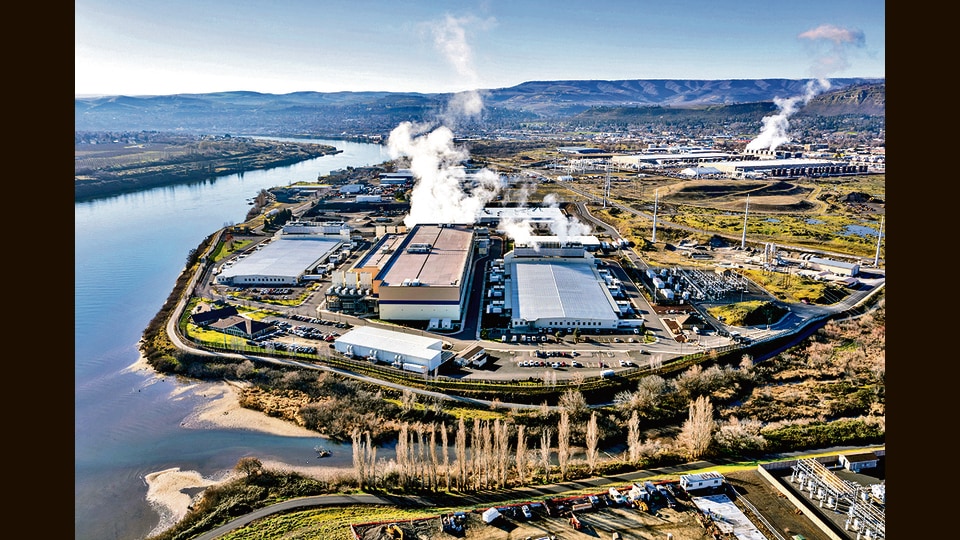
Rack for rack, a cutting-edge AI outfit can emit about 15 times as much heat as the average conventional system. Something’s got to give, says Mridula Ramesh. In this week’s Trade-Offs.
Erin Brockovich, the environmental campaigner immortalised in the Oscar-winning film, is digging into AI data centres. This week, I’d like to explore why.
HEAT: A FEATURE, NOT A BUG
AI’s story began nearly 80 years ago, in the offices of Bell Labs, with the invention of the transistor.
At its simplest, a transistor is a microscopic switch made from silicon. Think of it as a sandwich, where a slice of “receiving” silicon is placed between two slices of “giving” silicon, with a gap of insulating material in-between. Apply a little voltage and a bridge opens up, and electrons begin to flow from the giving to the receiving silicon layer, turning on the transistor.
Moving electrons generate heat. Seen this way, a transistor is like a tiny heater powered by electricity.
Engineers pack these transistors onto chips — thin pieces of silicon that resemble miniature cities, with transistors as buildings, wires as roads, electrons as traffic, and clocks as traffic lights that work to keep everything in step. The Intel chip powering my laptop contains more than a billion transistors: an entire miniature city of tiny heaters.
But chips, like cities, come in different forms.
The CPU (central processing unit) is a generalist: it can open a browser, check email or play music, handling tasks as directed, in careful sequence. The GPU (graphics processing unit) is a specialist. In its early days, it drew the millions of pixels needed for videogames by performing many similar calculations simultaneously.
It turns out this works brilliantly for the mathematics behind AI, which involves multiplying vast grids of numbers to train and run models. Nvidia, the company most closely associated with GPUs, has unsurprisingly become the rockstar of the AI world.
Chips, along with memory, storage, networking, power and cooling hardware, are packed into servers. Servers are stacked in racks. Racks are grouped together to make a data centre.
A conventional data centre, running websites or cloud storage, relies largely on CPUs, and an average rack in such a centre draws about 8kW. In an AI data centre, GPUs do the heavy lifting. A high-density AI rack can draw over 2,000 units of electricity a day at 80% utilisation.
A large AI data centre can therefore consume millions of units daily.
Nearly all that electricity ends up as heat. Rack for rack, a cutting-edge AI system can emit about 14 times as much heat as the average conventional rack.
An AI rack is, in effect, a 120-kW electric heater that happens to answer questions.
High electricity use and heat generation are a feature of AI, not a bug.
ENERGY
All told, how much electricity are we talking about?
According to the International Energy Agency, data centres consumed 415 TWh in 2024, enough to meet the average annual electricity needs of 353 million Indian households. The UN thinktank United Nations University expects this to rise to 945 TWh by 2030.
In India, a recent report suggests that datacentre electricity demand could grow from 10 TWh in 2025 to 191 TWh (!) in 2040.
There is good news here, with a caveat.
Many leading hyperscalers advertise their vast purchases of renewable power as proof of corporate virtue. But renewable energy did not spring fully formed from capitalism’s generous heart. It was helped along by subsidies, regulation and decades of political pressure over climate change.
That is precisely how markets are supposed to work: governments set a direction and draw a line around what is no longer acceptable, and capitalism gets to work, finding progressively cheaper ways to meet the constraint.
Hyperscalers in India have bought a lot of renewable energy (and offsets) to power their centres. But to someone familiar with the innards of electricity adjustment, the relative opacity in how they match seasonal and diurnal generation with constant use invites further scrutiny.
If we as a country are subsidising that cost (through generous policy support), what precisely are we getting in return?
WATER
All this electricity, turns to heat.
On a visit to such a centre, Joanna Stern, reporting for The Wall Street Journal, said it was hot enough around the servers to “blow-dry my hair”.
Cooling involves two separate tasks: lifting heat away from the chips and servers, and ejecting it from the building. The first can be done in several ways: by blowing cold air through servers; increasingly, it is done through direct-to-chip cooling, in which cold plates sit on GPUs and a sealed liquid loop carries heat away. The latest avatar is immersion cooling, in which servers are submerged in a non-conducting liquid that absorbs their heat.
Once the heat reaches the edge of the building, it can be ejected through dry coolers (with or without chillers) that use little or no water; through evaporative cooling towers, which can consume about 1.5 to 2 litres per kW-hour of computing electricity; or through a hybrid of the two.
Smaller conventional data centres typically use some form of dry cooling, but AI centres, because of the concentrated heat, may need something more powerful. Depending on the combination of technologies and the local climate, a 100 MW AI data centre can consume almost no onsite water for cooling — or over 2 million litres a day.
Which brings us to an inherent trade-off underpinning datacentres.
Water usage effectiveness, or WUE, measures litres of onsite water consumed per unit of computing electricity. Power usage effectiveness, or PUE, compares the electricity used by the entire facility (including cooling infrastructure) with that used by its computing equipment.
Dry cooling can lower WUE, but often raises PUE, increasing electricity consumption and the remote water footprint of compute. A low WUE, therefore, can be a misleading badge of virtue: it may simply move the water burden from the data centre’s cooling tower to a distant power station. Studies have shown that the offsite water footprint of data centres far exceeds what is used onsite.
Indeed, the United Nations University Institute for Water, Environment and Health estimates that in 2025 the electricity consumed by data centres carried a water footprint of 4.5 trillion litres, most of it embedded in the water footprint of the electricity used in data centres.
The Lawrence Berkeley National Laboratory estimated that by 2028 hyperscale data centres in the US alone could consume between 60 and 124 billion litres. We look set, if anything, to overshoot that number.
In 2025, according to its own sustainability report, Google alone consumed 41 billion litres of water, 97% of it in its data centres — enough to meet the annual water needs of nearly two million Indian households (assuming an Indian needs about 135 litres of water per day).
Google says its projects replenished water equivalent to 78% of its freshwater consumption in 2025. Such accounting matters, and can catalyse useful innovation.
In Uttar Pradesh, the company is funding precision drip irrigation, measuring the water saved and creating an incentive for farmers to use less; it is also restoring lakes and watersheds across India. Having interacted with many of the organisations doing this work, I know that it is far from nothing.
But replenishing water elsewhere does not erase extraction from the watershed around a data centre. That matters particularly because a Bloomberg analysis found that many new data centres are located in stressed watersheds. In India, most such facilities are coming up around Mumbai and Chennai — neither renowned for their water security.
Meanwhile, what lies unspoken may be far more revealing than what is reported.
Amazon says Amazon Web Services consumed just 0.12 litres of water per unit of computing electricity globally in 2025; however, its Asia-Pacific operations outside China averaged 1.10 litres — more than nine times as much. Climate possibly explains some of the difference, but it’s unclear from the reports what role climate played, and what came down to technological choices.
AWS also claims water positivity in India and has repeatedly said that some of its Indian data centres use no water for cooling. Yet the same regional factsheet says AWS withdrew more than 383 million litres in Mumbai in 2025, and more than 56 million litres in Hyderabad. Where was this water used? How much was consumed (versus merely withdrawn)? Offsite or onsite? The lack of clarity is a big part of the problem.
TELL IT LIKE IT IS
As Brockovich has pointed out, what angers communities is not only the resources used but also the secrecy surrounding it all.
Communities in the US, she reports, complain of water pressure drops, water turning muddy and wells running dry — inconveniences familiar to anyone living above a draining aquifer. Add to this noise, heat and, in parts of America, higher water and electricity bills.
And what do communities get in return?
The lure of “jobs” seems hollow on closer inspection: Hundreds of construction jobs (thousands at the largest sites) may appear briefly, but many go to migrant workers rather than local residents. Once construction ends, a 100 MW AI data centre may consume the electricity of a small city, yet employ only about 60 people onsite. (The engineers who design and manage the AI systems usually sit elsewhere.) So the benefits are dispersed and often distant, while the demands for land, water and electricity are intensely local.
The outrage over this is spreading. Last month, the US reportedly saw an unprecedented 142 demonstrations against AI data centres. Similar opposition has surfaced in Chile, in Europe, and even in Thane.
Something has to give.
(Mridula Ramesh is a climate-tech investor and author. She can be reached on tradeoffs@climaction.net. The views expressed are personal)


