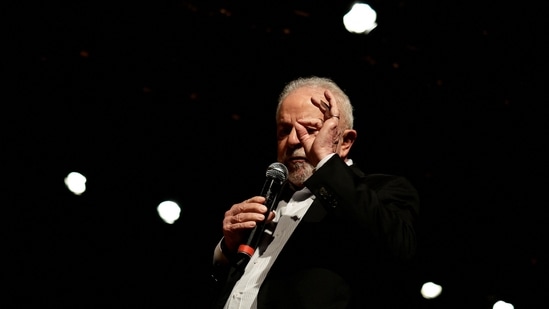
Luiz Inacio Lula da Silva is set to govern the largest Latin American economy for the third time, defeating the incumbent President Jair Bolsonaro by a slim margin. Delivering his victory speech on October 31, Lula pledged to govern for all Brazilians, however, the task of presiding over the divided nation and its economy appears more daunting than how it was in 2003, which was when Lula came to power for the first time. An HT analysis of Brazil’s official
Per capita GDP has been stagnant for a while
{{^usCountry}}{{/usCountry}} Per capita income, which is a better measure of standards of living, delivers a poor picture of Brazil’s economic performance. IMF data on real per capita GDP shows that there has been a stagnation on this front in the last few years. This number touched a high of 6,130 Brazillian real in 2014, but then fell to 5,623 Brazillian real in 2016. By 2021, it had slowly crept up to 5,696. Even in 2022, it remains 311 Brazilian real (5,819) behind its pre-recessionary level (2014) and IMF expects it to remain below till at least 2027. Against this backdrop, the nature of economic policies Lula puts in place to raise the per capita incomes will be interesting to look out for. What is certain is that delivering a hike in incomes similar to his first and second term – the per capita incomes rose by 26% in 2010 from 2003 – will be a far-fetched idea.
Promise of zero deforestation
Brazil, which covers almost 60% of Amazon rainforest, faced a huge international backlash under the presidency of Bolsonaro for accelerating the Amazon deforestation, threatening not only wildlife and indigenous communities, but also the global climate. Data from the Brazil’s National Institute of Space Research (INPE) shows that Amazon deforestation rates spiked to more than 10,000 sq km in 2019 and 2020, from 7,000 sq km in 2017. Lula has promised to eliminate the illegal clear-cutting in the Amazon rainforest and provide new protections for indigenous lands. An analysis by Carbon Brief suggests that if Lula’s next administration follows through these pledges, the annual deforestation in the Brazilian Amazon could be down by nearly 90% by the end of the decade (https://bit.ly/3DTlusC). To be sure, Lula’s earlier crackdown on deforestation – the deforestation rates was brought down to 70 km2 in 2009 from the historic peak of 28 thousand km2 in 2004 - is a testament to his current promise as well.
Narrow victory margin means a divided Congress
Lula defeated Bolsonaro in the closest election in the history of Brazilian democracy. He won with 50.9% of the votes, to Bolsonaro’s 49.1%, as per the official tally. Beyond his election promises, the success of Lula is also attributed to the fact that he ran the elections involving a coalition of 10 parties ranging from the left to the centre-right; Lula’s campaign has brought together two political forces - the centre-right Social Democratic Party and the Brazilian Democratic Movement - who had been enemies in the 2000s with the Lula Workers’ Party.
This means Lula will face a divided congress and divided country, with Bolsonaro’s allies having captured a large presence in both Houses on top of controlling the country’s three most populous states, Sao Paulo, Minas Gerais and Rio de Janeiro. A bigger question also remains on how long such a diverse coalition will stay together and put up the fight against Bolsonaro in both houses of the parliament.
“Lula’s challenge of governing is bigger than that of winning the election. Brazilian society needs to be rebuilt in its institutional and fiscal basis,” said Carolina Botelho, a political scientist with the Institute of Advanced Studies at Sao Paulo University, to Bloomberg on October 31 (https://bloom.bg/3FB188O). “Lula will need to recover the internal and external trust of financial agents and civil society”, she added.