
 E-Paper



Karnataka election result: How HD Deve Gowda’s JD(S) lost the electoral battle
The party’s tally in the assembly polls has tumbled to 20 seats from 37 won in 2018, compounded by a sharp fall of five percentage points in vote share

 Prefer HTon Google


From kingmaker to a bit player, the decline in the fortunes of the Janata Dal (Secular), led by former Prime Minister H D Deve Gowda, has been nothing short of dramatic. The party’s tally in the assembly polls has tumbled to 20 seats from 37 won in 2018, compounded by a sharp fall of five percentage points in vote share from 18.3% to 13.3%, leading to its worst electoral performance since 2004.
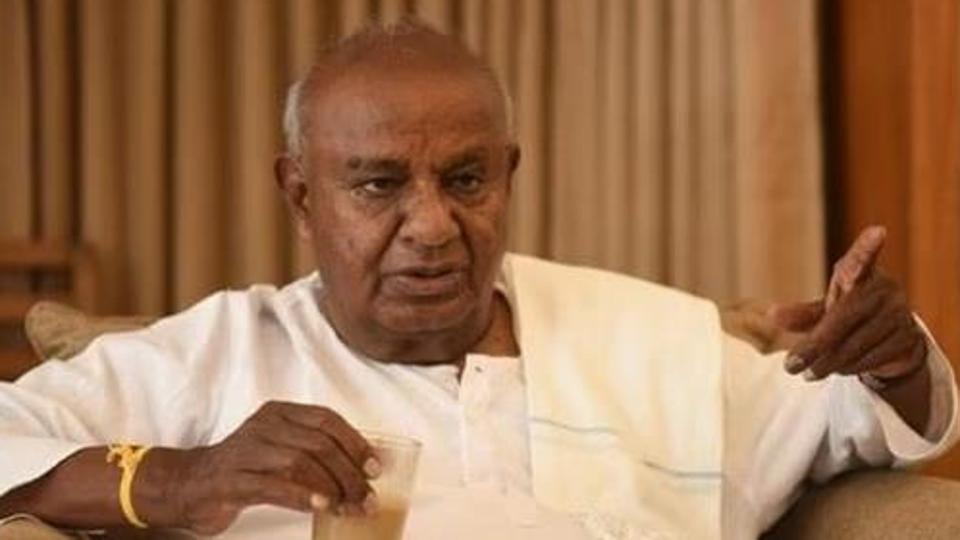
The JD(S) campaigned vigorously, claiming that it would be the kingmaker in Karnataka and HD Kumaraswamy would become chief minister. Several opinion and exit polls had projected a hung assembly, which could have led to the party’s crucial role in forming a government.
The results on Saturday showed its electoral strategy did not work, with experts saying voters, including from the party’s vote bank of Vokkaligas, preferred the Congress as it had a chance to form a stable government on its own. The JD(S), as a result, put up a poor show even in its bastions.
Also Read:‘Just wait and watch’: Ex-PM Devegowda on upcoming Karnataka Assembly elections
Accepting the party’s defeat, Kumaraswamy said, “In a democratic system, the people’s mandate is final. I accept defeat and victory with equanimity. My struggle will continue.”
Its biggest defeat came in Mandya district, where the party had won all seven seats in 2018. This year, it could retain only two. In Hassan, the home district of Dewe Gowda, the party could win five seats in 2023 compared to seven in 2018.
Of the three contesting members of the Dewe Gowda family, two sons, H D Kumaraswamy and H D Revanna, won, but grandson Nikhil Kumaraswamy lost from the stronghold of Ramanagara to Congress leader Iqbal Hussain. In the Vokkaliga belt of Old Mysuru region, the party could win only 14 of the total 59 seats. In 2018, it had won 29 seats.
This is a major decline and the JD (S) is facing its worst crisis in 20 years, political analyst Sandeep Shastri said. In fact, the Bharatiya Janata Party getting more votes in the Old Mysuru region benefitted the Congress at the cost of JD (S).
“The competition in old Mysore saw the JD(S) sliding to the advantage of the Congress. While thr BJP increased its vote share in old Mysore, JD(S) seats fell as the Congress increased its vote share,” Shastri said.
The drubbing for the JD(S) was also a result of the party failing to get good number of seats outside the Old Mysuru region. In 2018, the party had got 11 seats outside the region. This time, the number shrunk to only one and that too in the Vokkaliga dominated constituency in Bengaluru.
A combination of anti-incumbency against sitting JD(S) MLAs, too much importance to the family and a lack of support from the Muslim community were the main reasons for the party’s downfall, experts and party workers said. But the most important factor was the shift of Vokkaliga votes away from the party.
The vote share of Congress in Karnataka assembly polls went below 34% only once in 1994 when the vote share fell to 24%. On Saturday, the party showed a vote share of about 43%, winning 136 seats and a majority. The BJP won 65 seats.
“If you want to answer the question whether Vokkaliga voters have moved away from the JD(S), the vote share explains it. If Congress has increased its vote share by 9% from its base, the anti-incumbency vote generally gives 1-2% votes. The rest is 7% and Vokkaligas account for around 12% of the votes in the region. This shows that a good chunk of Vokkaliaga votes moved to the Congress,” said a JD(S) leader who didn’t want to be named.
One of the reasons for this shift was anti-incumbency.
Nyame Gowda, a former government employee from Mandya, said people were unhappy with the Gowda family and its MLAs. “Even before the election and after the election, one thing people were talking about was how Kumaraswamy took away several projects from the various constituencies when he was chief minister after his son lost the Lok Sabha election. There was anger and it has resulted in negative votes,” he said.
In JD(S)’s blueprint for the 2023 polls, Muslims featured prominently. The party made CM Ibrahim party chief and even took a stand during the hijab issue to appeal to Muslim voters. “But the Congress has swept the Muslim votes. Not only have they prevented the shift of Muslim votes, JD(S) Muslim voters have moved to the Congress as the latter was the seen as the party capable of putting the BJP on check,” said Shastri.
The outcome of the election also presents a leadership conundrum for the party. “HD Deve Gowda is ageing and may not be active in the next election. HD Kumaraswamy also has some medical complications. The party now doesn’t have a third layer of leadership,” said political observer A Narayana. “Nikhil Kumaraswamy has lost both Lok Sabha and assembly elections. Because the party is family centric, they have not allowed any leader to grow up the rank either. This will be a real concern for the party.”
The family centric structure of JD(S), too, played a role in its defeat. “Many leaders within the party felt alienated from the family,” Narayana added. “People of Mandya and Ramanagaram are known for rejecting one party over such issues and they did.”


