
 E-Paper



The dynamics of grassroots democracy
Meerut, Banswara and Kolhapur have become milestones of the 76-day LS poll campaign with the narrative and tone turning in each place

 Prefer HTon Google


Meerut, Banswara, Kolhapur
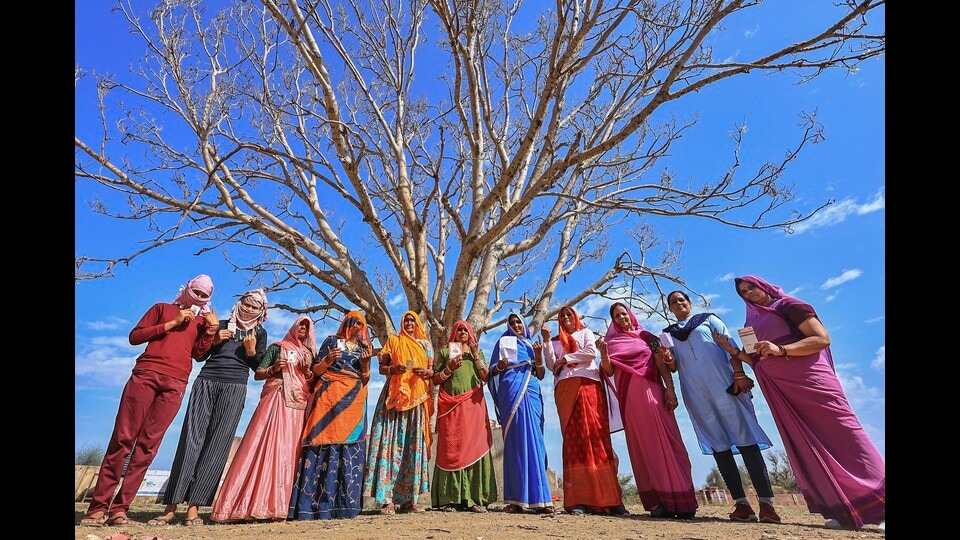
Located across the scorched expanse of India’s heartland, these three cities have many things in common – none of them metropolises but tier 2 and 3 cities bursting at the seams with the dreams and aspirations of middle India, where some families are looking to pull themselves out of penury and others are aiming for a life the previous generation could never dream of. Their roads are indifferent, infrastructure scattershot, and services frail. Yet, adversities can’t lid the unquenched thirst of their residents, expertly straddling both cosmopolitan aspirations and small-town moralities, to match, or even beat, their big-city cousins.
The heat and dust of this summer’s general elections, though, forged these three places together as the three milestones on the gruelling road of the general elections campaign that took 76 days to traverse; in each of these three places – Meerut on March 31, Banswara on April 21 and Kolhapur on April 27 – the narrative and tone of the campaign turned, birthing a bouquet of new issues and reactions, and holding out clues on both the evolution of the campaign and the strategies of the two camps – the National Democratic Alliance (NDA) and the Indian National Developmental Inclusive Alliance (INDIA).
First, Meerut. With Uttar Pradesh chief minister Yogi Adityanath and newly minted ally Rashtriya Lok Dal chief Jayant Chaudhary on stage, Modi assumed a lofty tone as he expounded on the many achievements of his tenure and his future vision for India. Yes, there were some barbs at the Opposition, especially on corruption and dynastic politics, but the majority of the speech was devoted to the PM’s plan to build a Viksit Bharat (developed India). He highlighted the developmental works and welfare schemes implemented during his 10-year tenure and sought to connect with farmers in this agricultural belt by reminding people how his government conferred the Bharat Ratna on Chaudhary Charan Singh posthumously.
“The 2024 elections are not only about forming a government but this mandate will make India the third largest economic superpower in the world…The whole world is watching India with confidence, our government has also started preparing for its third term. We are making a road map for five years, what decisions have to be taken in 100 days after the formation of the government, what is the development plan in 10 years,” he said.
These were the early days of the campaign, when the Bharatiya Janata Party (BJP) was flying high after the inauguration of the Ram Temple in Ayodhya. The party sought to mould the narrative around Modi as the statesman and his achievements over the last 10 years.
Inflection pointOn April 21, in Banswara, Rajasthan, there was an abrupt turn in this road. Two days after the first phase of the polls, Modi lashed out at the Opposition in language far sharper than at any point earlier in the campaign, saying that the Congress had been taken over by “urban Naxals and Leftists”. Showcasing one’s development record was relegated to the back seat as an aggressive PM used controversial language to step on the gas.
“So who will they give this property to? To those who have more children… to illegal infiltrators… Can your hard-earned property be given to infiltrators? Do you agree with the Congress manifesto?” said Modi.
This was an inflection point. The previous week was roiled by concerns over a lower-than-expected turnout and snowballing anxiety among Dalit groups that the BJP’s hegemony — it had publicly declared from Parliament its intention to win 370 seats – could give way to attempts to amend the Constitution. In the bylanes of Dalit-dominated regions such as Agra, speculation infused into these concerns a political dimension, which was soon picked up by the Opposition. Before Banswara, Modi and Union home minister Amit Shah had repeatedly said they had no intention of changing the Constitution, but this was the first time that they were shifting to the offensive – by using language tinted with faith-based dogma that opponents said was a barely disguised dog whistle for minorities (Modi in a TV interview later denied this and said he only meant the poor). Nonetheless, the contours of a harder edge, and a more rough-and-tumble campaign shorn of niceties and lofty rhetoric was visible.
By the time Modi travelled to Kolhapur, Maharashtra on April 27, two days of the second phase, the switch was complete. The first few weeks of the campaign were dominated by the PM’s critique of the Congress’s manifesto and comments by Sam Pitroda on wealth redistribution and a wealth tax, but these were slowly fading from the campaign by the time Modi’s plane touched down in Maharashtra. Instead, a new narrative was taking its place – it’s not the BJP that was looking to take away quotas from Dalits, Adivasis and backwards, it was the Congress; and worse still, it had done so in states such as Karnataka and given it to Muslims.
“They want to give reservations based on religion. They want to take the SC/ST/OBC reservations and want to give it to their vote bank. In Karnataka they have started this,” Modi said.
In the coming weeks, this argument would be sharpened as the BJP moved from being defensive on the question of the Constitution to getting on the offensive by linking it to its greatest strength – religion-based polarisation. It not only helped fire up the core base after an indifferent first phase voting, but also upset the laser-like focus the Opposition had trained on the BJP on the Constitution question. Till the end of the campaign this week, Modi stuck to some version of this argument, now having excised any reference to wealth redistribution or the Congress manifesto; He still occasionally mentioned mangalsutra or buffaloes and the possibility of the Congress snatching it, but the shift to an argument around quotas was unmistakable.
Whether this pivot was successful will only be known when the results are out, but it was clear that the campaign had three distinct phases – a reference in Telangana to “tempos full of cash” supplied by Adani and Ambani to the Congress notwithstanding – with a gradually rising quotient of polarising content, directly proportional to the BJP’s comfort level with the pace of electioneering. It energised the BJP’s base, helped the campaign become less defensive and more combative, even if its strategy drew condemnation. Most importantly, it built for the BJP an alternative to the Opposition’s numerical argument of agda-pichda (85% backward and Dalit communities taking on the 15% forward or upper caste communities) with its own formulation of another 85-15, that of Hindus taking on minorities who had been notionally appeased by previous governments.
Opposition pitchesIn contrast, the Opposition’s campaign had multiple founts in line with its strategy of making the elections as localised as possible. So regional leaders catered to caste and community based grievances in an attempt to make the BJP respond to localised sentiments through state-level leaders, rather than fight on national issues and the image of Modi. The only two national issues that the Congress consistently brought up and fought on were the question of the Constitution and the issue of unemployment, with Mallikarjun Kharge and Rahul Gandhi even carrying pocket versions of India’s founding document to illustrate their commitment to the vision of the country’s framers. In the initial days, the Congress focussed on its promises of a nationwide caste census and doing away with the 50% notional cap on reservations (notional because with a string of new caste-based quotas in some states and the nationwide economically weaker section bracket, the ceiling has been virtually breached anyway). But after the first few weeks, there was a visible shift towards the language of protecting the Constitution. This was a perceptible nod to anxieties emanating from the ground, and an implicit admission that, while important, explaining the complicated link between a caste census and constitutional rights (or jobs) was tougher than using the far simpler (and more emotive) image of the Constitution.
As the campaign shifted to the poorer north from the prosperous south, the question of jobs became more central to the Opposition’s campaign as the Congress focussed on the fractious issue of the four-year army recruitment scheme Agnipath and its implications on regions where tens of thousands of young men look at the army not just with pride and national glory but also through the lens of economic safety and social standing. Only in the closing weeks did the Congress frontally attack Modi repeatedly, referring to his remarks about his birth, for example, made in television interviews. Elsewhere, leaders such as Mamata Banerjee, Tejashwi Yadav, Uddhav Thackeray and Akhilesh Yadav ran largely independent campaigns with the Congress content to play second fiddle to campaigns forged on regional themes, pride and concerns.
The results of the elections are still three days away but the campaign’s tumultuous 76 days underlined some fundamental tenets about India, and left some lingering questions.
First, the questionsWelfare, an issue which played a decisive role in the 2019 polls, appeared to have faded somewhat. To be sure, welfare is still very important – for the BJP, it is the single largest vote-catcher after Modi, and its sharpest tool outside its core base, the “upper castes”. A chunk of the Congress’s manifesto was dedicated to its own bouquet of welfare promises, and Kharge even promised to double the BJP’s ration delivery. But is welfare being finally matched by aspiration on one side, and economic anxiety on the other? Can it still single-handedly swing elections?
Modi remains India’s most popular leader by a distance. If the BJP clinches 2024, it’ll be because of him. But are we approaching the peak of his popularity? And how is the connection between the PM and the woman voter? Is it as robust across classes in 2019, or is there some fraying?
And will the controversies surrounding turnout, hate speeches, and some allegations of voter suppression hurt India’s democratic legacy and its custodian, the Election Commission? The poll body has an exalted standing but concerns linger around controversies around delayed numbers, its apparent reluctance in cracking down on hate and extremist speeches, and allegations that in some areas, minorities faced trouble in voting.
Now, the takeawaysOne, these were India’s most explicitly caste-coded elections in a generation. Not since the Mandal churn in the 1990s have both sides talk so persistently about caste-based reservations. Both national contenders headlined their rallies on quotas and sought to project themselves as protectors of reservations. Unthinkable even a decade ago when caste quotas were seen by caste-elites as an undesirable baggage from India’s past, this campaign saw both sides embrace the centrality of reservations in India’s political economy. To be sure, this thrust subsumed two distinct worldviews – Modi and the BJP casting Scheduled Castes, Scheduled Tribes and other backward classes (OBCs) in a singularly Hindu mould, and pitting them against Muslims; and the Congress making the argument that social justice is fundamentally incompatible with Hindutva. Nevertheless, to see the question of reservations for OBC and SC reservations for non-Hindus – itself a thorny issue that sparked heated debates among India’s founding members – elevated from esoteric debates in universities to the core of the campaign was an extraordinary, if somewhat bizarre, spectacle.
Simplistically, this clash could be seen as a battle between Mandir (BJP) and Mandal (Opposition); but over the last decade, the BJP has managed to marry elements of the two (remember that at its core, Mandal mobilisation was about arithmetic and not secularism) as it expanded its presence among smaller OBC and SC groups, wooed them with faith-based acceptance, cultural nationalism and welfare. Its attempt to communalise reservations is the next step on this road. Similarly, the Congress has transformed from a party that was lukewarm about reservations in the Jawaharlal Nehru era, to reluctant co-passenger during the Mandal era, to enthusiastic driver of the agenda today – another once-unimaginable metamorphosis. So the correct question is not whether Mandal is dying (because it very clearly isn’t) but how Mandal is evolving.
Two, India’s grassroots democracy is robust, thrumming with energy and still competitive. At its core, democracy allows individuals and communities to jostle for power and space, rights and benefits; it allows for manoeuvring as parties and groups negotiate; and it allows for realignments as aspirations change and eras evolve.
Over the last decade, and indeed at specific moments in the past (the Emergency, for example), India’s top-down democracy has faced a squeeze with a narrowing of space for civil society groups, as a strong government cracked down on what it believed were inimical elements, sparking allegations of civil rights violations, muzzling of free speech, and unjust incarcerations. Without delving into that separate (and valid) debate, it wouldn’t be a stretch to say that the vibrant campaign was a testament to the resilience of the country’s bottom-up democracy.
Look back. India approached 2024 with a sense of the inevitable. Not since the heyday of Jawaharlal Nehru and Indira Gandhi did one party appear so comfortably placed to come back to power. The Opposition was in chaos, riven by dissension, desertion and the incarceration of two chief ministers, amid allegations that federal agencies were being used as political tools. And yet, the campaign managed to not only instil a semblance of a level-playing field, but also saw the pitch become more competitive as the days progressed. To be sure, the dwindling numbers of Muslim candidates indicate the same space isn’t available to minority communities. This is also possibly why the Congress chose to not engage on quotas for OBC and SC Muslims, instead of mounting an ideological defence.
And three, the rise of the Constitution as one of the central themes of this election is one of the most reassuring takeaways of these polls. The image of the Constitution is an emotive metaphor for India’s marginalised communities because, at the birth of the Republic, it was the singular bulwark between the promise of a better life and the veil of caste dogma that shrouded the society.
Today, at a moment of social anxiety in the heartland -- when once-dominant communities are reeling under sub-par intergenerational mobility, where sporadic anger over exam paper leaks or botched government exams is singing towns and cities hitherto unexposed to protests, and where the government job is back in pride of place in small-town India -- the Constitution represents not just idealism, but very real worries about income, poverty and aspiration.
This is an important moment. Historian Rohit De’s book, A People’s Constitution, chronicles the engagement of ordinary people with the Constitution in its initial years. The emotive connect with this document was forged painstakingly over the decades by India’s most marginalised groups who saw in this book a path to a life they’d been denied by caste. In their personal lives, in community struggles, on the streets and inside homes, portraits of Dr Ambedkar were always accompanied by copies of the book that he helped steer and draft. In the alleys of Bhim Nagari celebrations or the fields of Bhima Koregaon, slim volumes of the Constitution printed by unsung regional publishers were ubiquitous, bought by thousands of people to adorn their barebones home or for their children to start dreaming about an equality they hadn’t experienced yet.
That connection was brought to fruition in the 2024 general elections, where the ultimate swing voter – the marginalised – took centre stage during a long and winding campaign.


