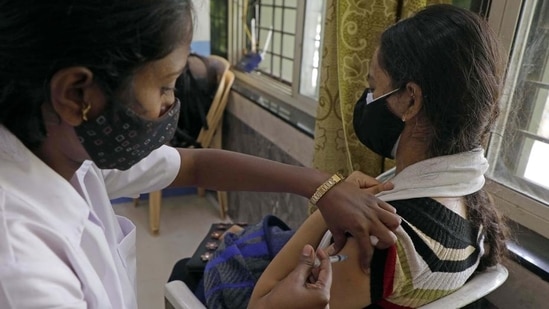
India administered its billionth dose of Covid-19 vaccines early on Thursday, the only country other than China (2.2 billion doses administered) to cross the milestone. India’s adult population (the only ones eligible for vaccines right now) is estimated at 940.2 million, and this milestone in absolute numbers is a milestone in coverage too. As of 5pm, around 76% of adults in the country had received at least one dose of the two-dose vaccine. And around 31% have been fully vaccinated.
Himachal has administered twice the number of doses per hundred adults as Jharkhand
There are significant variations with India. Himachal Pradesh has administered at least one dose to all adults while Jharkand has covered only 58.6% of its adults. In the share of fully vaccinated adults, Himachal Pradesh (57% adults fully vaccinated) is three times ahead of Uttar Pradesh, which has fully vaccinated the least (19%). But again, the populations of the two states are in entirely different ranges. Himachal has an adult population of 5.5 million, Uttar Pradesh, 147.4 million.
Inter-district disparity still high but lower than earlier
National and state-level projections for 2021 population are available from the National Commission on Population. There is no such projection at the district-level. HT has therefore used number of electors at the time of the 2019 Lok Sabha election as a proxy for adult population at the district-level. Diu has administered at least one dose of vaccine to 222% of its adult population as estimated by the number of electors and both doses to 145%. This could be because of people from other districts getting vaccinated in Diu apart from a change in population or low registration of adults as electors. In contrast, Senapati in Manipur, the worst-performing district has administered at least one dose to only 24.6% of its population and both doses to 11.9%.
Such individual comparisons can, however, be misleading because these districts are outliers. A better way to check inter-district disparity is by classifying districts into quartiles (bottom 25% to top 25%) for each day of vaccination. This shows that the top 25% districts have given twice the number of doses per hundred adults as the bottom 25% districts. This disparity is, however, much lower than earlier. At the end of January, the top 25% districts had given 5 times the number of doses per 100 adults as the bottom 25% districts. Even on May 1, when vaccination was opened up for all adults, this ratio was 3.8. the gap is clearly narrowing.
India’s 1.3 billion population poses a challenge....
Global vaccination data is available up to different dates for different countries. Taking the latest data for each country, India was second in the world in administering Covid-19 vaccines in absolute numbers. In terms of proportion of total population that has received at least one dose of the vaccine, India, with 52% coverage (overall population) ranks 101.
On top of the list are two British Overseas Territories of Gibraltar and Pitcairn Islands, with full coverage, but the population of the former is only about 34,000 that of the latter is less than 50 people. The United Arab Emirates, with 96% coverage, comes next but it also has a population of only 10 million. Among bigger countries or those with a population of 100 million or more, India is ranked 5th among 12 countries for which this data is available. Japan has covered the highest share of its population with at least one dose among these — 76%.