E-Paper



The rise and fall of the third front in Gujarat’s electoral arena
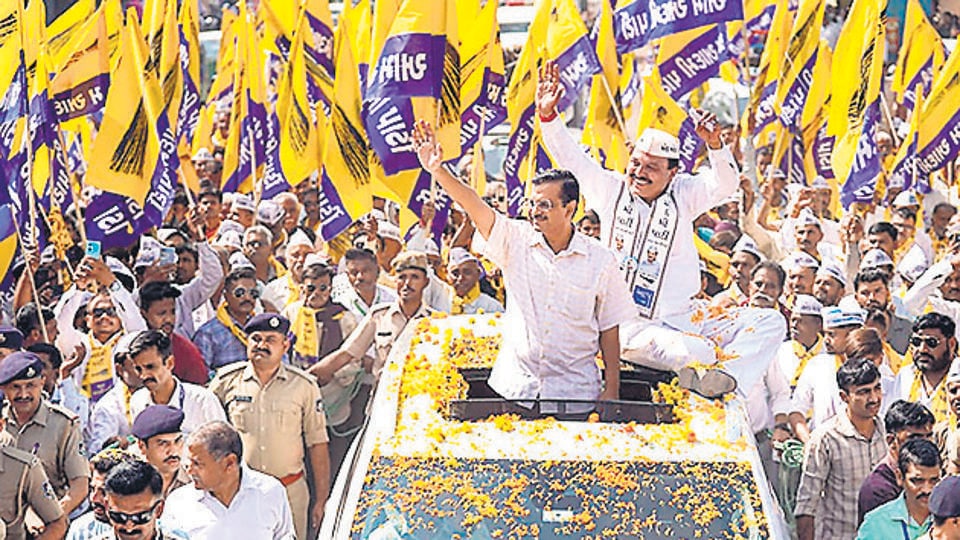
The AAP’s confidence arises from its performance in the Surat municipal corporation in January 2021 when the party won 27 seats, replacing Congress as the main opposition party in the civic body.

 Prefer HTon Google


In August, former Gujarat chief minister Shankersinh Vaghela announced, once again, that he was launching a new political front in Gujarat, the Praja Shakti Democratic Party, which would contest the Gujarat assembly elections.
Five years ago, Vaghela floated the Jan Vikalp Party which contested the assembly election in 2017. At the time, he claimed that it was a myth that a triangular contest was not possible in Gujarat, the home state of Prime Minister Narendra Modi. Jan Vikalp did not win a single seat. It’s vote share was less than 0.5%.
Click here for full coverage of Gujarat assembly election
This time he seems to have given up even before the first vote is cast.
“The contest is going to be between Bharatiya Janata Party and the Congress in Gujarat. Any political party such as the AAP (Aam Aadmi Party) cannot expect to come into Gujarat months ahead of the election and say ‘here is a new front’. It requires long term planning and lot of money. I don’t see any third front emerging in Gujarat politics anytime soon,” Vaghela said. In 1996, Vaghela, then with the BJP, split the party in Gujarat, and became chief minister with the support of the Congress, although he resigned after just around a year. The BJP, which won in 1995, also won the subsequent election in 1998. It hasn’t looked back since, and the contest has remained bipolar.
This is exactly what home minister Amit Shah, who is from Gujarat, has been saying in interviews. “In Gujarat, the contest has always between BJP and the Congress. In the past, from Chimanbhai Patel to Shankersinh Vaghela to Keshubhai Patel, people tried to make the contest triangular. All of them wound up their parties after the elections,” he told news channel Republic TV on Wednesday.
The AAP is trying to break this trend and has fielded candidates in all the 182 seats.
It’s primary target would appear to be the Congress.
“The Congress is not the same as it was in 2017. It is much weaker. A third front can emerge when one of the two main contestants are weak. This time, both are weak and hence, AAP is an option that the people are looking forward to,” said AAP’s chief ministerial candidate Isudan Gadhvi.
If that happens, the emergence of a third front could shake up the state’s politics.
In the past, parties attempting to present a third alternative have ended up merging with one of the two main parties.
Take the instance of the Gujarat Parivartan Party (GPP), which was floated by former chief minister Keshubhai Patel in 2012.
In January 2012, about 500,000 people from the powerful and influential Leva Patel community gathered at Khodaldham, on the outskirts of Rajkot, for a religious function. The event was seen as a launchpad for former Gujarat chief minister Keshubhai Patel, who soon floated a new party, the GPP, ahead of the assembly elections later that year.
A BJP strongman, Patel had scripted the BJP’s victory in Gujarat in 1995 and was the party’s first chief minister. Vaghela’s rebellion first cost him his chief ministership, and then the BJP its government. Sidelined by the BJP, he left it in 2012. But GPP managed to win only two seats in 2012 state elections. In 2014, it merged with the BJP, which won the elections with 115 seats and Patel announced his retirement from politics the same year .
Even Vaghela, who left the BJP in 1996 to float his own outfit, RJP, and merged it with the Congress ahead of the 1998 elections. He remained with the Congress till 2017.
States such as Uttar Pradesh, West Bengal and Bihar have seen contests between three or more parties with non-Congress, non-BJP alternatives also dominating the political narrative.
To be sure, the electoral contests of states such as Rajasthan, Madhya Pradesh and Chhattisgarh have remained bipolar – between the Congress and the BJP.
“The last triangular contest in its real sense would have been in 1990. It was between Janata Dal (JD), BJP and the Congress. The Congress vote share was 30.06%, JD was 29.6% and BJP was 26.7%. I don’t think there is a triangular contest this time around in Gujarat. The AAP, I am sure, will get some seats in the contest, it will not be zero,” said Jai Mrug, a political analyst and CEO of VotersMood Research and M76 Analytics.
That was the year former Congressman and Gujarat chief minister Chimanbhai Patel returned to power, first at the head of a Janata Dal and BJP coalition, and shortly after, the head of a Janata Dal-Congress one.
In terms of vote share, the 1990 elections also saw the arrival of BJP in Gujarat as one of the main political challengers. Five years later, the party roared to power.
Also Read| Number Theory: What a three-way contest entails for Gujarat polls
In the 1960s, during Congress’s rule, the Swatantra Party was the main opposition party in Gujarat. This merged with the Janata Party. In the early 1990s, the BJP replaced Janata Party and became the main opposition party.
The Mahagujarat Janata Parishad, which spearheaded the movement for a separate of Gujarat (not including Saurashtra), which was part of Bombay state in the first decades of the Indian republic, was the only socialist party that was successful in opening a new political front in Gujarat.
Indulal Yagnik, founder president of the Mahagujarat Janata Parishad, was elected to the Lok Sabha in 1957 from Ahmedabad constituency, which was then part of Bombay state.
“The decline of the Mahagujarat Janata Parishad and the Nutan Mahagujarat Janata Parishad in the ’60s saw the rise of the Swatantra Party and the Janata Party, which gave a new powerful narrative,” said Ghanshyam Shah, a political analyst based in Ahmedabad.
The Congress sitting MLA from Khambhalia, Vikram Madam, said he did not see a triangular contest in the coming elections, and that the fight is between BJP and Congress.
The AAP’s confidence arises from its performance in the Surat municipal corporation in January 2021 when the party won 27 seats, replacing Congress as the main opposition party in the civic body. BJP retained its winning position.
AAP received around 28% of the votes.