Forty-one workers emerged from the grim depths of a collapsed road tunnel in Uttarkashi on Tuesday evening, bringing the curtain down on a daring but painstaking operation that spanned 17 anxious days and multiple heartbreaks but eventually stood as a testament to the endurance of the human spirit, and the perseverance and skill of intrepid rescuers.
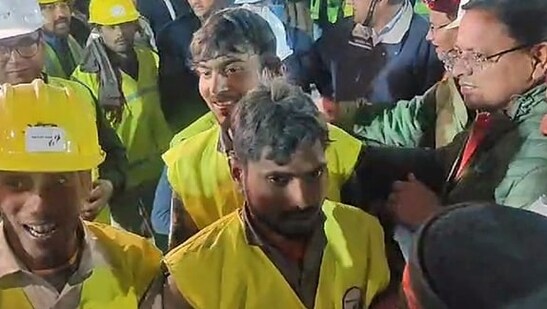
Twelve “rat-hole miners” burrowed through a wall of rock, mud and debris with hand-held tools in the final breakthrough on Tuesday, as the country heaved a collective sigh of relief. Hours later, disaster relief personnel pulled out the workers — exhausted and shaken but beaming, and in visibly good spirits — on wheeled stretchers through a 57-metre-long steel chute inserted into the cavernous tunnel between Silkyara and Barkot on a highway that is part of the Char Dham project.
Scenes of jubilation played out at the mouth of the tunnel that collapsed on November 12 as drained relatives of the trapped workers beamed, hugging their loved ones as they were wheeled out. The rescued men were welcomed as heroes with wild cheers and marigold garlands, as officials greeted them after 422 harrowing hours spent inside the tunnel.
“Finally, God heard us. My brother could be rescued. I am with him in an ambulance on the way to hospital,” said Sunil, a resident of Jharkhand, his voice choked with emotion.
{{/usCountry}}“Finally, God heard us. My brother could be rescued. I am with him in an ambulance on the way to hospital,” said Sunil, a resident of Jharkhand, his voice choked with emotion.
{{/usCountry}}The first worker was retrieved at 7.45pm, marking a success in the marathon first-of-its-kind operation where hopes of a rescue were repeatedly dashed due to the fresh collapse of debris and machine breakdown. But the relief personnel continued to make strenuous progress, refusing to be stymied by the cascading volley of challenges before them.
Union minister VK Singh and Uttarakhand chief minister Pushkar Singh Dhami welcomed the workers as National Disaster Response Force (NDRF) men brought them out.
President Droupadi Murmu led the country in hailing the successful operation, saying it was an emotional moment for everyone.”I congratulate the teams and all experts who have acted with incredible grit and determination to perform one of the most difficult rescue missions in history,” she said on X (formerly Twitter).
Prime Minister Narendra Modi saluted the spirit of those involved in the operation and said their courage and resolve have given a new life to them. “Everyone involved in the mission has created an amazing example of humanity and teamwork,” he said on X. He also spoke to the rescued workers over the phone and asked about their well-being.
Last week, engineers working to drive a metal pipe horizontally through 57 metres (187 feet) of rock and concrete ran into metal girders and construction vehicles buried in the rubble, snapping a giant earth-boring auger machine. Even as barrelling into the collapsed tunnel ran into fresh difficulties, rescuers established video contact through an endoscopic camera, and sent in chapatis, vegetables, khichdi, and fruits through a second six-inch pipe inserted into the debris.
The final breakthrough was made possible by a small group of rat-hole miners – sent in on November 27– who squeezed into a metal pipe and cut though the rock face by hand. Three men worked in tandem – one drilled, another scooped up the rubble by hand, and the third pushed the muck through a trolley to the other side of the pipe -- in eight-hour-long shifts through the night.
“I can’t express my happiness. I have done this for my fellow workers. The respect they (trapped workers) have given us, I can’t forget my whole life,” said Munna Qureshi, one of the rat miners.
The primitive strategy – often employed by illegal miners to extract coal through narrow, horizontal passages in India’s North-East – helped the operation overcome last-mile jitters after the augur machine – a corkscrew-like device with a rotary blade – got stuck in the rubble on November 24. Separate vertical drilling was started from the forested hill above the tunnel, its shaft reaching more than halfway through the 89 metres needed to reach the stranded men. Workers also had started digging, blasting and drilling through rocks from the far side of the road tunnel. Eventually, those efforts were not required.
“The nation salutes their grit in facing such a challenging situation in the tunnel for so long. My heartfelt gratitude to all the people and the agencies that have made tireless efforts to save the lives of our fellow citizens,” Union home minister Amit Shah said on X.
Mohsen Shahidi, DIG, NDRF said, “It was a challenge to rescue 41 trapped workers. The last intervention was a joint operation from NDRF and SDRF...so many agencies were involved in the rescue operation.The operation was successful because of the proper coordination among agencies.”
A group of 41 ambulances crowded the makeshift road laid to the mouth of the tunnel. Workers were rushed to Chinyalisaur. Health facilities were created at three places — a 10-bed facility at the tunnel site, a special 41-bed facility at Chinyalisaur nearly 30km away, and beds at the district hospital in Uttarkashi, officials familiar with the matter said.
“They will be thoroughly checked and kept under supervision of the doctors after which they will be discharged. They are all safe and healthy,” Dhami told reporters.
The crisis began on November 12 while the workers were attempting to complete the final 400m stretch of the 4.5km-long tunnel on the Yamunotri National Highway in Uttarkashi when it collapsed partially at 5.30am, trapping them inside. Frantic rescue operations began almost immediately as rescuers managed to establish contact with the workers via walkie-talkie sets and pumped in oxygen and food through pipes laid down to supply water for construction.
But the efforts hit its first major hurdle the next day after hulking excavator machines scooping out debris triggered a fresh collapse of rocks and mud inside the tunnel. Underpowered machines also scuttled the operation briefly, sparking angry protests by rescuers. Eventually, a second auger machine began to grind through the rock face from November 16.
The first breakthrough came at 3.45am on November 21, when the first grainy visual emerged of a man in a blue hard hat, peering into the six-inch pipeline. From one end, there was the booming voice of rescuers, looking on anxiously. “Are you okay?” the rescuer asked. The man in the blue hat responded with words of encouragement, and said, “I am okay.”
With this, rescuers were finally able to establish video communication with the 41 workers, confirming that they were all alive, had access to electricity with lights visibly on in the background, were drinking, eating and taking walks. And exactly a week later, the proverbial light at the end of the tunnel had brightened into a full-scale rescue mission, whose success reverberated in every corner of the country on Tuesday night.