E-Paper



‘Bunkers’ built to guard violence-hit villages in Manipur
The existence of bunkers that dot the Manipur landscape symbolise the anarchy that the state has descended into

 Prefer HTon Google


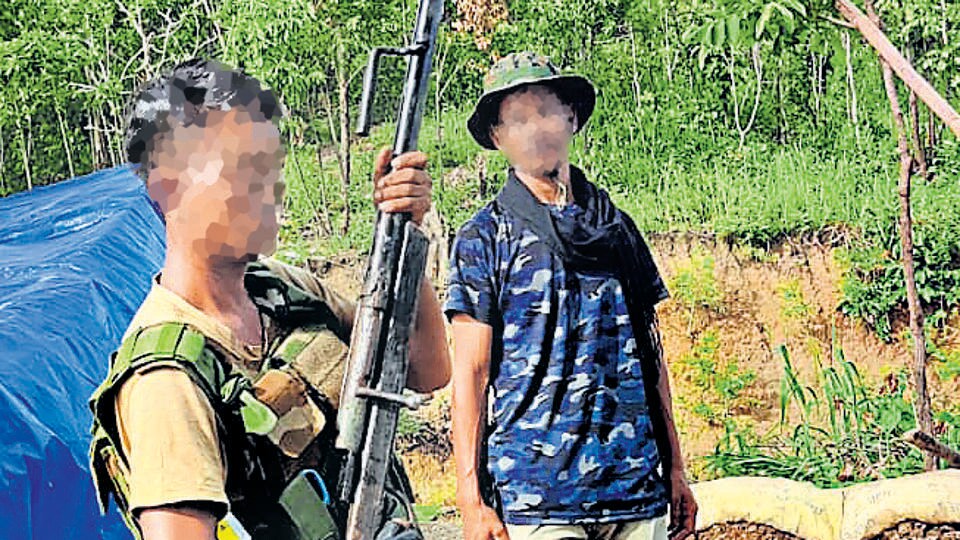
They call it Tiger camp. One and a half hours away from the town of Churachandpur, winding up a lush green hill, is a narrow gravel road. Travel up it, and a clearing emerges, dotted with makeshift structures to keep away the sun and the rain, made of plastic sheets, locally sourced bamboo and wood. Inside, between 50 and 60 Kuki men take turns looking out into the distance with powerful binoculars from their bunkers, rifles hung across their shoulders. Some rifles point out into the distance, as the men stare out into the undulating distance from where one can see villages of three different districts, Kangpokpi, Chandel and Kakching. In their field of vision, and also the primary focus of their surveillance are similar bunkers built by the Meiteis, that in turn, keep an eye on them. This is Manipur, in the middle of what is close to civil war; where citizens, that had normal workaday lives have turned “village defence volunteers”, guarding their villages with weapons in hand, unsure of people that they once called neighbours.
Read | Mob sets houses afire, forces open fire as Manipur remains on edge
Take for instance, 40-year-old Orlando in olive green military fatigues, who only wants to be identified by his first name, and is one of the men with a rifle in hand. Until five months ago, Orlando lived in Mumbai, a village success story. For more than two decades he built a career as a social worker, spending time in Delhi, even a year in Germany. Earlier this year, he returned home after he was separated from his wife. “I left Manipur when I was 17. But I decided to return to my village after we got separated because I wanted my 13-year-old son to get a chance to learn his mother tongue,” Orlando says.
But on May 3, a month and a half after his son started school, Churachandpur and all of Manipur began to burn in ethnic turmoil. Tensions had been building but a Manipur High Court order that asked the state government to consider including Meiteis, the numerically dominant community in the state with 53% of the population, in the Scheduled Tribes list, lit the fire. There were protests from the tribal community, particularly the Kukis. Violence broke out across the state that has continued since, leaving over 150 dead, 300 injured and over 50000 people displaced.
In the first wave of the violence that engulfed Manipur, Orlando began managing relief camps for Kukis that arrived in Churachandpur, fleeing the Meitei dominated Imphal valley. “I was sleeping at home on May 3 when I got a call and had to rush to help thousands of displaced people find shelter and safety. I became a social worker again,” said Orlando.
Also read | Shocked, not a single question on Manipur admitted since July 20: Chidambaram
Sometime over the past two months, Orlando volunteered to help defend their villages, even as his son was deposited with his aged parents.
Now, Orlando is one of the men atop Tiger Camp, tasked with keeping an eye out for any attacks on Kuki villages and to check the movement of “outsiders.” He is able to meet his son and parents once a week, during the night. His son has not adjusted well, sunk into depression, and now requires professional help. “The present situation is horrible. You don’t want this to happen to any human being. There are instances of countries going to war, but we were not given a choice. It’s tough for families and especially children, but I have no plans to going back to my previous life unless our demand of total separation from Manipur is achieved,” said Orlando, his watch post barely a hundred metres away from another, more professional post manned by Central Reserve Police Force (CRPF) personnel.
Next to Orlando, is 32-year-old Paokhosat, once an NGO worker, now “defence secretary” at Tiger Camp. “This strategic point, which we have named Tiger Camp, is close to several nearby districts where Meiteis reside. If they are able to cross this point, which we are guarding, they will be able to attack all nearby Kuki areas, even reach Churachandpur town. On this hill we have three bunkers which the defence personnel guard on a rotation basis,” said Paokhosat.
The camp itself has small makeshift shelters made of plastic sheets, bamboo and wood. In the middle is a temporary kitchen where meals are prepared by volunteer cooks, the rice and other essentials donated by villages close-by, and ferried to the camp in vehicles. Meals-- rice and vegetables-- are cooked twice a day; breakfast and dinner. On some days, if they are lucky, the supply vehicles bring chicken, pork or beef.
Some sleep huddled next to each other, but bathing is possible only when they go home, or if they walk to the closest Kuki village three kilometres away. There is one small battery used to charge mobile phones, but they try to avoid turning on the makeshift lights so as not to get noticed from afar.
The man in charge of the post is 59-year-old Lalkhojang, who has been designated “volunteer commander” and ensures a daily routine that begins at 4 am. At that time, those not on security duty leave their mattresses on the floor, and get ready for the day, replacing those that have spent the night awake. Those not manning the posts exercise, or clean their weapons, or do chores such as cleaning the camp. There is no internet thanks to a ban in place since May 3, so the rest of the day is spent sitting in groups and chatting, with old friends and new.
Most carry weapons, either single and double-barrel rifles, pistols and revolvers. The volunteers claim these are licensed, but there is no way to tell. Some guns are fashioned from locally sourced iron pipes. All volunteers have spent weeks training on how to handle weapons. “We are ready to continue for as long as this continues,” one volunteer says.
In many ways, the existence of bunkers such as Tiger Camp that dot the Manipur landscape, set up by both Kukis and Meiteis, symbolise the anarchy that the state has descended into -- a dangerous combination of ethnic hatred, government apathy, the presence of insurgent groups, and people that have turned to arms to protect themselves. On July 4, Manipur Chief Minister N Biren Singh said that the state government would destroy all “illegal bunkers” .
Those at the helm of these camps say they will not move, despite the threat of government action, or even the knowledge that they could be in danger. In early July for instance, three village defence force volunteers were killed and five others injured after they came under attack in Khujuma Tabi in Bishnupur district. Even at Tiger Camp, volunteers say they faced gunfire from alleged Meitei groups on one occasion, where one volunteer reportedly sustained a bullet injury to the leg. “But we will protect our bunkers and our camp,” another volunteer says.
It isn’t just adults like Orlando, Paokhosat or Laokhojang that are making these choices. Standing gun in hand, is a 16-year-old boy, a school student, who only two months ago dreamt of a professional football career, posters of Lionel Messi on his wall. A month ago, when his village of D Khangjol came under attack, he left and became a defence volunteer. Next to this 16-year-old is another boy of the same age, also a school student. “It is a tough life. I miss my family, friends and home-cooked meals. But we have to defend our land,” he says.
If the violence ends, he has a dream he wants to return to. “I want to join the Indian Army.”