
 E-Paper



TN governor again storms out of assembly, Stalin hits back
The Lok Bhavan listed 12 reasons for the governor walking out. Inside the assembly, chief minister M K Stalin said that his party, the DMK, would take efforts to amend the Constitution to eliminate the practice of the Governor delivering a speech at the beginning of the year

 Prefer HTon Google


For a third year in a row, Tamil Nadu Governor R N Ravi declined to read his customary speech prepared by the state government and walked out of the legislative assembly on the opening day of the first session in a re-run of what has become an annual showdown with the DMK-led state government -- and for the same reasons.
The Lok Bhavan listed 12 reasons for the governor walking out. Inside the assembly, chief minister M K Stalin said that his party, the DMK, would take efforts to amend the Constitution to eliminate the practice of the Governor delivering a speech at the beginning of the year. The House also adopted a resolution moved by Stalin to record the English version of the speech as read.
The DMK formed the government in May 2021, and Ravi became governor that September . Since then they have had multiple confrontations over various issues, the most significant being the legal battle in the Supreme Court over the latter not signing bills. Ravi has delivered the customary address only in 2022. In 2023, he omitted a few portions of his speech and added his own comments. But, in 2024, 2025 and now in 2026 he walked out of the House without reading the speech. Governors aren’t allowed to add their own comments to the customary speech prepared by the state government; nor do they fact check the speeches.
Ravi’s 12 reasons
Among the 12 reasons raised by the governor’s office was an old one -- the playing of the state anthem at the beginning of the session and the national anthem at the end. “The national anthem is yet again insulted...,” Lok Bhavan said in its statement. In Tamil Nadu, the state anthem “Tamil Thai Vazthu” is always played at the beginning of the session and the national anthem at the end. Ravi kicked up a fuss over this last year too.
The other reasons the Lok Bhavan listed include: the governor’s microphone being repeatedly switched off preventing him from speaking; numerous unsubstantiated claims and misleading statements in the speech; and the speech ignoring issues such as women’s safety , prevalence of narcotics and attacks against Dalits .
“Claims that the state attracted huge investments to the tune of over 12 lakh crores is far from the truth,” the Lok Bhavan statement said. Crucial directions of the Madras High Court on the restoration and preservation of ancient temples have not been implemented even after five years, the governor’s office added. “Several thousand temples in the state are without Board of Trustees and are directly administered by the state government. Millions and millions of devotees are deeply hurt and frustrated with the mismanagement of temples. Sentiments of devotees callously ignored.”
State vs Centre
After Ravi walked out, Speaker M Appavu read the 65-page speech in Tamil which urged the BJP-led Union government to release funds due to Tamil Nadu. “It is a matter of grave concern that the Union Government has been adopting an adverse attitude towards the state , leading to the continued denial of approvals and financial allocations for several essential projects,” the speech said.
It added that it was “disappointing” that even during natural disasters such as Cyclones Michaung and Fengal, the Union Government released only meagre amounts and was yet to fully releasethe funds under Samagra Shiksha Scheme. “Due to the non-release of Rs.3,548 crore, the state government has borne the entire expenditure of these schemes,” the speech read.
It urged the Union government to withdraw the VB-G-RAM-G scheme that replaces MGNRES and reiterated that the state will not accept a three-language formula and will oppose the imposition of Hindi.
DMK to seek scrapping of Governor’s speech
Stalin said that the governor’s action was insulting to the people of Tamil Nadu. “It is not good that the government prepares and sends a speech every year and the Governor disagrees with it without reading it properly,” the chief minister said. “Governors acting as an obstacle to state governments is happening not only here but also in various states…It is the practice for the Governor to read the government’s policy statement properly at the beginning of the year. When someone continues to violate that practice, the question of why such rules should be kept naturally arises in everyone’s mind. Therefore, I also announce in this assembly that the Dravida Munnetra Kazhagam will take up efforts to amend the Constitution to eliminate the practice of the Governor’s speech at the beginning of the year with the support of like-minded political parties across India.”
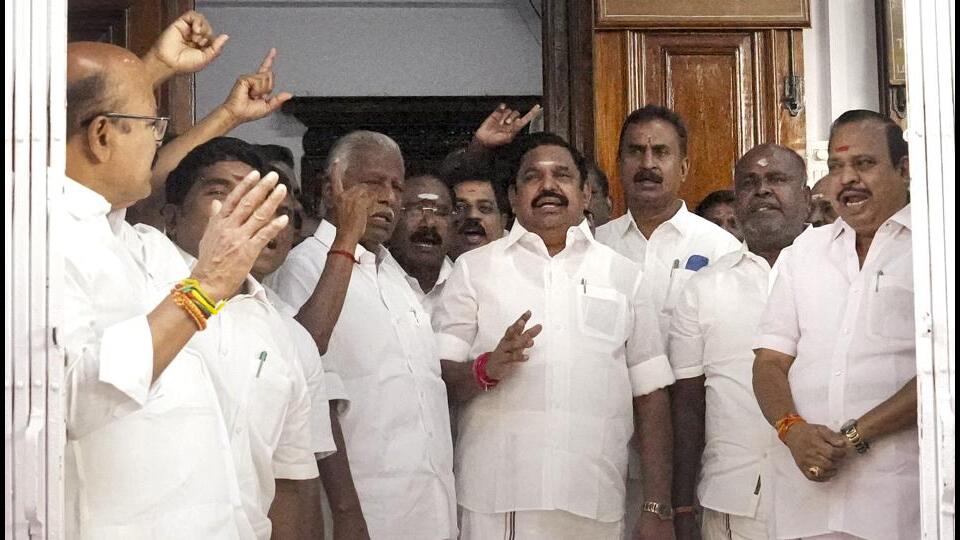
The Opposition in the state, however, backed the governor. “All the issues listed by the governor are true. The governor is only saying he will not read wrong statements,” AIADMK general secretary Edappadi Palaniswami said. BJP spokesperson, ANS Prasad, said the governor was within his right to skip parts of the speech written by the DMK government. “That he refused to deliver the DMK drafted speech is his constitutional integrity and not political theatre...Deceiving the assembly on vital issues undermines constitutional transparency,” he said.


