
 E-Paper



Top court holds colleges answerable for suicides
The bench directed that Sample Registration System data on suicides be maintained by all HEIs for the 15-29 age group


The Supreme Court on Thursday held higher educational institutions (HEIs) accountable for students’ mental well-being, making it mandatory to report every suicide or unnatural death and provide round-the-clock medical help on residential campuses, based on recommendations from an expert panel headed by a former top court judge.

A bench of justices JB Pardiwala and R Mahadevan adopted findings from the National Task Force (NTF), constituted by the court in March 2025 under retired justice Ravindra S Bhat’s chairmanship. The panel identified systemic changes to curb student suicides based on a survey of HEIs across the country. The NTF was formed after the court took suo motu cognisance of rising campus suicides and the lack of effective redressal mechanisms.
While separate UGC guidelines exist on ragging, drug abuse, sexual harassment, accessibility, suicide prevention and mental health, the court noted they remain largely on paper—”prescriptive”, with no implementation mechanism.
The bench directed: “All HEIs must report any incident of suicide or unnatural death of a student, regardless of the location of its occurrence… to the police authorities no sooner they come to know about the incident.”
Using its Article 142 powers, which allow the court to pass any order in the interest of complete justice, the bench directed that Sample Registration System data on suicides be maintained by all HEIs for the 15-29 age group. It also ordered the National Crime Records Bureau (NCRB) to distinguish between school student suicides and those in higher education.
The NTF’s interim report found that in the 15-29 age group, suicide is the highest cause of death among women and second highest in men. Though only 3.5% of 60,383 HEIs responded to the survey, the bench said: “The youth of this country are increasingly becoming vulnerable to suicides than the overall population.”
The court directed: “Every residential HEI must have access to qualified medical help round the clock, if not on campus, then within a one-km radius to provide emergency medical health support to students.” The NTF found that over 70% of HEIs had no medical service provider and less than 20% had external linkage for such support.
Among disadvantaged students admitted on scholarships, the NTF found many institutions refused exam access or class attendance because of delayed scholarship disbursements by states or the Centre.
The court held: “No student should be prevented from appearing in an examination, removed from hostels, barred from attending classes, or have their marksheets and degrees withheld because of delays in disbursal of scholarships. Any such institutional policy, may be viewed strictly.”
“Affirmative action cannot stop at merely ensuring their entry into higher education. It must also reflect in the creation of adequate support systems which ameliorate instead of exacerbate existing inequities,” the bench said.
Even on Equal Opportunity Centres (EOC) and Internal Complaints Committees (ICC) for sexual harassment, the court found first-hand accounts from students and faculty “deeply disheartening”. “Though these bodies may find existence in several institutions, they lack independence and often work to favour the perpetrators or aggressors rather than the students.”
Students also cited extremely rigid attendance policies and faculty shortages as mental stress factors, with medical students noting on-call hours stretching 36-48 hours as additional causes.
The court directed all HEIs to fill vacant faculty positions (teaching and non-teaching) within four months, prioritising reserved posts.
The court directed the Centre and states to communicate its order to all HEIs for earliest and appropriate action.
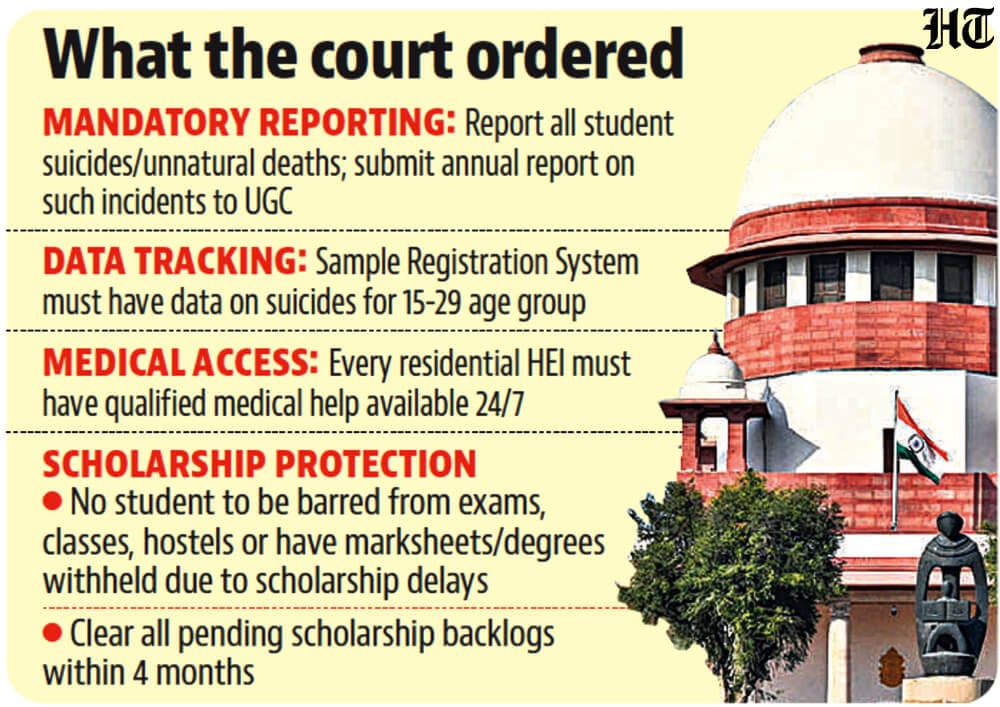
WHAT THE COURT ORDERED
MANDATORY REPORTING
- Report all student suicides/unnatural deaths, regardless of location (campus, hostels, PG accommodations, or outside)
- Submit annual report on such incidents to UGC and regulatory bodies
DATA TRACKING
- Sample Registration System must have data on suicides for 15-29 age group
- NCRB to distinguish between school and higher education student suicides
MEDICAL ACCESS
- Every residential HEI must have qualified medical help available 24/7—on campus or within 1km radius
SCHOLARSHIP PROTECTION
- No student to be barred from exams, classes, hostels or have marksheets/degrees withheld due to scholarship delays
- Clear all pending scholarship backlogs within 4 months
- If not disbursed, sponsors must send notice with reasons to HEI and student within 2 months


