E-Paper



Trade, tech and security in focus at Jaishankar’s meetings with UK leaders
Jaishankar held talks on Tuesday with his UK counterpart David Lammy on taking forward the bilateral comprehensive strategic partnership

 Prefer HTon Google


NEW DELHI: Trade, investment, technology cooperation and joint efforts to tackle trafficking and extremism were in focus during external affairs minister S Jaishankar’s meetings with the top UK leadership, including Prime Minister Keir Starmer.
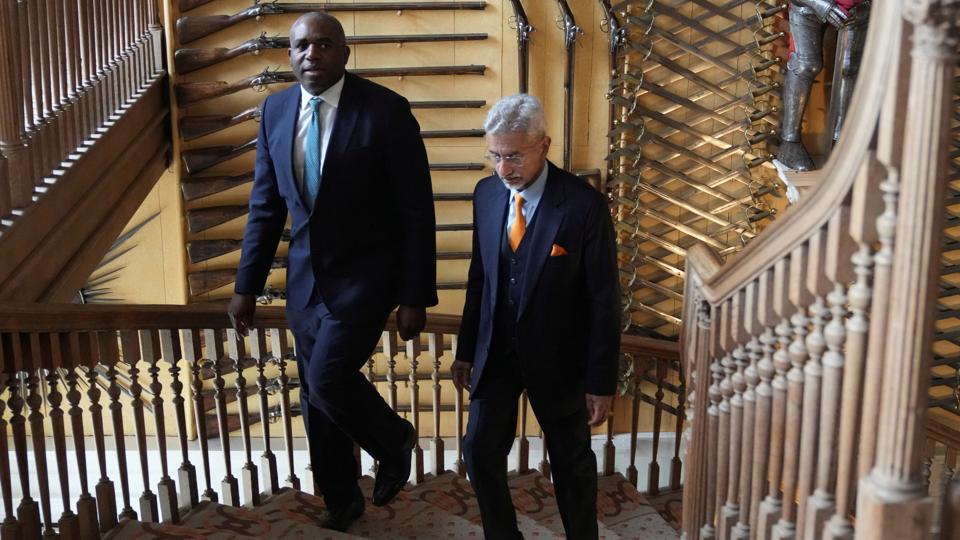
Jaishankar, on a nearly week-long visit to Britain and Ireland, held talks with his UK counterpart David Lammy on Tuesday and Wednesday to take forward the bilateral comprehensive strategic partnership and bolster economic growth, technological innovation and collaboration on global challenges such as climate change.
After the talks held at the historic Chevening House in Kent, Jaishankar said on X that he had “wide-ranging and productive” discussions with Lammy, with the focus on “strategic coordination, political cooperation, trade deal negotiation, education, technology, mobility and people-to-people exchanges”. The two foreign ministers agreed to formulate the next steps to strengthen cooperation in these areas.
“We exchanged views on regional and global issues including the Ukraine conflict, West Asia, Bangladesh and the Commonwealth. In an uncertain and volatile world, India-UK ties contribute to stability and prosperity,” Jaishankar said.
A readout from the British side said the two leaders discussed “Russia’s ongoing war in Ukraine, the Middle East and other global affairs”. Lammy emphasised Britain’s desire to deepen the partnership with India as part of the Labour government’s “Plan for Change” and noted that one of his first visits as foreign secretary was to New Delhi.
Lammy said he and Jaishankar are “supercharging our £41 billion trading relationship with India, after trade talks were relaunched in Delhi”. He was referring to the resumption of talks last month on an India-UK free trade agreement (FTA) after a gap of almost a year.
Britain’s trade minister Jonathan Reynolds travelled to New Delhi to meet his counterpart Piyush Goyal and resume the FTA negotiations.
Lammy said the opening of new Indian consulates in Belfast and Manchester during Jaishankar’s visit reflect the “growing links between our peoples”, and the expansion of India’s diplomatic presence will boost trade relations and support the Indian community in the UK.
The foreign ministers also discussed the India-UK Technology Security Initiative (TSI), which was launched last July. These discussions focused on opportunities for citizens in both countries from closer collaboration in sectors such as artificial intelligence, telecoms and critical minerals.
The TSI is spearheaded by the national security advisors of India and the UK to expand collaboration in critical and emerging technologies.
Before the talks with Lammy, Jaishankar met Prime Minister Starmer at 10 Downing Street on Tuesday and discussed taking forward bilateral and economic cooperation and enhancing people-to-people exchanges. Starmer shared the UK’s perspective on the Ukraine conflict, Jaishankar said on X.
Jaishankar also met home secretary Yvette Cooper and discussed the “flow of talent, people-to-people exchanges, and joint efforts in tackling trafficking and extremism”, he said on X. At a separate meeting with trade minister Reynolds, Jaishankar discussed the progress in the FTA talks.
Among Jaishankar’s key engagements in the UK will be the formal opening of the new consulates in Manchester and Belfast, the capital of Northern Ireland. India and Ireland are expected to announce the formation of joint economic commission when Jaishankar travels to Dublin for the first visit by a senior Indian leader since 2015.
Reynolds’ visit to India last month coincided with Indian investments worth more than £100 million in the UK. These investments cover sectors such AI, professional services and textiles and are expected to create hundreds of jobs over the next three years.
The year-on-year inward FDI stock from India increased 28% at the end of 2023, and India has remained the second largest investor in the UK in terms of the number of projects for five consecutive years. UK insurance firms are eyeing an expansion in India following the recent budget that increased the amount of FDI in the insurance sector from 74% to 100%.
The UK also highlighted the “living bridge” between the two countries by hosting a reception with Indian scholars at Chevening House that celebrated India’s position as home to the world’s largest Chevening scholarship programme.
“Great to meet Chevening Scholars from India along with FS @DavidLammy...A vivid expression of our talent and people-to-people exchanges, they surely are great advocates of India-UK ties,” Jaishankar said on X.
Chevening is the UK government’s flagship international scholarship and fellowship programme, and it offers fully funded scholarships for a one-year postgraduate course in the UK and short-term fellowships to mid-career professionals. The Chevening programme in India is the largest in the world, benefiting more than 3,900 scholars and fellows since 1983.