After Pakistan's military on Friday night launched an attack on 26 locations across India, Turkish Kamikaze drones were among those recovered from Jammu Naushera and other bordering areas. Kamikaze drones were also found in Punjab's Amritsar.
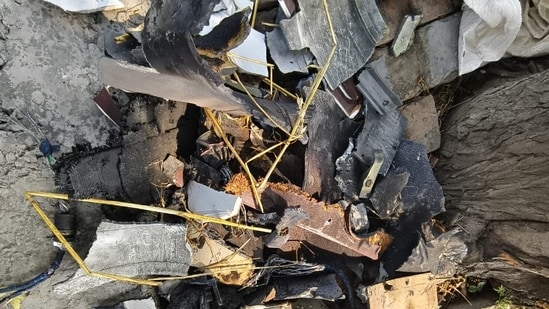
Before agreeing to a ceasefire on Saturday, Pakistan had launched an attack targeting various military installations and civilian areas, which was thwarted by India's air defence system. Fragments of debris from the Byker YIHA III Kamikaze drones were recovered after they were destroyed while in the air.
Also Read: Army Jawan from Andhra Pradesh killed in action along LoC in Jammu and Kashmir
Fragments were also recovered from Barmer in Rajasthan. In Punjab's Firozpur, a Pakistani drone struck a residential area and injured a family of three, with one of them critically wounded.
The Indian Army stated that they are maintaining a high state of alert, adding that all such aerial threats are being tracked and engaged using counter-drone systems.
What are Kamikaze drones?
{{/usCountry}}The Indian Army stated that they are maintaining a high state of alert, adding that all such aerial threats are being tracked and engaged using counter-drone systems.
What are Kamikaze drones?
{{/usCountry}}Kamikaze drones, also known as loitering munitions, operate by hovering over a target and then crashing into them once they are identified - turning themselves into explosive missiles.
The weapon was first developed in the 1980s, and deployed in the 1990s by various countries. Since then, they have evolved to carry out long-range strikes and have become more tactically sound.
Also Read: 'Keep in mind, Pahalgam attack is original escalation': India's message to Pakistan
Unlike normal surveillance drones, these are single-use attack weapons which are remotely operated.
The name “Kamikaze” hails back to the World War 2 period, where the term was used to describe Japanese suicide bombers. Hence, they are also known as ‘suicide drones.’
How do Kamikaze drones work?
Kamikaze drones combine the function of an airborne carrier and an explosive missile at the same time. They also allow one to precisely identify targets and strike accurately.
The loitering munitions are usually launched from the ground, after which they can fly autonomously or be steered manually as well. The drones use electro-optical systems to locate their targets and carry small warheads used to destroy radars, vehicles and more.
These drones have been used in several global conflicts including in the Russia-Ukraine war. Some countries have developed their own variants of this technology, such as the Switchblade in the United States, Shahed in Iran and Harop in Israel.
Kamikaze drones are particularly durable and can remain airborne for a long time while identifying their target. They can also cover more ground while travelling from one location to the next. The American Switchblade loitering munition can even fit into a backpack.
They can also be deployed in swarm formations, capitalising on their stealth and agile flight.