E-Paper



Decomposing and covered with plastic sheets, unclaimed bodies await justice
At least 147 people have been killed in ethnic clashes in Manipur, India over the past three months, leaving many bodies unclaimed and decomposing.

 Prefer HTon Google


CHURACHANDPUR/IMPHAL: The stench is everywhere. It lingers in the air outside the main gate of Churachandpur Medical College. It grows stronger near the gate of the close-to-empty administrative building. Walk inside the front door, and it’s difficult to breathe. In rows inside the “demonstration room”, there are 20 coffins. Seventeen of them are full of bodies, wrapped in traditional Manipuri shawls — unclaimed from the violence that has claimed at least 147 lives in the state.
The room only has air-conditioners, desperately ineffective against decomposition in the humid summer. The hospital ran out of space in the morgue on May 3; the day Manipur spiraled into a cycle that has now lasted close to three months, creating fault lines and fear so deep that for some families even the collection of bodies of the people they loved is a bridge too far.
From May 3, Manipur has been in the throes of ethnic clashes, triggered by an order by the Manipur high court that recommended to the government that Meiteis, the dominant community in Manipur with 53% of the population, be included in the Scheduled Tribe list. This caused protests among the tribal population, particularly Kukis, and tensions led to clashes that have not subsided since. The first burst of violence, between May 3 and 6, where there was a wave of attacks and arson, with the army and paramilitary called in, made clear the new fault lines in the state. If Kukis fled the Meitei-dominated Imphal valley, Meiteis abandoned their homes in tribal districts such as Churachandpur. Since then, for men and women that got caught in the violence, even the act of collecting bodies has been fraught with danger.
A senior administrative official of the Churachandpur Medical College said that the morgue has six deep freezers full of bodies of those killed in the clashes. “But there were more bodies that kept coming. So we have had no option but to keep them in a room in the institute,” the official said.
At the Churachandpur district hospital, located in the plot of land next to the college, 12 more bodies lie in the morgue, unclaimed since early May. An official at the district hospital, requesting anonymity, whispers a truth that is well known: “Most of these 35 bodies that still lie unclaimed in this region are Meiteis,” the official said.
Then, 60km and a fault-line away, there are 27 bodies that lie without claimants at the Jawaharlal Nehru Institute of Medical Sciences (JNIMS) in Imphal East. Some have been here for over 80 days. “At one point, we had 59 bodies of victims of the ethnic clashes. While others have been collected by family members, 27 still remain unclaimed — some of them are yet to be identified. Our institute has two deep freezers where 12 bodies can be kept. The rest have been kept wrapped in plastic bags because we don’t have space to keep them. Unless the district administration gives permission, we can’t transfer the bodies elsewhere,” said L Deben Singh, director of JNIMS.
A few kilometres away, the mortuary of the Regional Institute of Medical Sciences Imphal (RIMS) has space for six bodies in the deep freezer, but has to contend with 25. In Meitei-dominated Imphal, these 52 bodies, are all largely Kuki, and most died in the first wave of violence.
“Some of the bodies were brought to us in very bad condition and had already started decomposing. We conducted post-mortems on them and have kept them at the mortuary. The local police have been given details of the bodies, but we have no way of identifying several of them,” said a senior officer of the forensic sciences department of RIMS.
Across Manipur then, there are at the very least, 87 families that have had to deal with not just loss, but the absence of closure. In Kangpokpi district for instance, the families of two Kuki women, aged 21 and 24, who were allegedly raped and murdered by a Meitei mob in Imphal on May 4, have had little word on their bodies, except that they are lying at JNIMS. The two victims were employed at a car wash centre in Imphal, and lived together at a rented accommodation.
On May 4, a mob allegedly dragged the two women out of the room, and allegedly raped and murdered them. “Since then, I know that my daughter’s body has been lying at JNIMS. But police have told us there is now way we can get her body right now. Besides justice for the crimes committed to them, we want the bodies of the two girls back so they can be buried with dignity,” said the father of one of the two girls. An FIR was filed in the case on May 16, but no police action has been taken thus far.
Priyobrata, a resident of Sekmaijin Khunou in Imphal, whose brother Irengbam Chingkheingganba, 24, was allegedly abducted and shot dead in Churachandpur said, “We have heard that the state government can’t do anything about retrieving bodies at the moment. My brother wasn’t associated with a radical outfit nor was he part of a defence volunteer group. Our family wants the body back.”
Multiple officials HT spoke to in both Imphal and Churachandpur said that any “retrieval” of dead bodies was difficult, because any movement from one district to another is still fraught with danger, from road blockades to weapon-toting defence volunteers, and Meitei and Kuki entry points.
Perhaps the most striking example for travel across districts being difficult was on June 4, when a seven-year-old boy, his 45-year-old mother and her acquaintance were on their way from Kangchupchingkhong in Kangpokpi to Imphal in an ambulance when a mob attacked them at Iroisemba in Imphal West district and they were burned alive. The boy had sustained a stray bullet injury and was being transferred for better treatment in the state capital. The ambulance was initially provided security cover by a team of Assam Rifles and then the Imphal West police but even that wasn’t enough to prevent the attack.
K Shivakanta Singh, superintendent of police Imphal East however said that despite the difficulties, a process has been initiated to transfer the bodies to the families of the victims. “We are trying to verify details of unidentified and unclaimed dead bodies with the help of police from other districts. Once all formalities are completed, hopefully they can be sent to the families,” he said.
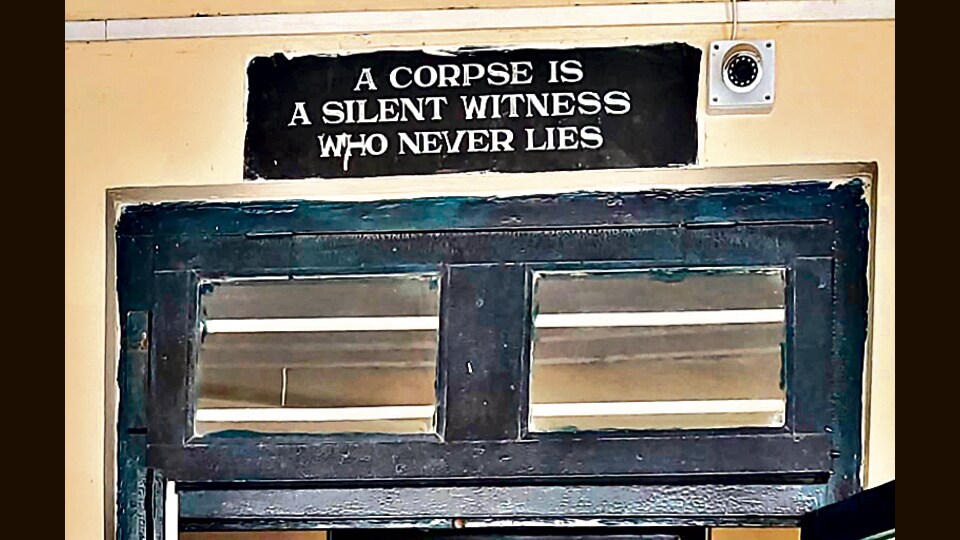
Meanwhile, families wait. In Churachandpur, along a “wall of remembrance” about 100 empty coffins lie in a row as a mark of respect. 60km away in Imphal’s Regional Institute of Medical Sciences, coffins are stacked inside a room. It has a board outside the main door: “A corpse is a silent witness who never lies.”