US President Donald Trump has decided to resume a military training programme for Pakistan that was cut off in 2018 while retaining a suspension in security-related aid, the top American diplomat for South Asia has announced.
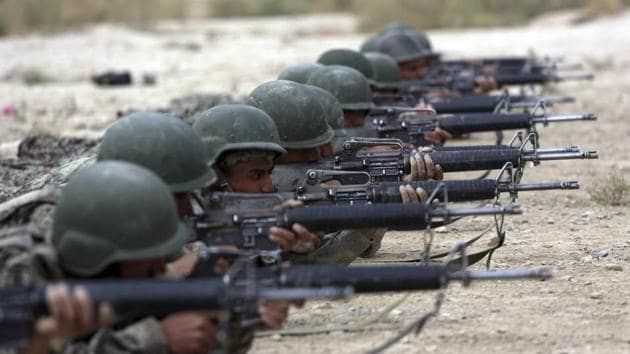
The resumption of the International Military Education and Training (IMET) for Pakistan was announced through a tweet by principal deputy assistant secretary for South and Central Asian affairs Alice Wells early on Saturday morning, about seven hours after secretary of state Mike Pompeo called Pakistan Army chief Gen Qamar Bajwa to discuss the fallout of the killing of Iranian general Qasem Soleimani.
Wells said in the tweet that Trump authorised the resumption of the IMET programme for Pakistan to “strengthen mil2mil (military-to-military) cooperation on shared priorities & advance US national security”.
She added that the “overall security assistance suspension for Pakistan remains in effect”.
{{/usCountry}}She added that the “overall security assistance suspension for Pakistan remains in effect”.
{{/usCountry}}The IMET programme for Pakistan, seen by US officials as a key trust-building measure, was cut off in August 2018, months after Trump famously announced the suspension of some $2 billion in security aid in a New Year’s day tweet.
In that tweet, Trump had accused Pakistan of giving the US “nothing but lies & deceit” in return for “more than 33 billion dollars in aid over the last 15 years”. He had also given safe haven to the terrorists the US was hunting in Afghanistan, Trump had tweeted.
Pompeo, who spent Friday reaching out to his counterparts in the UK, Germany, France and Russia and the Afghan and Iraqi presidents, opted to contact Pakistan’s military leadership, and not the civilian administration headed by Imran Khan, to discuss the fallout of the killing of Soleimani, the commander of the al-Quds Force foreign operations wing of Iran’s Islamic Revolutionary Guard Corps (IRGC).
The US secretary of state tweeted he had spoken to the Pakistan Army chief “about U.S. defensive action to kill Qassem Soleimani”. He added: “The #Iran regime’s actions in the region are destabilizing and our resolve in protecting American interests, personnel, facilities, and partners will not waver.”
Bajwa, according to the Pakistani military’s media arm, emphasised to Pompeo the “need for maximum restraint and constructive engagement by all concerned to de-escalate the situation in broader interest of peace and stability”. Bajwa also “reiterated the need for maintaining focus on success of (the) Afghan Peace Process”.
The resumption of the IMET programme also sparked speculation that the US envisaged a role for Pakistan in dealing with the tensions caused by Soleimani’s killing. Pakistan has good ties with both Iran and Saudi Arabia, the two key players in West Asia, though Prime Minister Imran Khan’s recent efforts to broker peace talks between the two rivals did not result in any success.
However, Pompeo’s outreach to the military leadership was criticised by Pakistani politicians, with Pakistan People’s Party leader Farhatullah Babar describing the move as a “national embarrassment” and a “travesty”.
Babar tweeted: “Secretary Pompeo is wrong in directly calling Gen Bajwa. He should have called corresponding Pak civilian leadership to explain US position. By calling army chief directly & bypassing civilian leadership Pompeo is undermining democratic and civilian governance in Pakistan.”
Pompeo’s move comes at a sensitive juncture in Pakistan’s civil-military relations as the Parliament is discussing amendments to crucial laws to validate a three-year extension in service given by Prime Minister Khan to Bajwa.
Pakistan’s Supreme Court initially blocked the three-year extension, though it subsequently granted an extension of only six months to Bajwa and asked Parliament to make a law regarding the matter. Bajwa was set to retire at the end of November last year.