E-Paper



Vessel journeys via Bangladesh, paves way for barging operations to Guwahati
It carried a consignment during the peak of the dry season when the river’s water level is at its shallowest


GUWAHATI: On March 15, MV Ram Prasad Bismil docked at Guwahati’s Pandu river port carrying 1783 MT of steel rods from West Bengal’s Haldia, nearly 1500-km away, after sailing for 27 days. The 90-metre vessel completed a pilot run and became the longest ever to sail on the Brahmaputra, the world’s ninth-largest river by discharge and the 15th longest.
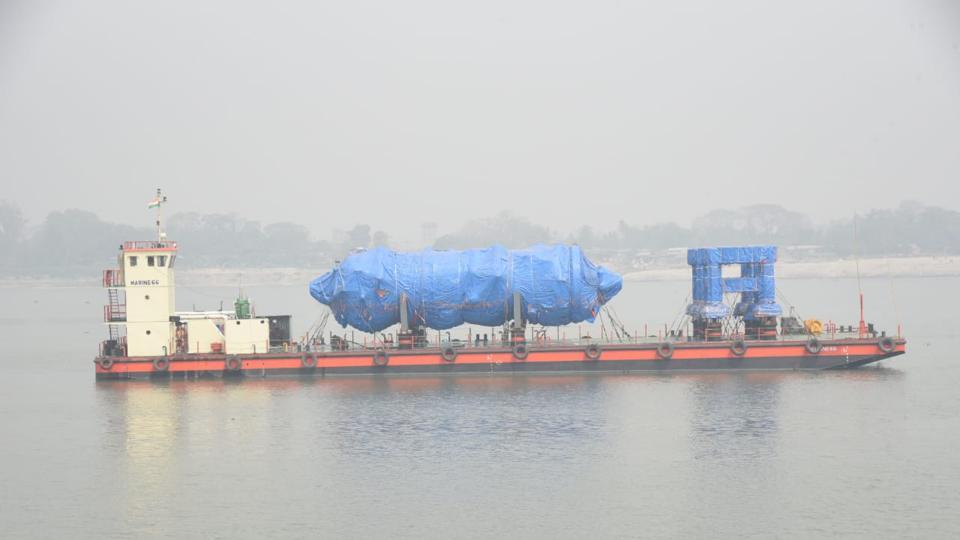
The vessel carried the consignment during the peak of the dry season when the river’s water level is at its shallowest. It journeyed via Bangladesh and paved the way for the commencement of barging operations from Kolkata to Guwahati via the India-Bangladesh Protocol Route (IBRP). IBRP allows inland Indian vessels to transit through specified routes in Bangladesh and vice versa.
“With the successful completion of the pilot run of this longest vessel plying on the Brahmaputra, we must recognise that this was made possible by the team to chalk out a working route during this season of challenging depth at many stretches,” said Union minister Sarbananda Sonowal.
MV Ram Prasad Bismil carried a heavy load. It needed a minimum two-metre water depth throughout the journey. To enable this, India and Bangladesh funded dredging on the IBPR’s Sirajganj-Daikhowa stretch. Officials of the two countries coordinated to ensure this historic cargo movement was smooth.
Inland Waterways Authority of India director A Selva Kumar said normal cargo vessels on rivers are usually 60-70-metre long. “...at 90 metres, MV Ram Prasad Bismil is the longest ever vessel to ply on the Brahmaputra. The journey was carried out in the leanest season when the water level on the Brahmaputra is lowest while carrying nearly 1,800 MT of cargo. It was very difficult. But we did it successfully.”
Another vessel, MV Lal Bahadur Shastri, arrived at Pandu earlier this month carrying 200 MT food grains from Patna. It marked the successful completion of the movement of cargo between the Ganga on the National Waterway 1 and Brahmaputra on the National Waterway 2.
Brahmaputra and Barak rivers in Assam have historically been used for ferrying people and cargo. During British rule, the rivers were used extensively for trade and travel between the northeast and Kolkata. With the growth of the tea industry in Assam, the rivers enabled the shipment of tea and other goods to Kolkata and other parts of the world.
The British East India Company used the Brahmaputra to connect Kolkata to Dibrugarh in Assam in 1844. Steamships were introduced in 1847. Around the same time, Assam’s Silchar was linked with Kolkata via the Barak-Surma-Meghna navigation channel. This low-cost and high-volume mode of transport came to a near standstill after 1947 due to the creation of East Pakistan (now Bangladesh).
With the signing of the inland water transit and trade protocol between India and Bangladesh and the agreement on the IBPR, river transportation is expected to be revived. “For the people of Assam, Brahmaputra is the lifeline. This was understood by Prime Minister Narendra Modi, which is why he envisioned the growth of this ecologically sensitive region via a medium that is widespread, economic, and environment friendly,” said Sonowal.
He said as per Modi’s vision, they are working to rejuvenate water transport in the region. “This is not only the cheapest and eco-friendly mode of transportation but also allows the long-awaited connect for businesses of the northeast through the marine network with the rest of the world.”
According to the development of the northeast region ministry, the region could generate cargo movements of 50-100 million metric tons over 20 years and inland water transport could play an important role. Coal from Meghalaya, limestone for cement plants, petroleum products from Assam’s Numaligarh refinery, etc could be part of cargo movement via the region’s rivers.
Kumar said waterways are the only option to carry very heavy and large materials needed for the expansion of the Numaligarh refinery. “There is demand for coal and textiles and yarn, which will be exported to Bangladesh. Many more such movement of cargo will take place in future.”
Kumar said transportation of goods by rivers costs around half of what it does via roads and around one-third by railways. “It takes more time, but that is also going to get reduced with better management of routes. There is also less pilferage of goods if they are sent by waterways.”