Reappointment of Nirmala Sitharaman as Union Finance Minister is another example of Prime Minister Narendra Modi’s farsightedness.
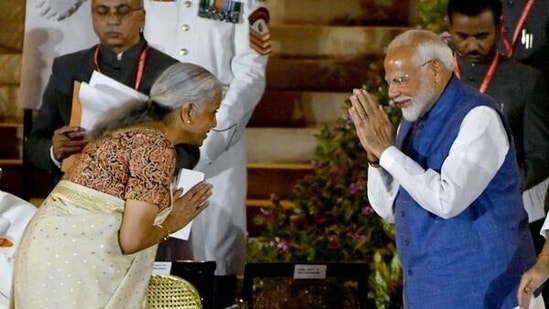
Continuity in the Big Four – Defence, Home, Finance and External Affairs – is reassuring for all those (both within and outside India) who believe in the making of a ‘Viksit Bharat’ by 2047 on a strong foundation of the Indian economy.
Economy is safe in her hands. She did it when the world economy crumbled due to Covid 19 pandemic in early 2020, bringing the worst devastation to even some of the developed countries.
Sitharaman rose on the occasion, provided a protective shield to over 800 million poor and hope to the industry despite over two months of hard lockdown. Her calibrated approach helped in saving both lives and livelihoods of millions in a better manner as compared to many developed nations. As a result, India’s economic recovery was faster, stronger and equitable.
India’s macroeconomic fundamentals are strong, rather stronger than what it was in 2014. But it is not due to any magic. It happened because of PM Modi’s trust in a lady who could translate his vision into reality.
There are some remarkable qualities of Sitharaman that make her class apart – honest, hardworking, humane, god-fearing, trustworthy, and straightforward to the extent of being blunt. These are certainly not the characteristics of a “typical” politician, but the most valued strength of a ‘right-hand man’ or a minister of a charismatic leader whose mission is to transform India into ‘Viksit Bharat’.
{{/usCountry}}There are some remarkable qualities of Sitharaman that make her class apart – honest, hardworking, humane, god-fearing, trustworthy, and straightforward to the extent of being blunt. These are certainly not the characteristics of a “typical” politician, but the most valued strength of a ‘right-hand man’ or a minister of a charismatic leader whose mission is to transform India into ‘Viksit Bharat’.
{{/usCountry}}Sitharaman was a star performer of the Modi 2.0 Cabinet. She not only navigated the Indian economy from the worst-of-the-century kind of global crisis in 2020-21 but also transformed it into the world’s fifth largest economies surpassing the United Kingdom.
It was her relentless efforts that transformed the banking channels from financial institutions into effective delivery mechanisms of welfare programmes. Today, the Indian banking sector is one of the strongest economic institutions. Between 2014 and 2023, banks recovered more than ₹10 lakh crores from bad loans.
Sitharaman put a full-stop on the exploitation of the banking sector by the previous Manmohan Singh-led Congress regime that resorted to “phone-banking” and benefited “cronies” through imprudent lending and keeping actual non-performing assets (NPAs) under wraps. The Modi government took out public sector banks from the twin balance sheet problem to be the realm of the twin balance sheet advantage.
Sitharaman’s relentless approach and constant monitoring of the economy since 2019 bore fruits. Under the leadership of PM Modi, she could transform the Indian economy from the “fragile five” to the fifth largest in the world. Not only was she able to successfully navigate the Indian economy from the devastating impact of Covid that hit the country in March 2020, she also put it on a high growth trajectory.
On May 31, it was officially projected that India’s GDP grew at 8.2% in 2023-24, higher than what was estimated by both government and private forecasters. The RBI on June 8 revised the GDP growth estimate for FY25 to 7.2% from 7%. Global agencies also followed suit.
Now, the World Bank’s forecast has upwardly revised India’s GDP growth for FY25 to 6.6% from 6.4% it had projected in January. Even her fiscal and RBI’s monetary policies helped in managing inflation well within the upper band of 6%. As per the latest official data released on June 12, India’s retail inflation rate eased to 4.75% in May this year, giving some room to her to boost growth in the forthcoming Full Budget, which is expected by the third week of July.
These are some of the reasons why PM Modi banked his faith on her for the second time, when he aimed to make India the third largest economy of the world surpassing Germany and Japan. The rise of Sitharaman is among the most remarkable stories of Indian politics in recent times.
A BJP spokesperson before the 2014 elections, Sitharaman was first appointed as a minister of state for commerce and industry (independent charge). But in 2017, in a sign of the faith that PM Modi had in her work, she was appointed as India’s first full-time woman defence minister.
It was under her leadership in the ministry that India successfully conducted the cross-border surgical strike against Pakistan in Balakot. Her loyalty to the cause and fortitude to achieve it leaves no doubt in PM Modi’s selection of her as the Finance Minister.