
 E-Paper



Waste to worth for green highways
India's road network is expanding rapidly, adopting waste materials like steel slag and recycled plastics to reduce environmental impact and carbon footprint.


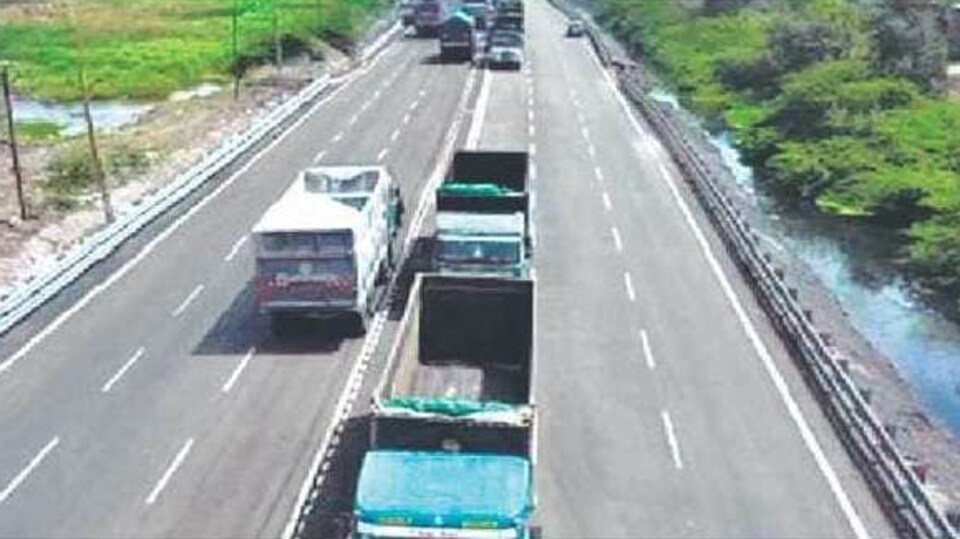
New Delhi: With more than 6.6 million kilometres of roads, India already has the second-largest road network in the world after the United States—and more are being built. The government is projecting the construction of around 40 kilometres of national highways daily, while municipal, district, and rural road networks continue expanding as the country grows economically.
However, building and maintaining infrastructure on such a massive scale has a significant environmental cost—from quarrying stone aggregates to the energy used in bitumen production and transport. To reduce costs and the carbon footprint, the road sector is witnessing a material transition—turning industrial, municipal, and farm waste into usable construction materials.
Masood Mallick, chairman of the CII National Committee on Waste to Worth Technologies, underscored the importance of these initiatives and suggested that the widespread use of waste in the road sector should be expanded into other areas. “India, with 17-18% of the global population on just 2.4% of the global land area face critical import dependence for materials like crude oil and critical minerals, has no room to repeat the wasteful ‘take, make, throw’ Western model.”
He said with virgin materials contributing roughly 40% of total carbon footprint, embracing frugality, reuse, and recycling is central to India’s economic, resource, and climate security.
Roads from industrial waste
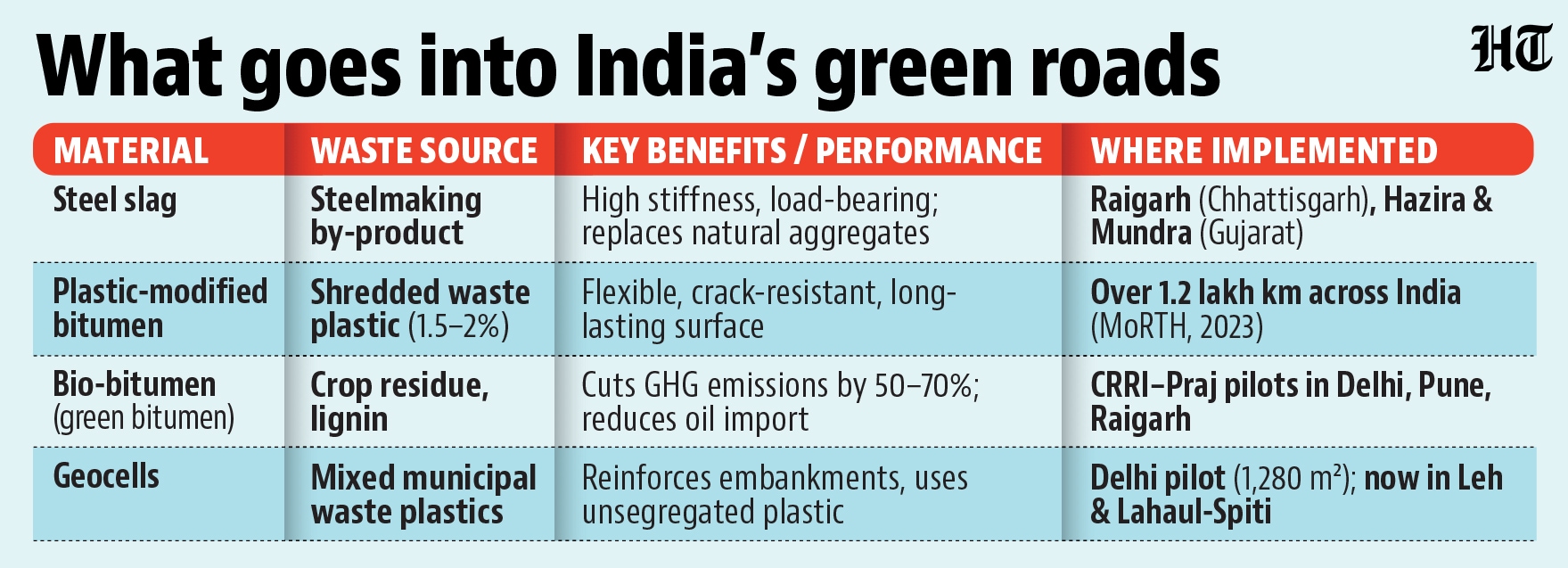
In Raigarh, Chhattisgarh, a two-kilometre, six-lane road leading to the Jindal Steel Plant—one of India’s largest integrated steel facilities—is being rebuilt using steel slag, a by-product of steelmaking. The project, technically supported by CRRI, is among India’s most advanced industrial waste utilisation efforts and follows successful pilots in Hazira and Mundra ports in Gujarat.
The Hazira port road—built in May 2022 using processed slag from ArcelorMittal Nippon Steel—showed that steel slag can replace natural aggregates in all pavement layers. According to CRRI and the Ministry of Steel, substituting steel slag for quarried stone can cut aggregate extraction by nearly 40%, reduce carbon emissions by about 30%, and divert over 22 million tonnes of slag generated annually from landfills into productive use.
“Processed steel slag aggregates can be utilised as a 100% substitute for natural aggregates in all the layers of bituminous and cement concrete pavement,” said Satish Pandey, senior principal scientist at CSIR–CRRI. “The Raigarh stretch will not only validate earlier findings but also help fine-tune design and construction parameters suitable for Indian conditions.”
Countries such as Japan and the Netherlands have already standardised the use of steel slag across multiple road layers, showing how industrial waste can become a vital building resource.
Plastic roads for durability
Another innovation changing road construction is the use of geocells—a honeycomb-shaped grid made primarily from recycled plastics. These structures, when filled with soil or aggregates, improve load distribution and make roads sturdier, especially in areas with weak subgrades.
CRRI and Bharat Petroleum Corporation Limited (BPCL) have jointly patented this system and demonstrated it on a 1,280-square-metre stretch near the DND–Faridabad–KMP Expressway. The pilot used about 20–25 tonnes of waste plastic, including multilayered and end-of-life mixed plastic, to create a durable base layer. Following its success, CRRI has expanded the use of geocells to Leh and Lahaul–Spiti, where conventional materials are scarce.
“Recycled geocells reduce the need for virgin material while simultaneously providing a solution for managing urban waste,” said Ambika Behl, principal scientist at CRRI. “We don’t require segregated plastic—any mixed or unsorted plastic can be turned into geocells, making it highly practical for India’s municipal conditions.”
Laboratory and field evaluations show that soils confined within geocells exhibit higher load-bearing strength—vital for cold, high-altitude regions prone to freeze–thaw damage.
India has been using shredded plastic in bituminous roads for nearly two decades, following recommendations from the Indian Roads Congress (IRC) and the Ministry of Road Transport and Highways (MoRTH). Adding 1.5%–2% of shredded plastic to bitumen increases flexibility, waterproofing, and resistance to cracking—while diverting tonnes of plastic waste from landfills.
Farm to road
Alongside plastic and industrial waste, the CRRI is working with industry partners on developing bio-bitumen made from crop residues such as paddy straw. This can replace up to 30% of petroleum bitumen, lowering both carbon emissions and import dependency—helping address the issue of stubble burning while contributing to circular economy goals.
Private sector laps up green shift
Even as codification is under way, several private players are experimenting with greener materials. Vertis Infrastructure Trust (VIT) has reused about 700 tonnes of waste plastic in its Udupi and Ulundurpet highway projects, achieving higher durability and lower maintenance.
“These experiments with asphalt mixes not only enhance resilience but significantly reduce environmental impact,” said Zafar Khan, Executive Director and Joint CEO of VIT. The use of Stone Matrix Asphalt at Udupi saved over 7,300 tons of bituminous concrete and 128,000 tonnes of aggregates.
A greenfield facility producing crumb rubber–modified bitumen (CRMB) from waste tyres and plastic waste–modified bitumen (PWMB) has also been set up in Mathura by Moglix, with an installed monthly capacity of 6,000 MT each. “Our focus is on producing bitumen that is both high-performance and sustainable,” said Rahul Garg, founder and CEO of Moglix.
Codes and green standards
Experts stress the urgency for codification and standardisation to enable wider adoption of such materials. CRRI, along with the IRC, is developing a Green Rating Framework for Road Construction Materials to assess recyclability, embodied energy, and life-cycle impact.
“The idea behind standardising and codifying sustainable road construction practices is to move from one-off experiments to sector-wide adoption,” said Ambika Behl. “The sustainability framework aims to bring uniform guidelines and measurable parameters so that such practices can be compared and scaled up across projects.”
The GRIHA Council, which rates India’s buildings and infrastructure on environmental performance, launched the Infrastructure Rating for Highways in December 2024 with 12 sustainability criteria—covering governance, carbon emissions, waste management, and social impact. Implementation, however, remains voluntary.
The National Highways Authority of India (NHAI) in its sustainability report noted a reduction in greenhouse gas intensity—from 1.0 to 0.8 MTCO₂e/km—and the use of 631 lakh metric tons of recycled materials such as fly ash, plastic waste, and reclaimed asphalt.
GRIHA’s experience in the building sector highlights the potential of such frameworks. Certified projects have installed 599 MWp of renewable energy, planted 27,000 trees, preserved 28,000, saved 2,97,000 MWh of energy, conserved 1,03,624 million litres of water, and avoided 8,400 gigatonnes of CO₂ emissions.
“If similar sustainability models are integrated into highways, India can embed circularity and carbon reduction goals in line with its 2070 net-zero commitment,” said Sanjay Seth, vice president and CEO of GRIHA Council.


