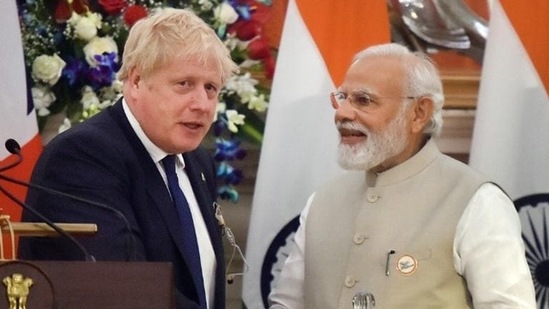
British prime minister Boris Johnson, on Friday, the second day of his ongoing visit to India, spoke about having discussions with India on issues related to human rights. “Our relations with India, and how deal with questions like human rights or democratic values…of course, we have these conversations. But, the advantage of our friendship is we can have these conversations in a friendly and private way,” news agency ANI quoted Johnson as saying in a press meet.
Prime Minister Narendra Modi with his British counterpart Boris Johnson at a press conference in New Delhi on Friday. (Raj K Raj/HT PHOTO)
The Conservative Party leader, who is visiting India as his country’s premier for the first time, further said that the Asian nation has ‘constitutional protections’. India, he said, is a ‘very, very different country from autocracies around the world’.
{{/usCountry}}
{{#usCountry}}
The Conservative Party leader, who is visiting India as his country’s premier for the first time, further said that the Asian nation has ‘constitutional protections’. India, he said, is a ‘very, very different country from autocracies around the world’.
{{/usCountry}}
“It is a great, great democracy, and that’s why it is a stunning, shining fact. 1.35 billion people live under democracy, and that’s something we should celebrate…an opportunity for a closer cooperation and partnership,” the UK PM remarked.
However, the 57-year-old also said that all this does not mean he will not raise ‘tough consular questions as I have today’.
Last week, US secretary of state Antony Blinken said that Washington is monitoring ‘concerning developments’ in India, including a rise in ‘human rights abuses’ by state officials. Blinken made the remarks during a press briefing, and in the presence of external affairs minister S Jaishankar and defence minister Rajnath Singh, after a 2+2 dialogue between the two sides.
{{^htLoading}} {{/htLoading}}
A day later, Jaishankar denied that human rights were discussed in this meeting. However, he also said that while people are entitled to have views about India, ‘we also have views on other people’s human rights, particularly when it pertains to our community’.
Follow the latest breaking news, major developments and agenda-setting stories from India and around the world with the newsdesk at Hindustan Times. Operating round the clock, the desk brings together experienced editors, reporters and correspondents to deliver fast, accurate and contextual reporting across subjects that influence public policy, governance, business, society and international affairs. The HT News Desk covers politics, elections, government policies, the economy, business and markets, science and technology, the environment, law and order, infrastructure, education, climate issues and geopolitics, while closely tracking developments across states, institutions and global capitals. The team also leads coverage of major breaking news events, policy announcements, court proceedings, natural disasters, public emergencies and significant international developments. Reports published by the newsdesk are based on information gathered from reporters on the ground, official statements, government agencies, court records, regulatory filings, recognised institutions and other authoritative sources. Stories undergo editorial scrutiny and verification processes to ensure accuracy, fairness and relevance, and are updated as events evolve and additional information becomes available. Whether covering a key political decision in New Delhi, an economic policy shift affecting millions, a landmark court ruling or a major global event, the HT News Desk aims to provide readers with reliable, fact-based journalism that delivers not only the latest developments but also the context and analysis needed to understand their wider implications.
Get the latest India News, breaking headlines, and real-time updates from across the nation. Stay informed on politics, government policies, crime, weather, and major national developments.
Get the latest India News, breaking headlines, and real-time updates from across the nation. Stay informed on politics, government policies, crime, weather, and major national developments.
Home/India News/'We discuss these things but…': UK PM on talks with India on human rights issues
{{^htLoading}}
Advertisement
{{/htLoading}}
SHARE THIS ARTICLE ON
{{#usCountry}}{{/usCountry}}
Notifications
Get breaking alerts directly from the newsroom
Notifications are on!You'll be notified when news breaks