E-Paper



We strongly condemn death of civilians: PM Modi on Israel-Hamas war
PM Modi said New Delhi has emphasised on dialogue and diplomacy to deal with the Hamas-Israel conflict.

 Prefer HTon Google


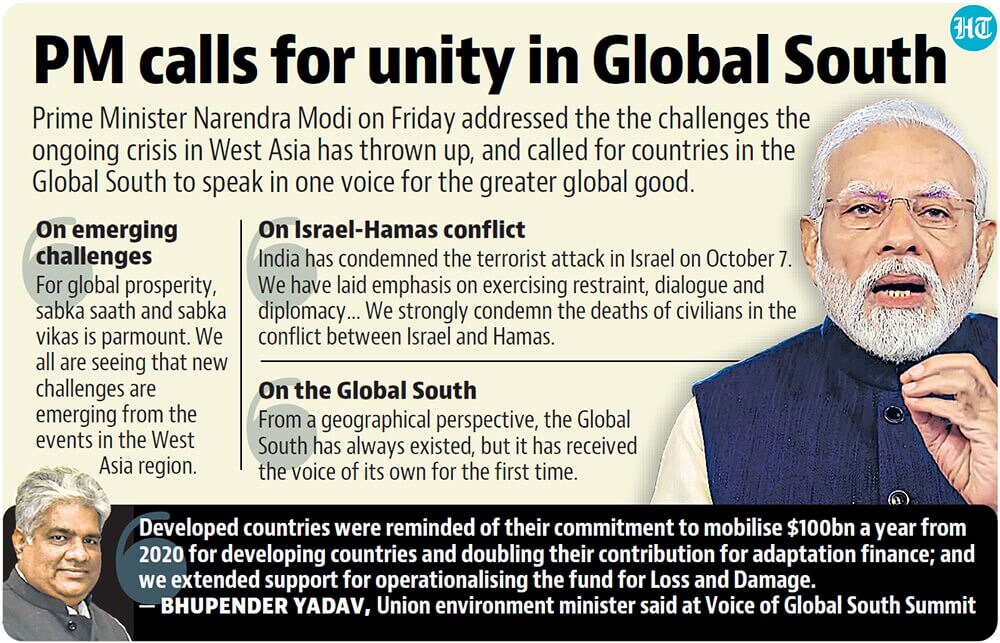
The developments in West Asia are throwing up new challenges and the time has come for countries of the Global South to speak in one voice for the greater global good, Prime Minister Narendra Modi said on Friday even as he condemned civilian deaths in the Israel-Hamas conflict.
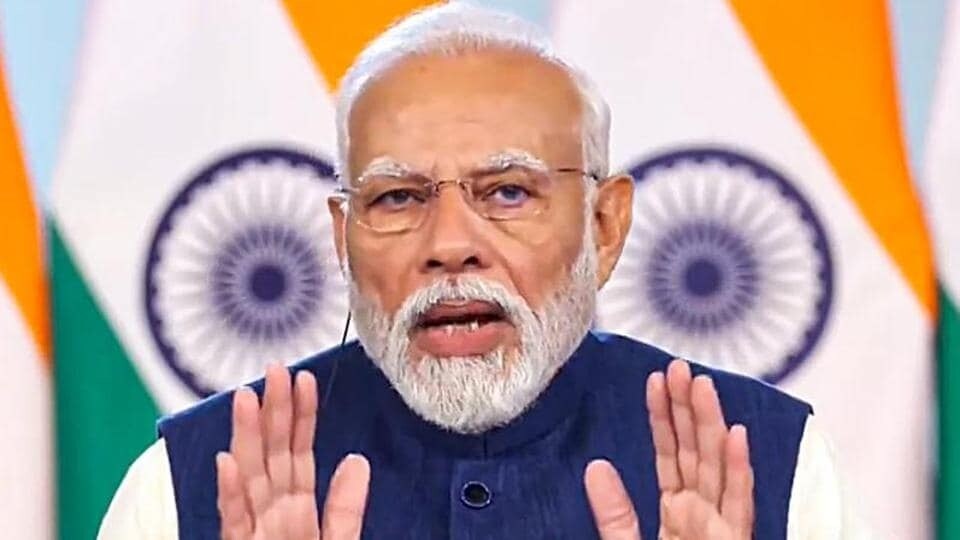
Modi made the remarks in his televised opening address at the second virtual Voice of Global South Summit, a mechanism created by India to bring together developing countries and to seek their recommendations for the country’s G20 presidency. Modi largely spoke on the achievements of the G20 presidency but referred to the crisis triggered by the October 7 terror attacks by Hamas.
“For global progress, sabka saath, sabka vikas (with everyone and progress for everyone) is necessary but we are all seeing that new challenges are emerging from the incidents in West Asia,” he said, speaking in Hindi.
India had condemned the horrific terror attacks in Israel on October 7 and called for restraint along with dialogue and diplomacy, he said. “We strongly condemn the death of civilians in the conflict between Israel and Hamas,” he added.
Also Read: Arm aid to Ukraine ‘decreased’ after Israel-Hamas war: Zelensky
Modi said that following his phone conversation with President Mahmoud Abbas of the Palestinian National Authority, India sent humanitarian assistance for the people of Palestine. “This is the time when countries of the Global South must talk in one voice for the greater global good,” he said.
In keeping with the theme of “one earth, one family, one future” for India’s G20 presidency, all countries should move forward with 5Cs – consultation, cooperation, communication, creativity and capacity building, Modi said.
India had initially backed Israel’s right to defend itself, but it has since adopted a more nuanced approach by calling for observance of international humanitarian law and avoiding of civilian casualties. While the Hamas attacks intense killed 1,200 people, Israel’s intense bombardment of northern Gaza has killed more than 11,400 people, including some 4,400 children.
Modi also spoke about forward movement on several initiatives unveiled at the first Voice of Global South Summit in January. He inaugurated Dakshin, a centre of excellence for the Global South that will focus on development and knowledge sharing. “During the G20 Summit, on behalf of India, I had proposed to launch a weather and climate monitoring satellite for the Global South. We are working rapidly on this,” he said.
He described Voice of Global South as a unique platform for the changing world of the 21st century that gives a voice to developing countries for the first time. When India became the chair of the G20 last December, it adopted the responsibility of taking forward the issues and concerns of the Global South, he added.
“The result of this was that we had success in getting the agreement of everyone on the issues of the Global South in the New Delhi leaders’ declaration,” Modi said.
He highlighted several achievements of the G20 that are important for the Global South, including the inclusion of the African Union as a full member of the grouping of 20 largest economies, agreement on major reforms of multilateral development banks and the focus on sustainable finance for developing countries.
An action plan to speed up implementation of the sustainable development goals (SDGs) will strengthen poverty reduction programmes in the Global South, and there was agreement on providing climate transition finance and technology to developing countries on easy terms. The launch of the Global Biofuel Alliance was very important for the Global South. “We hope that you will all join this,” Modi said.
India also believes that new technologies should not become a way to increase the divide between North and South, and that there is a great need for responsible use of technology in the era of artificial intelligence (AI). “To take this forward, the AI Global Partnership Summit is being organised in India next month,” he said.
The digital public infrastructure (DPI) framework adopted by the G20 will help with the last mile delivery of essential services and increase inclusivity, while India is creating a DPI repository to share its capabilities with the Global South.
Several heads of state and government joined the inaugural session of the virtual summit, including Bangladesh Prime Minister Sheikh Hasona, Indonesian President Joko Widodo and Mauritius Prime Minister Pravind Jugnauth.