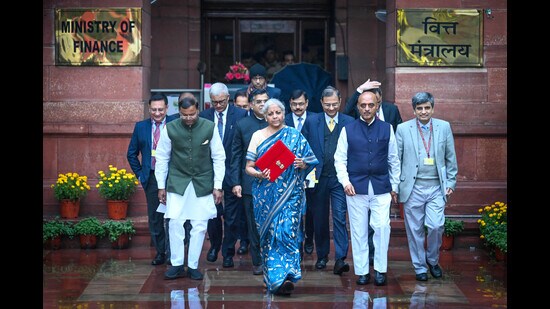
The message is that big-bang reforms will follow after the elections . “In the full budget in July, our government will present a detailed road map for our pursuit of “Viksit Bharat” (developed India) ”, finance minister Nirmala Sitharaman said in the interim budget speech.
This makes sense from a larger political economy perspective. While the BJP is confident enough to not see the need for rolling out any big-ticket populist scheme ahead of the elections, it does not want to risk potential backlash by announcing reforms that can be politically painful — such as large-scale labour reforms or aggressive disinvestment programmes. HT reported in May 2023 that the implementation of four labour codes is unlikely to happen before the 2024 elections.
Having said that, there are enough policy indications in the interim budget to suggest what the future policy trajectory might be.
The biggest hint came a day before the budget when the government made a change to the customs duty structure to reduce tariffs on components used in mobile phone manufacturing. A reverse duty structure on manufacturing components has been the biggest criticism of the Narendra Modi government’s manufacturing push so far. A radical restructuring of tariffs could be game-changing for the government’s Production Linked Incentive (PLI) programme and the manufacturing sector in India. In fact, the budget speech also suggests that the government’s revisiting of India’s terms of engagement with the rest of the world might not be limited to just tariffs. The finance minister talked about the government negotiating bilateral investment treaties with foreign partners to facilitate and fine tune foreign direct investment inflows in the country.
Similarly, the budget speech suggests that the government has not entirely given up on reforms in the agricultural sector despite having had to withdraw the farm laws. “For ensuring faster growth of the sector, our government will further promote private and public investment in post-harvest activities including aggregation, modern storage, efficient supply chains, primary and secondary processing and marketing and branding”, the FM said in the speech, keeping a window open for larger private participation in food markets which was a key component of the now withdraw farm laws.
{{/usCountry}}Similarly, the budget speech suggests that the government has not entirely given up on reforms in the agricultural sector despite having had to withdraw the farm laws. “For ensuring faster growth of the sector, our government will further promote private and public investment in post-harvest activities including aggregation, modern storage, efficient supply chains, primary and secondary processing and marketing and branding”, the FM said in the speech, keeping a window open for larger private participation in food markets which was a key component of the now withdraw farm laws.
{{/usCountry}}To be sure, the budget reiterates the government’s understanding that the most challenging reforms are to be done within the government rather than in markets. The document released by the CEA’s office before the budget weighed in on this issue emphatically. “In the next three years, India is expected to become the third-largest economy in the world, with a GDP of $5 trillion. The government has, however, set a higher goal of becoming a ‘developed country’ by 2047. With the journey of reforms continuing, this goal is achievable. The reforms will be more purposeful and fruitful with the full participation of the state governments. The participation of the states will be fuller when reforms encompass changes in governance at the district, block, and village levels, making them citizen-friendly and small business-friendly and in areas such as health, education, land and labour in which states have a big role to play,” it said.
The budget suggests that the government is likely to continue with its approach of nudging state governments to undertake reforms in areas where they have been difficult to push so far. Its announcement of another tranche of interest-free loans to state governments to “support milestone linked reforms” is one such example. The budget speech also talks about setting up a “high-powered committee for an extensive consideration of the challenges arising from fast population growth and demographic changes”, which will be “mandated to make recommendations for addressing these challenges”. Given the widespread demographic divergence among states and growing friction on devolution of fiscal transfers and pending delimitation, this committee’s recommendation could have far-reaching consequences. The fact that 2024-25 is also the year when the 16th Finance Commission will do most of its work makes the timing even more significant.
The other area where the interim budget has continued to pursue reforms is in subsidy-heavy sectors such as railways where most passenger operations continue to be loss making. The budget’s talk of converting “40,000 normal rail bogies to Vande Bharat standards to enhance safety, convenience and comfort of passengers” is nothing but a continuation of shifting of low-cost passenger operations to high-cost and low-subsidy ones. On this front, the government’s political approach has been to replace subsidy-heavy operations with completely new services rather than try and increase fares for existing services. While reduction in low-cost passenger operation capacity of the railways has triggered occasional criticism, so far, the government has managed to avoid any large-scale resistance.
But is there a larger reform message in the interim budget? It may not have any big-ticket policy tweaks , but there is a big political-economy takeaway to be drawn from it. By deciding against pushing on the populist paddle, the Narendra Modi government has shown that it is committed to the idea of a countercyclical fiscal policy. If the trend were to continue (the government has many economic and political tailwinds going for it at the moment) this is the most cherished and pragmatic reform India’s political economy needs.