E-Paper



What lies ahead for the Shiv Sena?
Is Shinde’s rebellion against Thackeray to be seen as the perfect palace coup which has given the rebel Sena camp the bargaining power to get the BJP to concede the chief minister’s post to the Sena?

 Prefer HTon Google


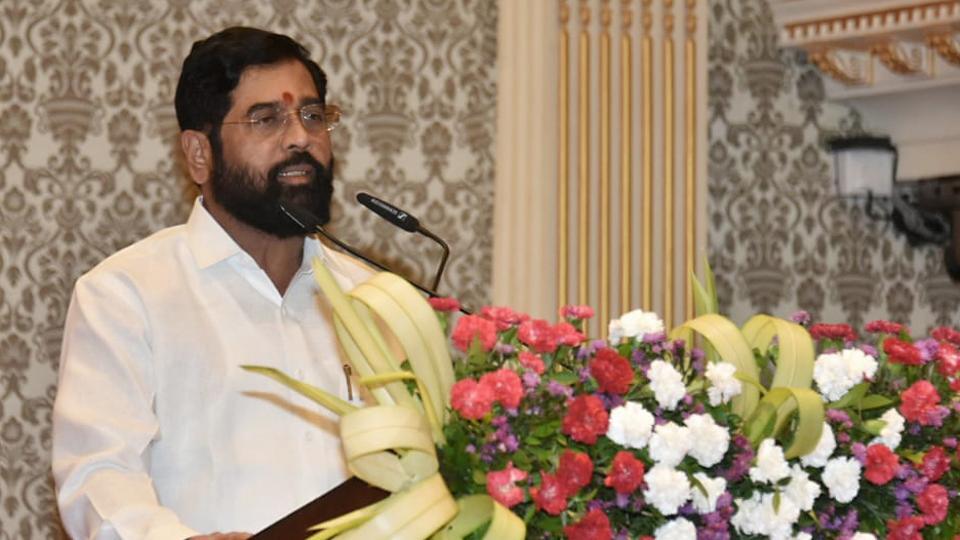
With the resignation of Uddhav Thackeray from the chief minister’s post on June 29 in Maharashtra, Shiv Sena’s two-and-a-half-year long tryst with power came to an end. While it was being widely expected that the Eknath Shinde faction, which rebelled against Uddhav would support the Bharatiya Janata Party’s (BJP) Devendra Fadnavis as the next chief minister candidate, Fadnavis himself announced on June 30 that Shinde would be the next chief minister of the state. Then, hours later BJP’s national president JP Nadda said Fadnavis would be the deputy CM.
Also Read | Maharashtra crisis: Conceded CM’s chair but key portfolios to remain with BJP
What does this mean for the future of the Shiv Sena as one knows it? Is Shinde’s rebellion against Thackeray to be seen as the perfect palace coup which has given the rebel Sena camp the bargaining power to get the BJP to concede the chief minister’s post to the Sena? Or is it just a cosmetic concession where the BJP has allowed the Shinde camp a face saver and it is the latter which will control real power in the state? What is going to be the fate of Uddhav Thackeray’s faction of the Sena?
It is useful to look at the history and evolution of the Shiv Sena to answer this question. Here are four charts which explain this in detail.
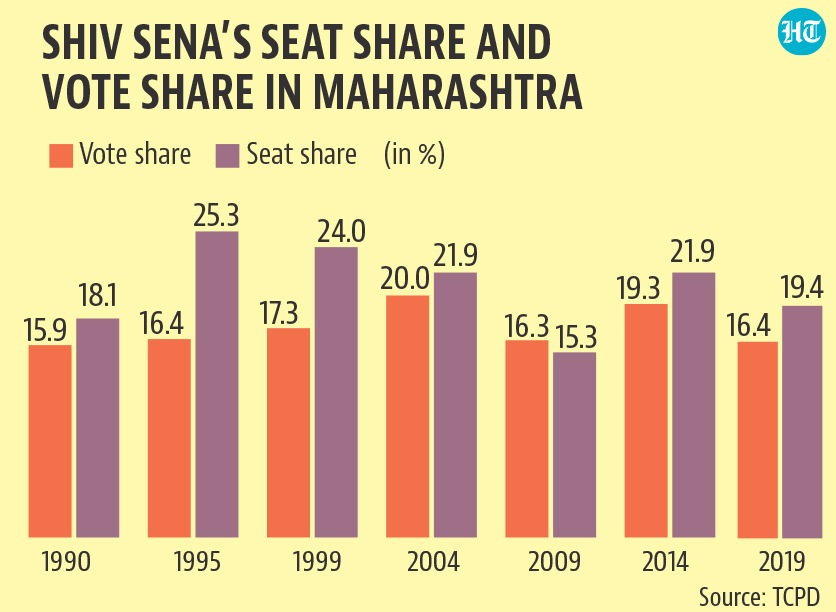
Assembly election results suggest Shiv Sena’s performance in the state has been largely consistent
Whether one looks at vote share or seat share numbers for the Shiv Sena in Maharashtra assembly elections, its performance has actually been quite consistent. In the last seven assembly elections in Maharashtra – the Shiv Sena fought all of these except the 2014 one in an alliance with the BJP – Sena’s vote share never fell below 15% and never went above 20%. A broadly similar pattern can be seen with its seat share in the assembly which has ranged from 15% to 25%, not a very wide variation. These numbers suggest that the Sena’s support base has been largely stable in the state.
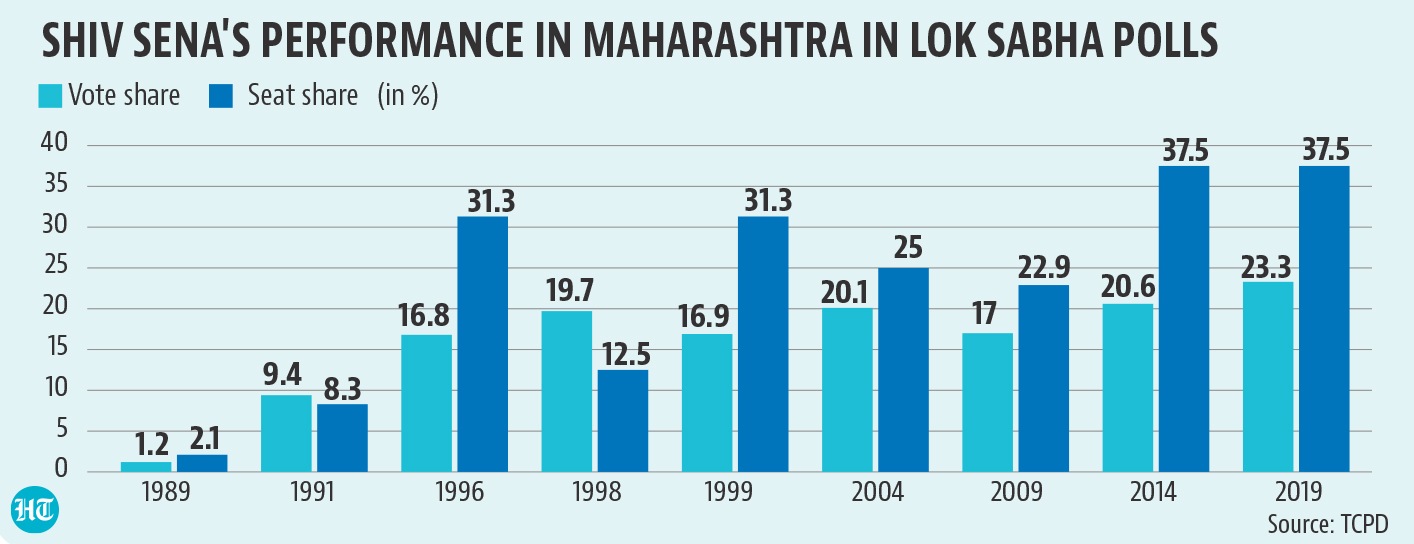
But Lok Sabha results suggest there is something else at play
The Shiv Sena’s best ever Lok Sabha performance came in the 2019 general elections. While Shiv Sena won 18 Lok Sabha constituencies in both the 2014 and 2019 general elections, at 23.3%, its 2019 vote share was 2.7 percentage points higher than that in 2014. Given the fact that the Sena was not able to match its Lok Sabha performance in both the 2014 and 2019 assembly elections, it can be said that the Lok Sabha tailwinds for it were largely a function of the popularity of Narendra Modi-led BJP.
Did the Shiv Sena draw the right lessons from its 2014 assembly election performance?
Did the Shiv Sena misread its 2014 and 2019 Lok Sabha victories as a reflection of independent support rather than gains of being an alliance partner of the BJP? Months after the BJP secured a parliamentary majority of its own; the first for a party since 1984, under the leadership of Narendra Modi in 2014, the Sena decided to part ways with the BJP in the Maharashtra assembly elections. Its adventure did not yield the desired results and it finished a distant second to the BJP in the assembly and had to join a BJP-led government.
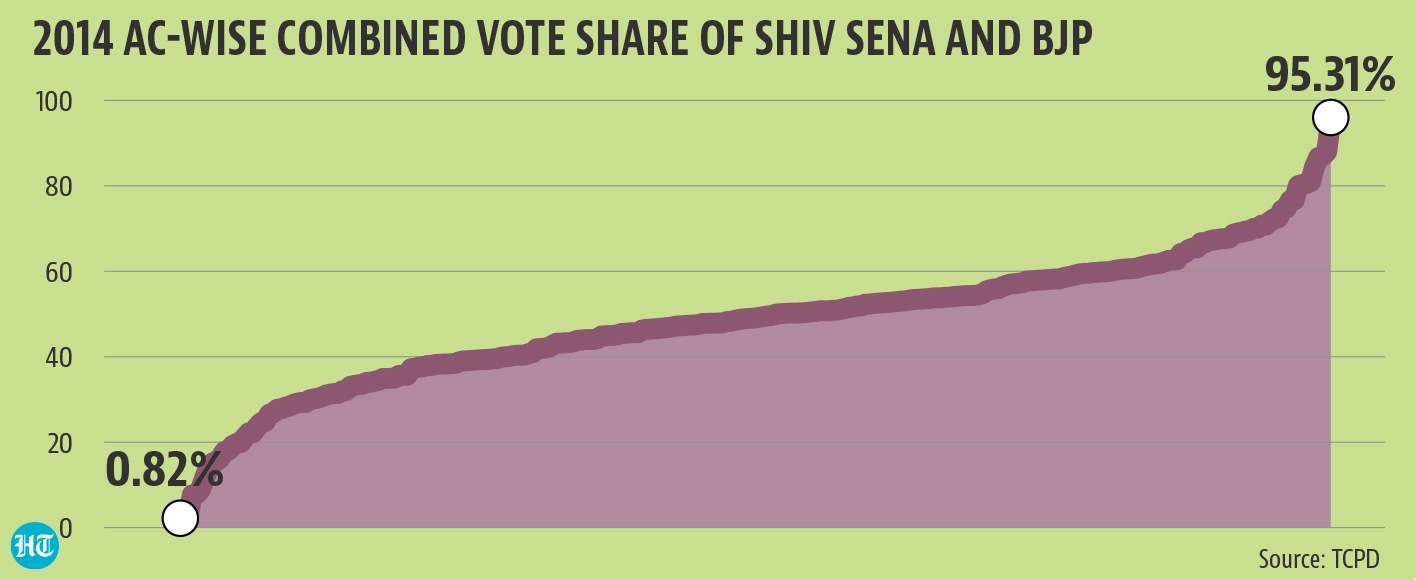
The 2014 assembly results also had a deeper political message for Maharashtra’s politics. Of the 288 assembly constituencies (ACs) in Maharashtra, 256 ACs saw both the BJP and the Shiv Sena contesting. There were only 54 ACs where the Shiv Sena and the BJP were in the top two positions. Of these, the BJP won 32 while the Sena won 22. One way to read these numbers is that there is limited appetite for an intra-right political contest in Maharashtra – in 80% of ACs voters saw the political contest as right versus non-right – and within the intra-right fight, the BJP already had an edge. The fact that combined median vote share of the BJP and the Shiv Sena was 49% in the 286 ACs at least one of them contested, also shows that there is largely a fixed support base for right wing politics in the state.
Can a return to nativism save the “Uddhav Sena”?
When read with the numbers above, Eknath Shinde’s deal with the senior right wing partner BJP, which also has got him the chief minister’s post, seems like the best possible outcome for the Shiv Sena.
The moot question is why did the BJP not agree to this when Uddhav Thackeray wanted the chief minister’s post after the 2019 election results. The only logical answer is that the BJP expects the new Sena faction to be less assertive than the one under Thackeray, which was not willing to accept the BJP as a senior partner even though it was more than clear in electoral numbers.
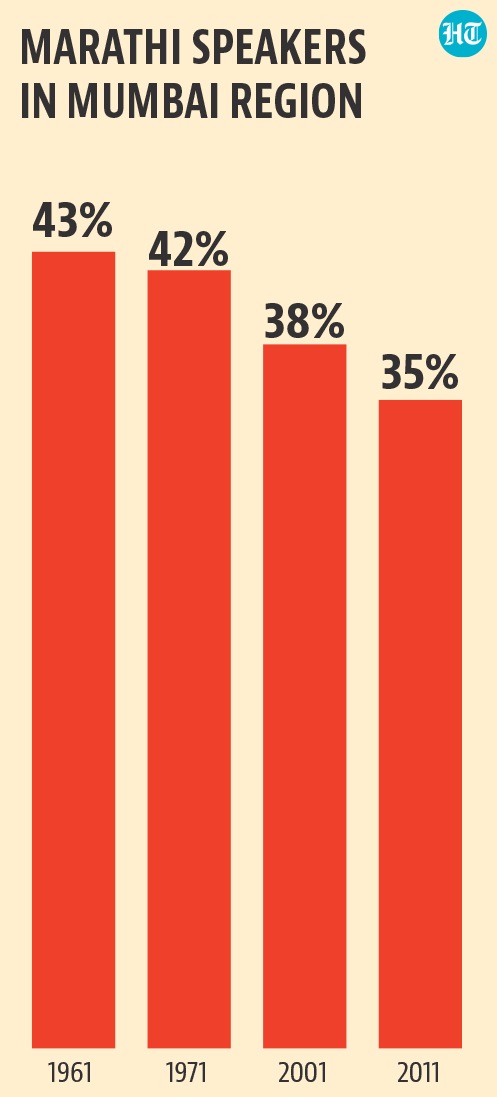
Can Uddhav Thackeray and whatever of the Sena that remains with him stage a political comeback from here? While predicting political outcomes is always hazardous, the only objective claim which can be made is that Thackeray will find it difficult to resurrect the Sena by using the Marathi pride card, the party’s preferred weapon since the time of his father who launched the political party in 1966. The biggest reason is the change in linguistic composition of the Mumbai region, where the Shiv Sena took birth. According to the 1961 census, 43% of the population in Greater Bombay reported Marathi to be its mother tongue. Data from the 2011 census (latest available figures) shows that this number had come down to 35%. With its original constituency continuously shrinking, the Shiv Sena under Uddhav Thackeray and his comrades will find it very difficult to resurrect the militant nativist politics against a stronger right wing opponent. Of course, Thackeray can try and build common cause with the non-right wing support base in the state, but that will require a recalibration of the Sena’s politics away from Hindutva -- and his first attempt to do so with the MVA hasn’t ended well.