E-Paper



What’s the tea? Food regulator now draws the line
In a notice, the Food Safety and Standards Authority of India (FSSAI) warned that labelling herbal or flower-based infusions as “tea” amounts to misbranding

 Prefer HTon Google


India’s food safety regulator has directed companies to stop using the word “tea” for beverages not derived from the camellia sinensis plant, a move that aligns the world’s second-largest tea producer with strict botanical definitions but threatens the branding of the booming herbal wellness sector.
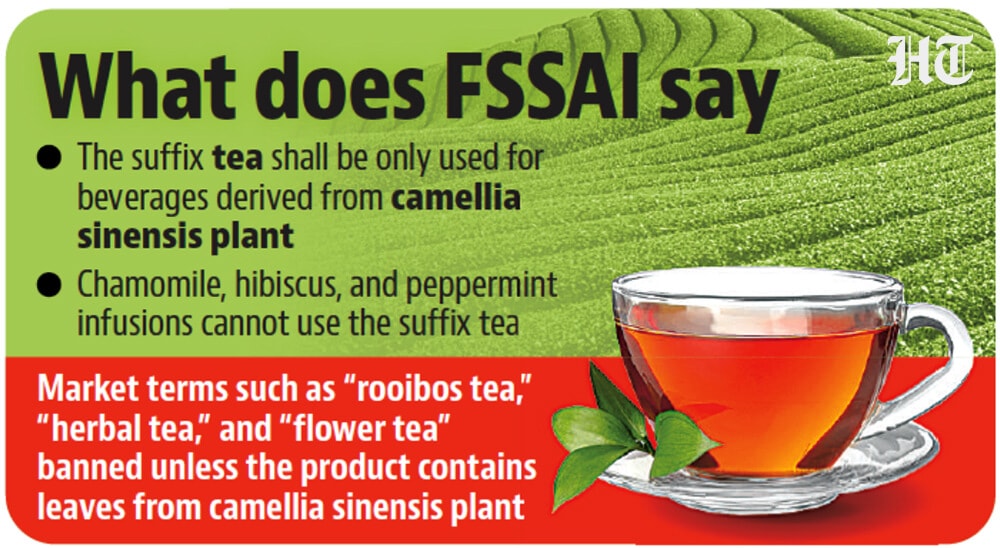
In a notice dated December 24, the Food Safety and Standards Authority of India (FSSAI) warned that labelling herbal or flower-based infusions as “tea” amounts to misbranding. The order effectively bans common market terms like “rooibos tea,” “herbal tea,” and “flower tea” unless the product contains leaves from the specific evergreen shrub defined by global standards.
“The use of the word ‘tea’... for any other plant-based or herbal infusions... is misleading,” the FSSAI stated.
It also cited food safety regulations that require product labels to indicate the “true nature” of the food.
Under the new rules, infusions made from chamomile, hibiscus, or peppermint—technically known as tisanes — must drop the “tea” suffix.
The directive hinges on a rigid biological distinction often unknown to everyday users. Scientifically, “true tea” (black, green, white, and oolong) comes exclusively from the camellia sinensis plant, a shrub native to East Asia. In India, it was introduced at some locations by the British in the 1830s as part of an effort to break China's dominance at the time. The leaves contain caffeine and the amino acid L-theanine, a unique chemical profile that distinguishes them from herbal infusions.
The authority has directed state food safety commissioners and regional directors to ensure strict enforcement, warning that “necessary action shall be initiated” against non-compliant businesses, including e-commerce platforms.
“All food business operators, including e-commerce platforms, engaged in manufacturing, packing, marketing, import or sale of such products are directed to refrain from using the term ‘tea’ for products not derived from Camellia sinensis,” the regulator said.