
 E-Paper



Delhi HC judge at centre of row with Arvind Kejriwal: Justice Swarana Kanta Sharma decides she won't recuse
AAP supremo Arvind Kejriwal argued his own case in the Delhi High Court last week, specifically a petition demanding that the judge step aside from excise case

 Prefer HTon Google


In one of the most unusual legal dramas in India’s recent political history, Aam Aadmi Party convenor Arvind Kejriwal argued his own case in the Delhi High Court last week — not the excise policy case, as such, that has dogged him for years, but his petition demanding that the judge hearing it step aside.
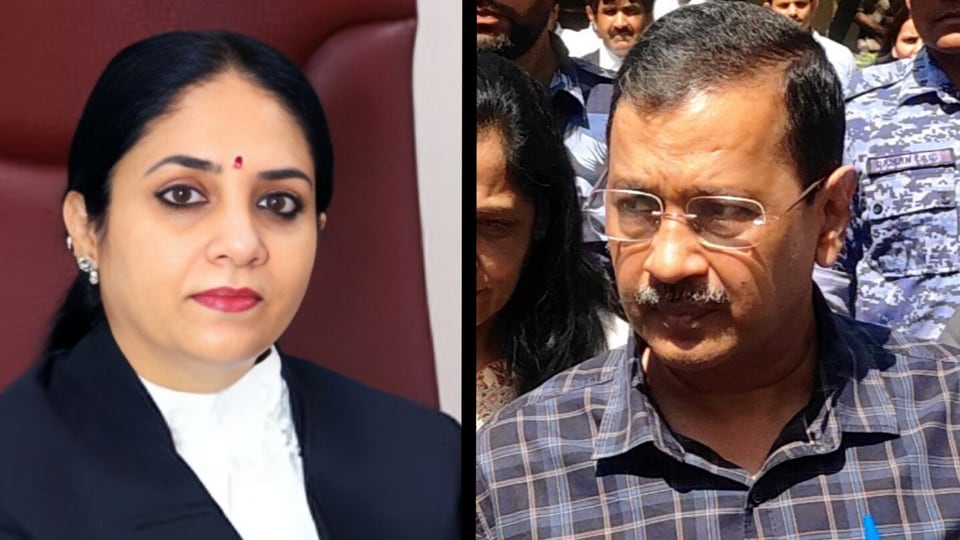
On Monday, Justice Swarana Kanta Sharma pronounced her verdict that she would not recuse herself from the case.
“If this court was to recuse, it would be an act of surrender and a signal that institution including judge and the court can be bent, shaken and changed. Applications seeking recusal are rejected,” she ruled.
So who is Justice Swarana Kanta Sharma, and how did she become the centre of one of India's most charged legal controversies?
From Daulat Ram College to the Delhi High Court
Justice Sharma's career started at an early age, as per details on the Delhi High Court website. A graduate in English Literature from Daulat Ram College, Delhi University, where she was adjudged the best all-round student of the year, she obtained her LLB in 1991 and her LLM in 2004.
In 2025, she also got a PhD for a thesis examining judicial education across the UK, USA, Singapore, and Canada. She holds a Diploma in Marketing Management, Advertising, and Public Relations as well, says the HC website. She became a magistrate at the age of 24 and a sessions judge 11 years later, on the day she turned 35.
In her judicial career spanning more than three decades in the Delhi district courts, she presided over a wide range of courts: Family Court, Motor Accident Claims Tribunal, Mahila Court, Special Court for Sexual Offences Against Women, and as a Special Judge (CBI).
She was elevated as a permanent judge of the Delhi HC on March 28, 2022, and it is in that capacity that the present controversy has arisen.
She is also the author of five books, ranging from guidance for women navigating breakups, to fiction, and judicial education.
Orders that sparked row
The latest controversy arose as Justice Sharma presided over cases linked to an alleged scam in the Delhi excise (liquor sales) policy. At first, she rejected bail pleas filed by Kejriwal, his fellow AAP leaders Manish Sisodia, Sanjay Singh, and Telangana politician K Kavitha, as the CBI and Enforcement Directorate built a case.
When a trial court discharged Kejriwal and 22 other accused on February 27 this year — concluding that the CBI's material did not form a case worth going to trial even — the CBI challenged that order before the High Court.
Justice Sharma, at the first hearing of the CBI's petition on March 9, stayed the trial court's direction for departmental proceedings against a CBI investigating officer, and called some of the trial court's observations "prima facie misconceived”.
This order was passed, Kejriwal later argued in her court, after hearing the CBI for just five minutes and without once hearing his side.
Kejriwal's arguments on RSS body, her children's work for govt
Kejriwal moved for a transfer of the case on March 11. When that was rejected two days later, he, Sisodia, and four others filed recusal pleas for the judge specifically.
Kejriwal, who worked as a government tax officer and a social activist before entering politics in 2012, appeared in court to argue the plea himself.
His arguments listed several grounds for why the judge should recuse. First, he contended that a thorough trial court order — arrived at after a review of 40,000 documents — was effectively overturned in five minutes. Second, he cited the Supreme Court's ruling in ‘Ranjit Thakur vs Union of India’, arguing that actual bias need not be proved: a reasonable “apprehension of bias” is itself sufficient grounds for recusal.
Third, and most politically charged, Kejriwal noted that Justice Sharma had attended four events organised by the Akhil Bharatiya Adhivakta Parishad, a lawyers' body affiliated with the RSS, the ideological parent of the BJP, AAP's principal political rival and the ruling party at the Centre.
“This case is political,” he told the court directly.
When Justice Sharma asked whether he thought she followed that ideology, Kejriwal turned the question back on her: “Do you?” She said she only wanted his contentions to be on the record properly.
Fourth, in an additional affidavit, Kejriwal alleged a conflict of interest, because Justice Sharma's son is empanelled as a Group A counsel representing the Centre before the Supreme Court, while her daughter is empanelled as a Group C counsel, also appearing as a pleader for the Centre before the Delhi High Court. Both are allocated work by Solicitor General Tushar Mehta, who is arguing the CBI's case before Justice Sharma, he noted.
CBI's counter, then court verdict
The CBI firmly opposed the plea with Solicitor General Mehta calling it a "dangerous precedent". He argued that judges routinely address bar association events regardless of political affiliation.
On her children being government-empanelled lawyers, the agency said they had neither dealt with nor assisted in the excise case in any capacity, and are independent practitioners not attached to any senior advocate.
Justice Sharma reserved her order last week, accepted Kejriwal's additional affidavit, and pronounced the verdict on Monday, after taking some further documents on record.
She gave a number of arguments in her order on why she won't recuse from case even as Kejriwal expressed “apprehension of bias”. She emphasised that a judge “cannot abdicate judicial responsibility in the face of allegations”, and that personal attacks on a judge are, in effect, “attacks on the institution itself”.


