
 E-Paper



Why am I being forced to choose between my faith, my education?: Hijab-clad doctor aspirant
Udupi was ground zero for the controversy around the headscarf, which spread across the state’s educational institutions and led to the high court dismissing the petitions stating that wearing the hijab was not an essential religious practice in Islam.


Fathima Hada takes a defiant tone when asked about her class 11 – pre-university (PU) first year, as designated by the state education department – examinations.
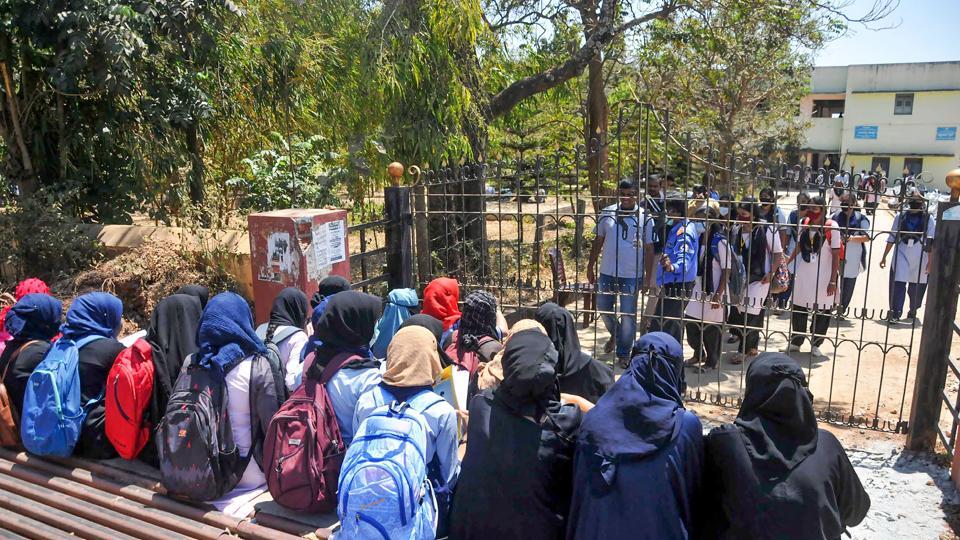
“Why am I being forced to choose between my faith and my education? Why are we not being allowed to write our exams?” questions the hijab-clad 16-year-old student of Mahatma Gandhi Memorial (MGM) college in Udupi – one of the more prestigious institutions in town.
Udupi was ground zero for the controversy around the headscarf, which spread across the state’s educational institutions and led to the high court dismissing the petitions stating that wearing the hijab was not an essential religious practice in Islam.
The first in her family to get a college education, Fathima is now among the students who are not being allowed to sit for their examinations while wearing the hijab. Soft spoken but determined, the 16-year-old says her entire year will be a waste if she is not permitted to appear for the examinations. But the Supreme Court’s refusal to hear the challenge against the HC verdict, has left her in the lurch.
Till the beginning of February, there was no bar on students wearing the hijab in MGM.
After the controversy broke in early January at a government girls pre-university college in town, the issue snowballed and spread to educational institutes in Udupi and across the state. The face-off between hijab-wearing students and their own classmates, clad in saffron shawls and turbans, has now become the defining image of growing polarisation of Karnataka, a state with globally-renowned prowess in technology and startups.
Fathima’s mother said the move to MGM was so that her daughter to achieve her goal of becoming a doctor. “She studied till the class 10 in another school but we decided to put her in MGM since the hijab was allowed. It was one of the main reasons along with the fact that it makes it easier to enter bigger medical colleges in Manipal (about 3 kms from the campus),” said the mother, who was permitted to study only till class 7 by her family.
Fathima’s sister, a first year BA psychology in SDM College, had tried every day for the past two months to enter the institution but to no avail, according to the family’s accounts.
Six girls from the PU college first hit the headlines in early January as they protested against the institution’s move to stop their entry to campus while wearing the hijab. Over the course of the month, four more colleges in Udupi and Kundapur districts issued the same ban. But the fight by these six students and the subsequent Karnataka HC verdict has affected thousands of students like Fathima.
The Basavaraj Bommai-led Bharatiya Janata Party (BJP) issued an order on February 5, stating that the uniform prescribed by educational institutions at the start of the year must be followed. This order, according to students, was misinterpreted by authorities to clamp down on the hijab.
Growing polarisation over the issue also became apparent as Hindu students in several parts of the state started donning saffron scarves to the campus. Incidents of sloganeering and rising communal tension forced the government to declare a shutdown of educational institutions.
The Muslim students protesting against the ban then moved the high court seeking that they be allowed to attend classes wearing the hijab. The court issued its verdict on March 15 after 11 days of continuous hearings.
Almost immediately, the verdict was challenged in the Supreme Court. On Thursday however, a bench headed by Chief Justice of India (CJI) NV Ramana turned down a plea seeking an urgent hearing of the challenge.
“Exams are approaching. These girl students are not being allowed to enter schools and colleges. One year will go to waste,” the counsel for the petitioners rued.
But the bench, which also comprised justice Krishna Murari, remained unmoved. “This has nothing to do with exams… don’t sensationalise the issue,” the CJI retorted.
Back in Udupi, about four kms from where Fathima lives, is another 17-year-old student fighting the same fight.
“Its (Hijab) is a part of you. It’s in my heart and mind and this (ban) stops you somewhere both mentally and physically,” she said, asking not to be named.
Her father, a retired hakim (practitioner of traditional medicine), has taken ill and her mother is a homemaker. Her two brothers have no formal qualification but assemble computers.
“My parents are saddened by whats happening. Our parents allowed us to achieve so much in life and our dreams become their dreams also,” she added.
However, she remains optimistic about finding another university to continue her education despite the high costs of private universities.
MGM, according to parents and students, charges around ₹30,000 while the second girl cited above studied in a state-run institution where fees were ₹3,000- ₹4,000, almost all of which, is refunded.
After the HC judgment on March 15, 17-year-old Aaliya Assadi, one of the petitioners in the original plea, had lashed out saying: “All I want to say to my principal and the lecturer sir who stopped me from going into class with the hijab is that since you denied me entry into class, today how many girls all over Karnataka are facing the problems of education loss? If he had just allowed us by saying yes, none of this would have happened. After this verdict, how many parents will allow them to go back to school and college. They stopped us not just with the hijab but also our education.”
The statements made against the verdict by the original petitioners has also manifested itself in ugly ways with small-time Muslim shop-owners being denied their right to do business in any Hindu religious fairs as the Hijab controversy claims more unsuspecting victims.
“There are girls who come to college with the hijab. There are no restrictions except that they have to take it off during classes. Except those six girls (original petitioners) all the others are coming. Except those six girls, there were no other problems in our college,” Rudre Gowda, the principal of the government girls PU college where the controversy kicked off, told HT earlier.
Another person directly related to MGM College, earlier told HT that students wore the hijab to classes earlier and was never a problem until the February 5 order.
Udupi-based Muslim scholar Abdul Lateef Madani, who is also a member of Muslim Okkutta, said: “There are at least four schools of thought by different teachers, but there is not one dispute on the hijab. Earlier, the order (interim order and govt circular) was misinterpreted. Now that there is a clear verdict, they (students wearing the hijab) will not be allowed. Students with talent and creativity will now remain away from education.”
As this reporter turns to leave the home, Fathima says: “Please help us write the exams,” making a helpless and desperate plea in the hope that her faith does not have to be sacrificed for her dream.


