E-Paper



With God as witness, parties in Nagaland sign deal to keep polls clean
The guidelines include several don’ts such as “shall not buy votes with money”, “shall not bribe voters”, “shall not distribute alcohol, drugs or other intoxicants to voters” and “shall not use support of underground groups for threatening voters”.


Keeping their political and ideological differences aside, seven political parties in Nagaland including those in power, have signed an agreement, with God as a witness, to keep elections clean in a church-brokered deal.
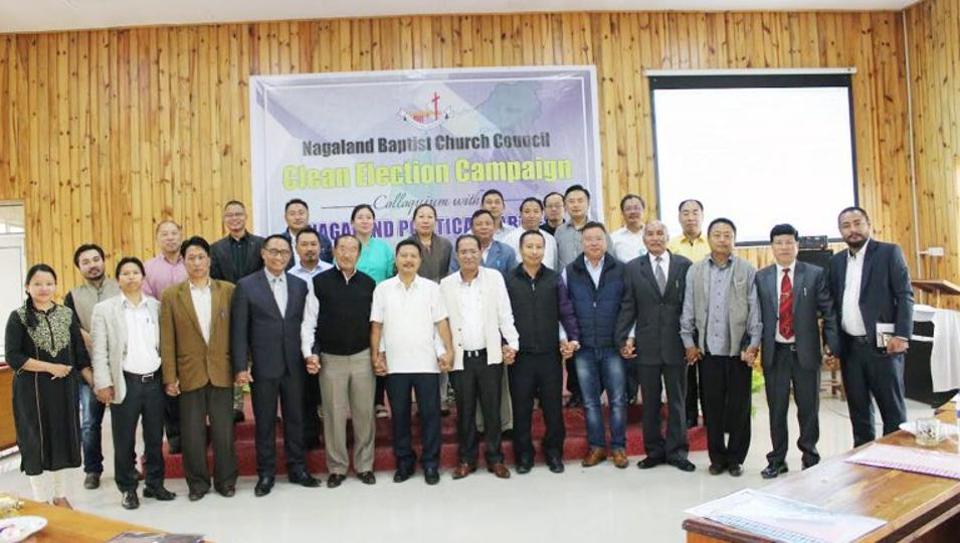
The 18-point agreement was signed on Thursday in Kohima by the ruling Naga People’s Front, coalition partner Bharatiya Janata Party, Nagaland Pradesh Congress Committee, Janata Dal(United), Aam Aadmi Party, Nagaland Congress and Democratic Progressive Party.
It was inked at the headquarters of Nagaland Baptist Church Council (NBCC), the umbrella organisation of nearly 1,500 Baptist churches in Christianity-dominated Nagaland.
Besides NBCC, another body called Clean Election Campaign (CEC) was instrumental in framing the deal ahead of assembly elections in the state due next year.
Admitting the state hasn’t witnessed a free and credible election in many years, the parties agreed to eradicate poll malpractices.
“We affirm the fact that NBCC and political parties should work together in addressing the evils of elections. Therefore, to realise the objectives of the CEC guidelines, the political parties in Nagaland along with NBCC agree to follow and practice the following principles signed before God,” the deal read.
The guidelines include several don’ts such as “shall not buy votes with money”, “shall not bribe voters”, “shall not distribute alcohol, drugs or other intoxicants to voters” and “shall not use support of underground groups for threatening voters”.
Some dos such as “shall have a clear and realistic manifesto”, “shall discipline party workers” and “shall deliver peace, justice and development for our people” are also there on the list.
Some of the guidelines are similar to the code of conduct issued by the Election Commission, but in a state where 88% of the total population are Christians (Census 2011), a church-brokered deal is expected to yield better compliance.
“If we can clean the dirty mess of electioneering system in our society, more than half of our problems will be solved and we will all be happier people,” Rev Zelhou Keyho, general secretary of NBCC, said on the occasion.
But there are already doubts whether the agreement would get implemented well. Politics in Nagaland is controlled to a large extent by the various tribal organisations and village councils and they aren’t part of Thursday’s deal.
“The NBCC needs to talk to the tribal organisations and village councils. Once they are brought in, the agreement on clean polls will be fully implemented,” K Therie, president of NPCC, told the Hindustan Times.
Opposition by tribal organisations on the issue of reservation for women in municipalities had led to violence in the state in February and had forced the state government to call off elections to urban local bodies.