Six months after India boasted that its tiger population was growing fast, conservationists said on Wednesday that 41 big cats of the feline specie had already died this year and worried that the country was not doing enough to save them.
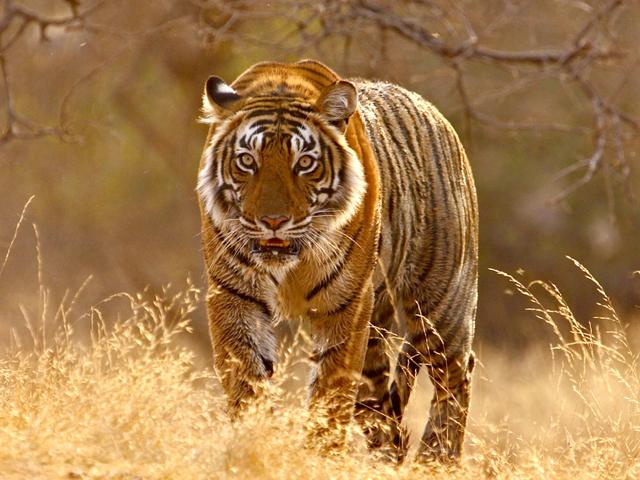
Despite awareness campaigns, India's National Tiger Conservation Authority and the wildlife group TRAFFIC said only seven of the cats died from natural causes, one was killed by authorities and the rest were illegally poached between January and August.
In January, Indian environment authorities had claimed conservation efforts were working as the number of tigers in the country had risen to 2,226 in 2014, up from 1,706 counted in 2010.
Experts say the partial death toll proves India was not doing enough to protect the endangered predators, noting 66 tigers died during all of 2014.
Of those which died naturally this year, two were killed in tiger battles, which experts say are becoming more frequent as the big cats vie for territory while their natural habitats shrink due to human encroachment.
Wildlife experts say tigers are facing increasing threats to their roaming territory as their traditional forests are being cleared to make way for huge power projects, roads and human habitats as the country pushes ahead with rapid industrialisation and economic development.
{{/usCountry}}Wildlife experts say tigers are facing increasing threats to their roaming territory as their traditional forests are being cleared to make way for huge power projects, roads and human habitats as the country pushes ahead with rapid industrialisation and economic development.
{{/usCountry}}"We are losing buffer areas around the tiger reserves every day and this is worrisome," said Shekhar Niraj, the head of TRAFFIC-India.
Coupled with the decline in deer, wild boar and other smaller animals that tigers prey on, the loss of buffer areas outside tiger reserves is increasingly driving the cats to move outside their established territory into human settlements, Niraj said.
A century ago an estimated 100,000 tigers roamed India's forests. Their numbers declined steadily till the 1970s, when India banned tiger hunting and embarked on a programme to create special reserves and protected areas in national parks and wildlife sanctuaries. Conservation efforts began to pay off around 2010, when tiger numbers began to slowly rise.
India faces intense international scrutiny over its tiger conservation efforts as it has nearly three-fourths of the world's estimated 3,200 tigers.
The illegal trade in tiger skin and body parts still remains a stubborn and serious threat.
Tiger organs and bones fetch high prices on the black market because of demand driven by traditional Chinese medicine practitioners.
India is also roping in celebrities to promote its tiger conservation programme. On Tuesday, Maharashtra announced that it was appointing Bollywood superstar Amitabh Bachchan as the state's tiger ambassador to create awareness about its efforts to save the specie.