Sign in

Dirty tricks help parties take campaigning to new low

If this poll battle has sunk to a new low, it’s because of the helping hand of the dirty tricks departments of political parties. These wings of the Congress and the BJP have in the past few weeks worked hard to fling mud at each other.

Updated on: Apr 29, 2014, 21:04:37 IST
Hindustan Times | By , New Delhi
Share
Share via
  • facebook
  • twitter
  • linkedin
  • whatsapp
Copy link
  • copy link

If this poll battle has sunk to a new low, it’s because of the helping hand of the dirty tricks departments of political parties.

A-combo-picture-of-BJP-and--Congress-party-flags

These wings of the Congress and the BJP have in the past few weeks worked hard to fling mud at each other.

The BJP attacked Congress president Sonia Gandhi's son-in-law Robert Vadra with a video on his alleged land deals in Haryana and Rajasthan on Sunday. The Congress hit back the next day with pictures and a video showing BJP prime ministerial candidate Narendra Modi with alleged Surat-based hawala operator Afroz Fatta. Minutes later, the BJP retaliated by circulating a picture of Fatta and Congress MP Mohammad Azharuddin.

Read:

Officially, political parties of course deny having any dirty tricks department but in reality they employ tech-savvy professionals who look for material that can publicly embarrass their party’s rivals.

“Any video or picture coming out in the election season is not a knee-jerk reaction but a well-planned move. Sometimes it takes months to find concrete evidence against an opponent. Using it at an appropriate moment is the work of a clever political mind,” said a political functionary who once was part of his party's dirty tricks department.

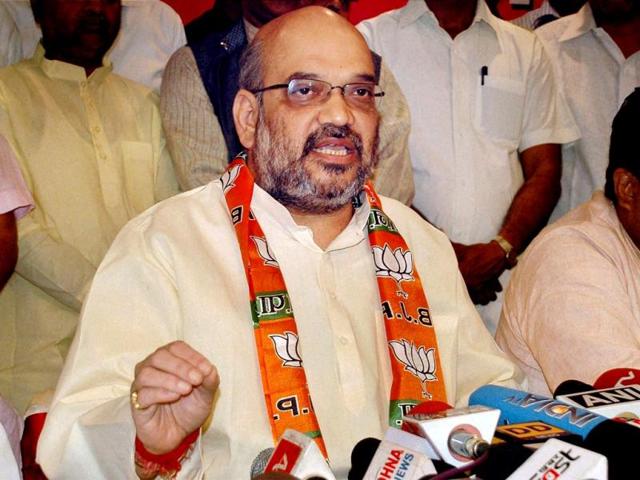
BJP leader Amit Shah's hate-speech that debarred him from campaigning for a week would not have gone public if the Congress hadn’t seized upon the opportunity. Shah sought "revenge" for the Muzaffarnagar riots at a closed door meeting with local Jat leaders and it was recorded. The video was then provided to some TV channels allegedly by Congress workers.


Read:

This was the Congress’ revenge for its Saharanpur candidate Imran Masoodlanding in jail after his hate-speech against Modi went viral. The six-month-old video was dug out by the BJP's Uttar Pradesh unit headed by Shah.

Congress insiders said the party has a dedicated team to track every speech of Shah and BJP sources disclosed that the party keeps tabs on Congress leaders like Beni Prasad Vermaand Salman Khurshid, who are prone to spouting controversial comments. While the Congress coordinates its dirty tricks from Delhi, the BJP does it from Lucknow and Ahmedabad.

Political parties also employ dirty tricks at the local level, especially to field namesakes against their rivals.

For example, there were 11 Chandu Sahus in the fray from Chhattisgarh's Mahasamund constituency from where Congress leader Ajit Jogi is a candidate. All Chandu Sahus, except the BJP candidate, had something in common. Their security deposits were paid in currency notes with similar serial numbers and the BJP’s Chandu Sahu accused Jogi of fielding them to confuse voters.

In a large number of constituencies in Kerala, many candidates had to face namesakes. In Kasargode, there are two candidates with the same surname: T Siddique from the Congress and an independent candidate called A Siddique.

“Finding a namesake is no problem. One just has to look at the electoral rolls,” said a Congress leader.

Full coverage: My India my vote

  • Chetan Chauhan
    ABOUT THE AUTHOR
    Chetan Chauhan

    Chetan Chauhan is the National Affairs Editor looking into all aspects of news and features from across India. A Chevening scholar with over three decades of experience in reporting and news management, Chetan has extensively covered all important aspects of the social sector, political economy, environment and climate change nationally and internationally. He did a journalism course at the Reuters Institute of Journalism in Oxford and Digital Media training at Nanyang Technological University in Singapore. He started as a reporter with The Statesman in 1996 and joined the Hindustan Times in 2000 in the metro bureau covering environment, crime and Delhi politics. He covered hot local news, from the Jessica Lal murder case to the rebellion of Delhi Congress MLAs against then Chief Minister Sheila Dikshit, to the replacement of toxic vehicle fuel with cleaner compressed natural gas (CNG) in the national capital. Some of his stories on air pollution became part of the Supreme Court’s landmark MC Mehta versus Government of India case in the National Capital Region (NCR), forcing the government to take corrective measures. As part of the national political bureau since 2004, he covered important central sectors such as environment, education, social justice, labour, rural development, water resources, renewable energy, agriculture, broadcasting and the Planning Commission for more than a decade producing several exclusive and investigative breaking stories. His specialisation is the environment, having covered at least a dozen United Nations global conferences on climate change, biodiversity and wildlife including climate summits in Paris, Copenhagen and Bali. He also covered India’s two five-year plans ---11th and 12th and reported on drafting and execution of right based laws such as Right to Education, Right to Information and rural job guarantee law, MG-NREGA, now being introduced in new format as VG-RAM-G Act. He has in-depth knowledge of social sector issues. He was one of the first to report on tigers vanishing from Sariska and Panna wildlife reserves in 2004 and 2008, respectively, leading to the setting up of the National Tiger Conservation Authority (NTCA) and the introduction of stringent penal provisions for poaching. He has written extensively on the rising human-animal conflict in India and the degradation of India’s biodiversity hotspots because of mining and other activities. Since 2004, Chetan has covered Parliament comprehensively and participated in training on the nuanced coverage of Parliament proceedings. He has travelled extensively across India to cover national and provincial elections since 1998, especially in the Hindi heartland states, considered India’s road to power. He writes a regular column for Hindustan Times, Ecostani, on important national politics, economy, Himalayan ecology and environmental issues. His other responsibilities include providing inputs for edits and edit page articles for the publication, apart from managing news flow from across India.Read More

Follow India news real-time updates and the latest news covered on Hindustan Times, featuring today's critical updates on Sonam Wangchuk LIVE and more across India.