While the eunuch community across the country lives in similar gharana-dera systems, those in Mumbai enjoy a greater autonomy and individual choice than those in north India, a paper presented at the Tata Institute of Social Sciences on Monday suggested.
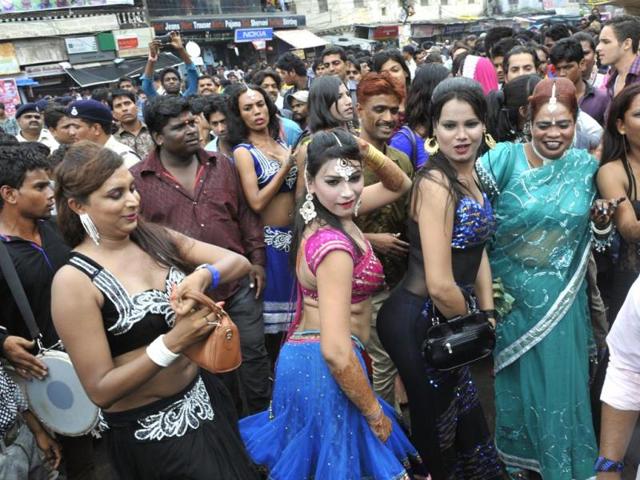
While the guru-chela relations hips form the primary kinship unit around which the social universe of the eunuch is composed, the gurus in Mumbai are more accepting of the choices the chelas make. These include the choice of living with partners and to be gainfully employed in areas such as community welfare programmes, as opposed to earning from the traditional ‘toli-badhai’ rituals.
For centuries, the community’s survival has been based on kin networks of gharanas and deras, where the eunuchs get social protection by being member of a gharana or clan, but are bound by hierarchy, strict rules of conduct, morality along with rules and rituals.
“Depending on the geographical location, the strict rules and regulations of the dera system prevent their members from leading a life on their own terms. Sharam, izzat and maan maryada shape the course of their lives,” the paper stated. “But in Mumbai, many gurus do not prevent the chelas from pursuing romantic relations,” said Asmita Aasaavari, research associate, collaborative research and dissemination (CORD), Delhi, who carried out the study.
She collaborated with Aarushie Sharma, TNS Market Research, Delhi and Sushreeta Mohapatra, a freelance writer from Jodhpur, for the project.
{{/usCountry}}She collaborated with Aarushie Sharma, TNS Market Research, Delhi and Sushreeta Mohapatra, a freelance writer from Jodhpur, for the project.
{{/usCountry}}Similarly, the paper said, that while the intentional and unintentional mention of sex work in the community in north India is strongly looked down upon, it has a greater acceptance in Mumbai. Titled ‘Families they choose: Examining the Hijra Family and Relations’, the paper largely talks about the nuances of a eunuch family in comparison to the normal monolithic understanding of a family.
The paper was presented at the ongoing conference on ‘Changing Families: Diversity and Synergy’ at TISS. The event is organised by TISS and Global Consortium for International Family Studies.