
Sign in

India may be hotter by 8 degrees, lose $200bn per year: Study

Global warming is at a much faster pace than estimated. The visible impact would be temperature crossing 50-degree mark by the turn of the century and water stress in the northern part of India, a new global study released on Monday in London and Mumbai said.

Updated on: Jul 14, 2015, 08:38:56 IST
Hindustan Times | By , New Delhi
Share
Share via
  • facebook
  • twitter
  • linkedin
  • whatsapp
Copy link
  • copy link

Global warming is at a much faster pace than estimated. The visible impact would be temperature crossing 50-degree mark by the turn of the century and water stress in the northern part of India, a new global study released on Monday in London and Mumbai said.

Article image

Climate change could cost India US $200 billion per annum if it fails to ensure adequate adaptation measures and the countries fail to reduce their carbon emissions, the study — Climate Change: A Risk Assessment — conducted by climate advisors to the governments in United States, United Kingdom and China, the world’s biggest carbon emitters, said.

They analysed data from across the world to arrive at the conclusions.

“The water stress will increase in coming years and will have implications on India’s food security,” said Arunabha Ghosh, chief executive officer of Council on Energy, Environment and Water, the Indian partner for the study funded by UK foreign office.

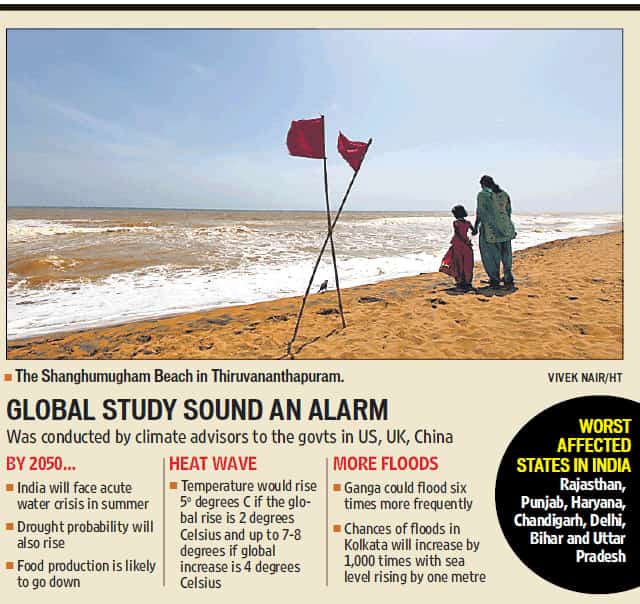
The authors have clearly outlined the northern part of India, including Delhi, Chandigarh, Bihar and Uttar Pradesh, as high impact zone of climate change in India.
Article image


In the report, they said, said high heat stress can have various implications, including restrictions on outdoor work and sports and not getting sound sleep.

Different scenarios presented in the report say the temperature could rise 8 degrees Celsius, crossing the 50-degree mark in cities like Delhi, Jaipur and Chandigarh during summer.

The study reiterated the fact that extreme rainfall will increase in India and sounded an alarm that frequency of floods will increase in the Gangetic plains.

Its implication will be on India’s food security with an estimated loss of up to US $200 billion per year by the turn of this century.

This is in tune with the assessment made by the Indian Agricultural Research Institute.

The report for the first time also showed internal security risks arising because of climate change.

It is well documented that a reason for rise of IS in was back to back droughts and food crises, the study said.

  • Chetan Chauhan
    ABOUT THE AUTHOR
    Chetan Chauhan

    Chetan Chauhan is the National Affairs Editor looking into all aspects of news and features from across India. A Chevening scholar with over three decades of experience in reporting and news management, Chetan has extensively covered all important aspects of the social sector, political economy, environment and climate change nationally and internationally. He did a journalism course at the Reuters Institute of Journalism in Oxford and Digital Media training at Nanyang Technological University in Singapore. He started as a reporter with The Statesman in 1996 and joined the Hindustan Times in 2000 in the metro bureau covering environment, crime and Delhi politics. He covered hot local news, from the Jessica Lal murder case to the rebellion of Delhi Congress MLAs against then Chief Minister Sheila Dikshit, to the replacement of toxic vehicle fuel with cleaner compressed natural gas (CNG) in the national capital. Some of his stories on air pollution became part of the Supreme Court’s landmark MC Mehta versus Government of India case in the National Capital Region (NCR), forcing the government to take corrective measures. As part of the national political bureau since 2004, he covered important central sectors such as environment, education, social justice, labour, rural development, water resources, renewable energy, agriculture, broadcasting and the Planning Commission for more than a decade producing several exclusive and investigative breaking stories. His specialisation is the environment, having covered at least a dozen United Nations global conferences on climate change, biodiversity and wildlife including climate summits in Paris, Copenhagen and Bali. He also covered India’s two five-year plans ---11th and 12th and reported on drafting and execution of right based laws such as Right to Education, Right to Information and rural job guarantee law, MG-NREGA, now being introduced in new format as VG-RAM-G Act. He has in-depth knowledge of social sector issues. He was one of the first to report on tigers vanishing from Sariska and Panna wildlife reserves in 2004 and 2008, respectively, leading to the setting up of the National Tiger Conservation Authority (NTCA) and the introduction of stringent penal provisions for poaching. He has written extensively on the rising human-animal conflict in India and the degradation of India’s biodiversity hotspots because of mining and other activities. Since 2004, Chetan has covered Parliament comprehensively and participated in training on the nuanced coverage of Parliament proceedings. He has travelled extensively across India to cover national and provincial elections since 1998, especially in the Hindi heartland states, considered India’s road to power. He writes a regular column for Hindustan Times, Ecostani, on important national politics, economy, Himalayan ecology and environmental issues. His other responsibilities include providing inputs for edits and edit page articles for the publication, apart from managing news flow from across India.Read More

Follow India news real-time updates and the latest news covered on Hindustan Times, featuring today's critical updates on Sonam Wangchuk LIVE and more across India.