Sign in

Marital discrepancy? Wives in affidavit tangle this poll season

Providing wrong information in an affidavit cannot be a reason for rejection of nomination, but leaving any column blank is. Incorrect affidavit can be a ground to move court, but only against the winning candidate.

Updated on: Apr 13, 2014, 24:57:11 IST
Hindustan Times | By , New Delhi
Share
Share via
  • facebook
  • twitter
  • linkedin
  • whatsapp
Copy link
  • copy link

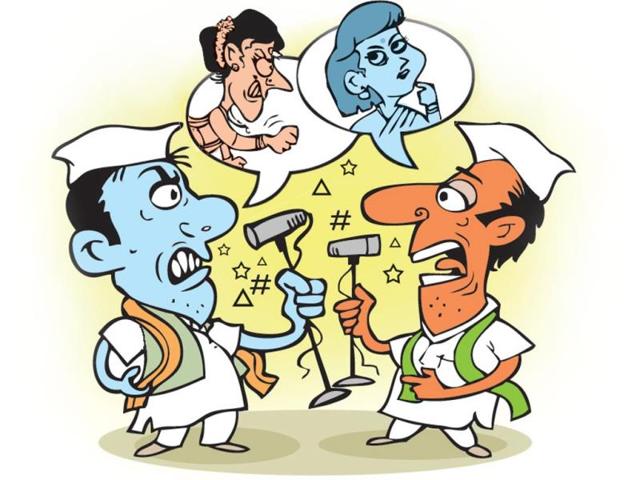
Discussing other people’s wives is not politically correct. But details on wives in affidavits of the candidates are providing ammunition for a bitter battle between arch rivals Congress and BJP 12 years after they had united to oppose the Supreme Court move to include familial details.

Illustration-Abhimanyu-Sinha

It started with Congress vice-president Rahul Gandhi on Friday asking why BJP’s PM candidate Narendra Modi had in his earlier affidavits not declared that he had a wife. Later, law minister Kapil Sibal asked the Election Commission to take action against Modi for not being ‘honest’ in the past.

Sister Priyanka Gandhi Vadra backed Rahul’s attack on Modi’s ‘marital discrepancy’.

For the first time in his affidavit submitted on Thursday to the returning officer at Vadodara, Modi disclosed information about his wife Jashodaben Modi. Her name was mentioned in the column where information about assets and liabilities of spouse and children are sought.

The EC does not seek the marital status of a candidate.

The BJP hit back on Saturday with party leader Subramaniam Swamy petitioning the poll body seeking action against Sibal, contesting from Chandni Chowk in Delhi, for not disclosing his wife’s assets and liabilities in three companies owned by her. Sibal dared Swamy to prove it.

Modi also joined in, asking EC to probe Congress’ Amritsar candidate Amarinder Singh for concealing foreign bank account of his wife Preneet Kaur. The EC has already sought a reply from Kaur, the Congress candidate from Patiala.

Jagdeep Chhokar of Association for Democratic Reforms, on whose petition the 2002 SC ruling came, said it takes time for political parties to understand what people want but it was “better late than never”.

Providing wrong information in an affidavit cannot be a reason for rejection of nomination, but leaving any column blank is.

Incorrect affidavit can be a ground to move court, but only against the winning candidate. Around 9,000 candidates have filed their affidavits.

  • Chetan Chauhan
    ABOUT THE AUTHOR
    Chetan Chauhan

    Chetan Chauhan is the National Affairs Editor looking into all aspects of news and features from across India. A Chevening scholar with over three decades of experience in reporting and news management, Chetan has extensively covered all important aspects of the social sector, political economy, environment and climate change nationally and internationally. He did a journalism course at the Reuters Institute of Journalism in Oxford and Digital Media training at Nanyang Technological University in Singapore. He started as a reporter with The Statesman in 1996 and joined the Hindustan Times in 2000 in the metro bureau covering environment, crime and Delhi politics. He covered hot local news, from the Jessica Lal murder case to the rebellion of Delhi Congress MLAs against then Chief Minister Sheila Dikshit, to the replacement of toxic vehicle fuel with cleaner compressed natural gas (CNG) in the national capital. Some of his stories on air pollution became part of the Supreme Court’s landmark MC Mehta versus Government of India case in the National Capital Region (NCR), forcing the government to take corrective measures. As part of the national political bureau since 2004, he covered important central sectors such as environment, education, social justice, labour, rural development, water resources, renewable energy, agriculture, broadcasting and the Planning Commission for more than a decade producing several exclusive and investigative breaking stories. His specialisation is the environment, having covered at least a dozen United Nations global conferences on climate change, biodiversity and wildlife including climate summits in Paris, Copenhagen and Bali. He also covered India’s two five-year plans ---11th and 12th and reported on drafting and execution of right based laws such as Right to Education, Right to Information and rural job guarantee law, MG-NREGA, now being introduced in new format as VG-RAM-G Act. He has in-depth knowledge of social sector issues. He was one of the first to report on tigers vanishing from Sariska and Panna wildlife reserves in 2004 and 2008, respectively, leading to the setting up of the National Tiger Conservation Authority (NTCA) and the introduction of stringent penal provisions for poaching. He has written extensively on the rising human-animal conflict in India and the degradation of India’s biodiversity hotspots because of mining and other activities. Since 2004, Chetan has covered Parliament comprehensively and participated in training on the nuanced coverage of Parliament proceedings. He has travelled extensively across India to cover national and provincial elections since 1998, especially in the Hindi heartland states, considered India’s road to power. He writes a regular column for Hindustan Times, Ecostani, on important national politics, economy, Himalayan ecology and environmental issues. His other responsibilities include providing inputs for edits and edit page articles for the publication, apart from managing news flow from across India.Read More

Check India news real-time updates, latest news on Hindustan Times and more across India.