E-Paper



At least four dead as heavy showers flood parts of NCR
A seven-year-old allegedly drowned in a waterlogged vacant plot in Sanjay Colony in the Samaypur Badli area, northwest Delhi.

 Prefer HTon Google


At least four people, including a three-year-old girl, died as heavy rains lashed Delhi-National Capital Region (NCR) on Thursday, submerging several areas under water that inconvenienced pedestrians and resulted in massive snarls on roads.
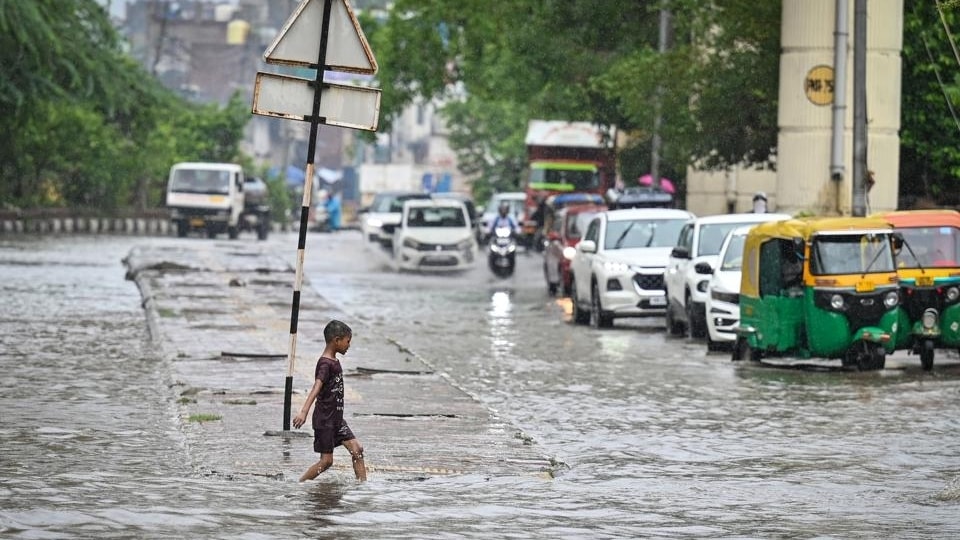
A seven-year-old allegedly drowned in a waterlogged vacant plot in Sanjay Colony in the Samaypur Badli area, northwest Delhi. Police said they were still investigating the details of the death, including the ownership of the plot. According to an officer aware of the details, the boy, a class 3 student, had gone to the plot near his house with his five-year-old brother early in the morning to defecate.
“My two sons left home around 8.30am to defecate in the open area. The seven-year-old was sitting on a wall when he slipped and fell into the vacant plot that was submerged with rainwater. It was an accident,” his mother, Tamanna, told reporters.
Also Read: Rohini building collapse: 2 more bodies pulled out of debris; toll rises to 3
3 dead in Ghaziabad
The other three deaths were reported from Ghaziabad.
In Sarvodaya Nagar, the body of the three-year-old was found facedown in the water and it is suspected she slipped and drowned in rainwater that had accumulated in the locality, police said. In Indirapuram, a 24-year-old guard, identified as Bablu Kumar, allegedly died after being electrocuted while crossing a park near the private office where he worked.
Also, a man’s body was recovered from a drain adjacent to Delhi-Saharanpur Road after he allegedly fell. It is suspected that he did not see the drain on the heavily waterlogged road. His identity has yet to be established.
Also Read: When will Delhi-NCR's wet spell end? IMD says rainfall likely to continue till...
Low pressure cause of Delhi rains
Across Delhi-NCR, it rained nearly continuously from late Wednesday night until mid-afternoon on Thursday. Experts said the heavy downpour was caused by a low pressure area reaching Delhi. “It travelled from the Bay of Bengal to western Uttar Pradesh during the early morning hours, bringing rain,” said amateur meteorologist Navdeep Dahiya.
Residents questioned monsoon preparedness across the region as it triggered widespread waterlogging, uprooted trees, and caused drains to overflow.
Reviewing the situation from the 24x7 monsoon control room, Delhi PWD minister Parvesh Verma maintained that months of desilting, deployment of pumps and round-the-clock monitoring ensured smooth traffic movement at critical locations and hotspots such as Minto Bridge, Zakhira underpass, Dhaula Kuan, Moolchand and Pul Prahladpur flyover despite over 100mm rainfall in several parts of the city.
Also Read: Delhi-NCR rain fury: Car inside ditch, clouds engulf high-rise, severe waterlogging | WATCH
However, low-lying areas and markets witnessed knee-deep water. Complaints poured in from Sadar Bazar, Gandhi Nagar, Laxmi Nagar, Patparganj, Seelampur, Kirari, Sangam Vihar, Badarpur, Civil Lines and Khajuri Khas, among other localities. Ghazipur on NH-9 also witnessed prolonged traffic congestion after roads were inundated.