
 E-Paper



Chhattisgarh CM discuss Bastar projects with PM Modi, seeks ₹10,500 crore urea plant
Chhattisgarh CM Vishnu Deo Sai sought Centre’s support for Bastar projects, including a ₹10,500 crore urea plant, power connectivity and AIIA.

 Prefer HTon Google


Chhattisgarh chief minister Vishnu Deo Sai on Friday met Prime Minister Narendra Modi and presented a development roadmap for the state, seeking the Centre’s support for key projects including a ₹10,500 crore gas-based urea plant, permanent power connectivity for 461 remote villages and an All India Institute of Ayurveda (AIIA) in Raipur or Bastar.
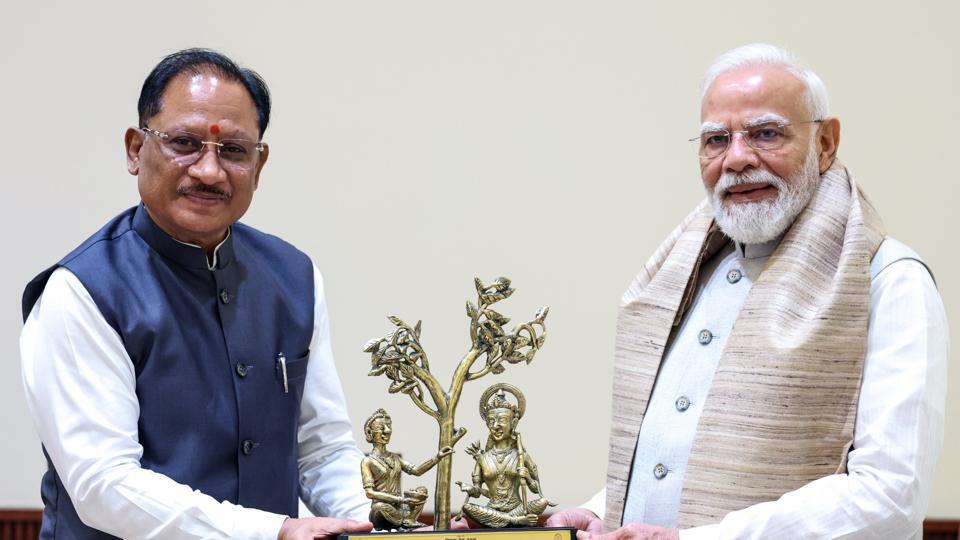
The chief minister urged PM Modi to expedite approval for the proposed gas-based urea plant in Rajnandgaon, saying land acquisition and state-level clearances have already been completed. He said the project would improve fertiliser availability for farmers in Chhattisgarh and neighbouring states while generating employment and attracting industrial investment.
Sai also sought special central assistance to connect 461 villages in Bastar and other sensitive areas to the permanent electricity grid. These villages currently receive power through off-grid systems due to security and geographical constraints. Permanent grid connectivity, he said, would improve education, healthcare, communication and economic opportunities.
The chief minister requested the Centre to establish an All India Institute of Ayurveda in Raipur or Bastar, highlighting the state’s rich repository of medicinal plants and traditional tribal knowledge. He said such an institution would strengthen research, education, healthcare and the local economy based on medicinal plants.
Presenting the state’s “Bastar Vision”, Sai said government schemes under Niyad Nella Nar 2.0 and Bastar Munne are being implemented across 5,542 villages, benefiting nearly 3.9 million people. He said welfare schemes, including ration distribution, Ayushman Bharat, Jan Dhan accounts, forest rights and the Pradhan Mantri Awas Yojana, are reaching remote villages that were once severely affected by Maoist violence.
Highlighting improvements in education, Sai said 421 schools that had remained closed in Maoist-hit areas have been reopened. The government is also planning education cities in Orchha and Jagargunda, modelled on Dantewada, to provide quality residential education and coaching facilities for tribal students.
On healthcare, he said more than 3.4 million people have undergone health screening under the Mukhyamantri Swasth Bastar Abhiyan. Medical infrastructure is being expanded with super-speciality facilities in Jagdalpur and a medical college at Geedam.
Sai said connectivity remains the foundation of Bastar’s development. He informed the Prime Minister that work is progressing on the ₹3,513 crore Jagdalpur-Raoghat railway line, while air connectivity from Jagdalpur is also being expanded. He also briefed Modi on the final phase of the Raipur-Visakhapatnam Expressway and the proposed barrage on the Indravati river, which is expected to irrigate around 32,000 hectares.
The chief minister said the state is working to position the historic Bastar Dussehra as a global tourism brand while upgrading tourism infrastructure at destinations such as Chitrakote and Tirathgarh waterfalls.
Sai said the Bastar Olympics, which saw participation from more than 400,000 youths, has emerged as a symbol of social change by promoting sports, peace and community participation.
On the industrial front, Sai said Chhattisgarh has received investment proposals worth nearly ₹8 lakh crore since the launch of the state’s Industrial Development Policy 2024-30. He said the investments include emerging sectors such as AI data centres, semiconductor manufacturing, hyperscale data centres, global BPOs, garments, chocolates, electronics and intraocular lens manufacturing.
He also highlighted governance reforms, saying Chhattisgarh ranked first in regulatory and institutional parameters in NITI Aayog’s investment friendliness assessment. The state has enacted the Ease of Doing Business Act, 2026, introducing risk-based regulation, self-certification and time-bound approvals.
Sai informed the Prime Minister that Chhattisgarh has already created 1.042 million Lakhpati Didis, surpassing its target, and now aims to make another 1.4 million women financially self-reliant. He also invited Modi to attend the proposed Lakhpati Didi Sammelan in Raipur in 2027.
The chief minister said the state has launched a ₹500 crore AI Mission to promote technology-driven governance across sectors, including education, healthcare, agriculture and public administration.
Sai also highlighted the state’s improving fiscal position, saying GST revenue has grown by 18% while mineral revenue has registered record growth. He said Chhattisgarh has become the first state to auction tin and lithium blocks.
According to the chief minister, digital governance reforms have enabled 528 online services across 36 departments through the Seva Setu portal, while registry-linked automatic land mutation and Aadhaar- and video KYC-based property registration have made public services more transparent and citizen-friendly.
Sai expressed confidence that the Centre would extend support for the state’s proposals and said Chhattisgarh is committed to achieving the goal of a “Viksit Chhattisgarh” in line with Prime Minister Modi’s vision of a “Viksit Bharat”.
-kW0H-U20214218012MgB-250x250%40HT-Web.jpg)


