Eager to dip their toes again in the waters of space exploration after the Chandrayaan 1 moonshot in 2008, engineers at the Indian Space Research Organisation (Isro) wouldn’t want to miss today’s launch of the Mars Orbiter Mission (MOM). Dictated by the orbital mechanics of Earth and Mars, this narrow launch window opens every two years, allowing spacecraft to achieve an optimal trajectory by combining the least amount of fuel and the shortest journey time. The next window is in January 2016. There will still be quite a few prayers at mission control as the Polar Satellite Launch Vehicle (PSLV) — which usually puts small satellites into low-earth orbit over the poles — leaves the launchpad at Sriharikota. S Arunan, project director, however, is confident. “The risks are minimal,” he said in a telephone interview. “The PSLV is a proven launcher and we’ve done elaborate testing on all the spacecraft systems.”
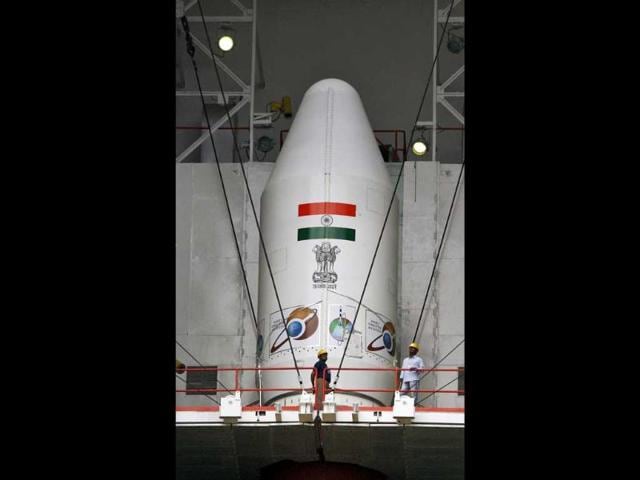
Resembling a large refrigerator-sized box covered in gold foil, the MOM rides an advanced variant of the PSLV. The probe will first be lifted into an elliptical low Earth orbit and gradually pushed into higher orbits over 25 days. It will then stretch its solar wings and catapult Marswards on a nine-month, 400 million km trip. During its projected lifespan of six months, the MOM’s onboard sensors will explore the Red Planet’s surface, topography, mineralogy and atmosphere. The Isro is the sixth space agency to launch a mission to Mars after the United States, Russia, Europe, China and Japan.
The MOM will chalk up some firsts in the history of Mars exploration, too. It is the first mission to be launched into an elliptical Earth orbit. Space agencies like the Nasa and the ESA prefer a straight flight trajectory out to Mars. Besides, it is the first Mars mission to use a light booster like the PSLV.
And the mission has been realised at an incredibly low budget: its Rs 450-crore price tag is less than 0.01% of India’s annual budget, making it the cheapest ever to head for Mars. The Nasa, the ESA and Japan’s JAXA spend several times more. In comparison, Nasa’s new Mars mission, MAVEN, scheduled for launch November 18, took almost six years to fabricate, and cost more than 10 times. “Isro’s budget for 2010 happens to be our highest ever. And it’s just 3% of Nasa’s budget for the year 2010,” adds Radhakrishnan. So science apart, the MOM’s success will certainly give an enormous boost to Isro’s standing in the global launch business, promoting investor confidence.
{{/usCountry}}And the mission has been realised at an incredibly low budget: its Rs 450-crore price tag is less than 0.01% of India’s annual budget, making it the cheapest ever to head for Mars. The Nasa, the ESA and Japan’s JAXA spend several times more. In comparison, Nasa’s new Mars mission, MAVEN, scheduled for launch November 18, took almost six years to fabricate, and cost more than 10 times. “Isro’s budget for 2010 happens to be our highest ever. And it’s just 3% of Nasa’s budget for the year 2010,” adds Radhakrishnan. So science apart, the MOM’s success will certainly give an enormous boost to Isro’s standing in the global launch business, promoting investor confidence.
{{/usCountry}}Mars, though, has a reputation for being a graveyard for spacecraft. Of the 51 missions dispatched, 30 have failed. Half of Russia’s probes were claimed by launch failures while other spacecraft failed to rendezvous with Mars or burned up in the planet’s atmosphere during landing attempts. It is against these grim odds that Isro is launching its maiden Mars probe. A small mathematical error could result in the MOM missing Mars by tens of thousands of miles. As Radhakrishnan says, “The spacecraft’s arrival point on Mars has to be calculated to an accuracy of 60 miles about 280 days in advance.”
Thank you Nasa for the peanuts — the traditional lucky charm passed around mission control before every launch — you sent on Isro’s MOM Facebook page! The MOM’s sure going to need it.
Prakash Chandra is a science writer
The views expressed by the author are personal.